


Preguntas frecuentes
Naturaleza refinada, calidad definida
Ciencia verde para una vida mejor

Will pectin degrade during the baking process? And is it necessary to add other hydrocolloids to improve its heat stability?
I. Will pectin degrade during baking?
Under typical baking temperatures and durations, pectin itself does not undergo complete chemical degradation (i.e., large-scale molecular chain breakdown), but its functional gel network structure can be significantly affected or even destroyed.
Chemical Stability: Pectin is a polysaccharide composed of galacturonic acid linked by glycosidic bonds. In the combined presence of water, high temperature, and acidity, these bonds may undergo a certain degree of hydrolysis, especially during prolonged baking in a very low pH environment (<3.0). However, for most fruit fillings (typical pH 3.0-3.5) and standard baking times, this hydrolysis is limited. The primary risk is functional loss, not complete decomposition.
Functional Changes (Key Point):
Gel Network Breakdown: The gel structures of both high methoxyl pectin (dependent on high sugar, high acid, and hydrogen bonds) and low methoxyl pectin (dependent on calcium ion bridges) are thermally reversible. When the baking temperature exceeds the gel's melting point (typically 60-85°C), the gel network disintegrates, causing the filling to thin and lose water-holding capacity. Even after cooling, due to prolonged high temperature and water evaporation, the gel's strength and structure cannot fully recover, potentially leading to a watery, misshapen filling.
Conclusion 1: The main issue pectin faces during baking is not chemical degradation, but the thermal destruction and potential weakening of its gel structure, leading to the loss of its functionality (gelling, water-holding, stabilizing).
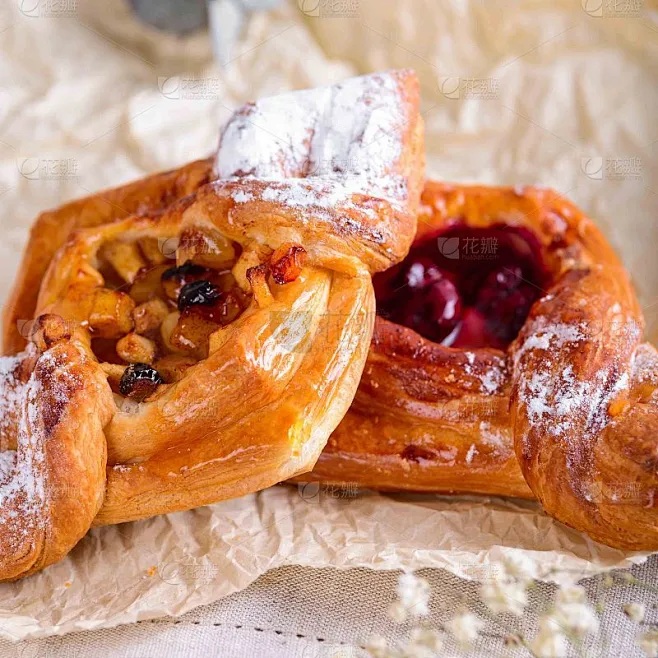
Yes, it is often necessary. To compensate for pectin's functional shortcomings at high temperatures and achieve a filling that is stable, non-watery, and has good texture both before and after baking, adding other hydrocolloids with better heat stability is a common and effective formulation strategy.
Purpose: Adding other hydrocolloids is not to "prevent pectin degradation" but to:
Provide continuous viscosity or structural support to the system during the stage when the pectin gel is thermally destroyed, preventing water separation and solid sedimentation.
Improve the final product's texture, making it softer, smoother, or more elastic.
Increase the filling's tolerance to temperature, acidity, and moisture changes during baking.
Common Hydrocolloid Choices and Principles:
Xanthan Gum: One of the primary choices. It maintains excellent viscosity stability over a wide range of temperatures and pH levels (including boiling conditions), and exhibits high pseudoplasticity, effectively suspending fruit particles. It does not form a gel but provides solid "fluid support."
Locust Bean Gum: Often used synergistically with xanthan gum. Their combination produces a powerful synergistic effect, significantly increasing the system's viscoelasticity and strength, creating a more heat-resistant network structure with a smooth mouthfeel.
Low-Acyl Gellan Gum: The gel formed by low-acyl gellan gum is thermally irreversible and possesses excellent heat stability. Theoretically, it can provide a rigid framework during baking. However, because its gel texture is typically firm, brittle, and elastic, which does not match the soft texture desired for most fruit fillings, and it is sensitive to ion concentration requiring precise process control, it is less commonly used in general baking fillings compared to the previous two. It is more suitable for products with extreme requirements for hardness and heat stability.
Application Recommendations:
For most jams and fruit pie fillings, adding a 0.1%-0.3% blend of xanthan gum and locust bean gum (typically in a 1:1 ratio) is a classic and reliable solution to enhance heat stability. They provide protection throughout the heating-cooling cycle and optimize mouthfeel.
If pursuing extremely high heat stability and a firmer texture is acceptable, low-acyl gellan gum can be tested, but rigorous formulation trials are required to control its texture and the impact of ionic environment.
Summary:
Pectin's functionality can significantly decline due to thermal destruction during baking, though it does not completely degrade. To improve product success rate and quality stability, it is strongly recommended to incorporate other hydrocolloids with better heat stability (such as a xanthan gum and locust bean gum blend) for synergistic enhancement. This is a mature and highly effective industrial solution.
CAG Hydrocolloids offer high quality pectin, Xanthan gum and gellan gum for bakery fillings, please contact CAG for details.

Email: info@cagcolloids.com
Tel: 0086-19884908291 / 0086-573- 88067623
Website: www.cagcolloids.com
Address: No. 399, East Tongfu Road, Tongxiang City, Zhejiang Province. China.