


Preguntas frecuentes
Naturaleza refinada, calidad definida
Ciencia verde para una vida mejor

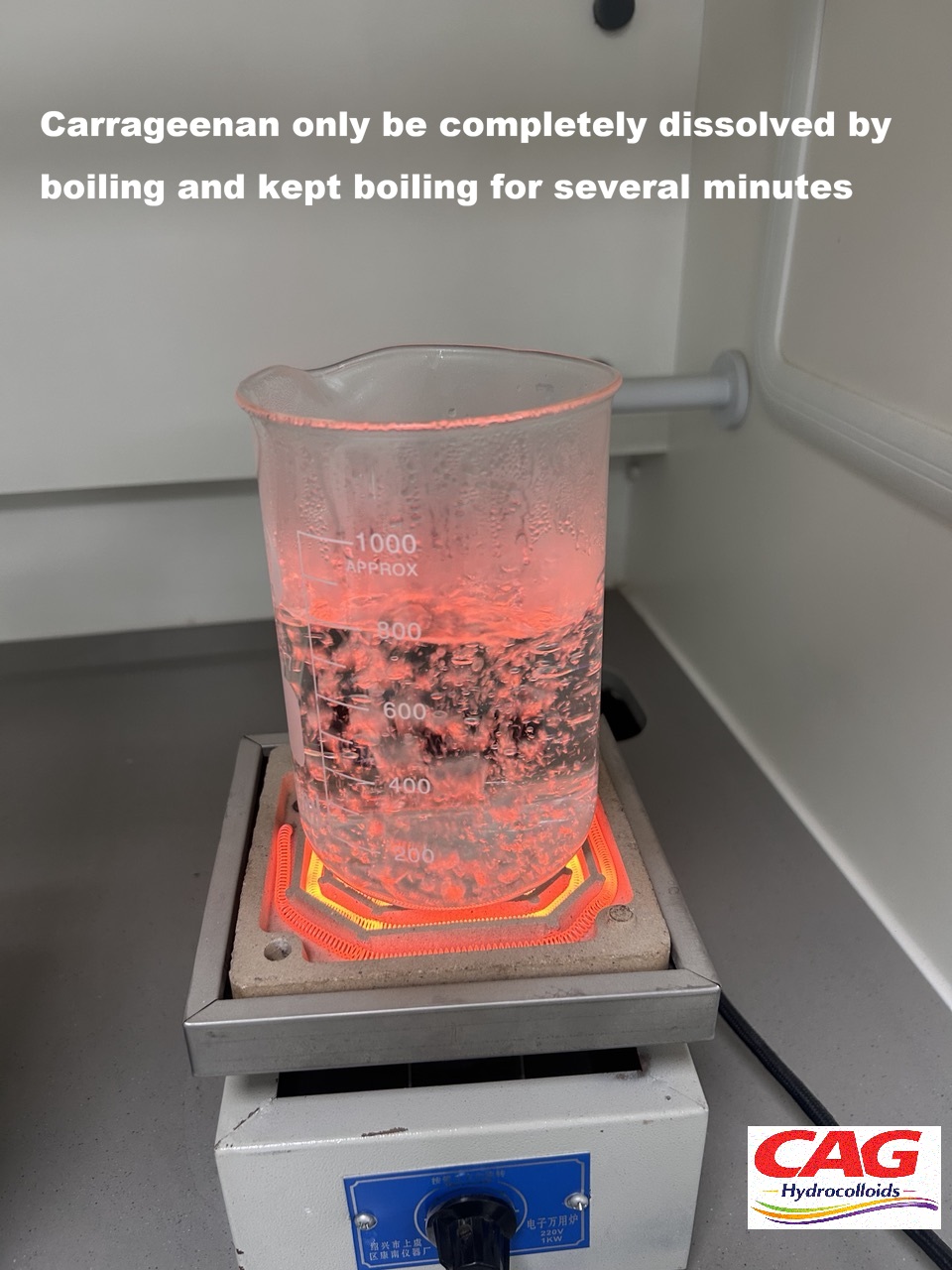
Why must carrageenan be completely dissolved by boiling and kept boiling for several minutes?
Reasons why carrageenan must be boiled and kept boiling for several minutes to achieve complete dissolution
Molecular chain unwinding and thorough hydration
Carrageenan (κ-, ι-, λ-types, etc.) is a helical polysaccharide polymer with tightly entangled molecular chains at room temperature. Boiling (100°C) provides sufficient thermal energy to break hydrogen bonds, allowing the helical structure to fully unwind and achieve molecular-level dispersion.
This is especially critical for κ-carrageenan, whose gel precursors must be completely unwound at high temperatures to later reform into a uniform three-dimensional network upon cooling.
Overcoming ion shielding effects
Carrageenan is an anionic polysaccharide highly sensitive to cations (especially K⁺, Ca²⁺). Ions in water can bind to sulfate ester groups, inhibiting molecular hydration. Boiling enhances molecular thermal motion, weakening electrostatic ion adsorption and promoting dissolution.
Eliminating "pre-gel" interference
At temperatures around 70–80°C, carrageenan can form localized weak gel clumps (pseudo-dissolution) that encapsulate undissolved particles. Sustained boiling melts these clumps, ensuring system homogeneity.
|
Defect Type |
Mechanism Analysis |
Specific Manifestations |
|---|---|---|
|
Uneven Gelation |
Undissolved particles act as structural weak points, disrupting gel continuity. |
Localized soft, mushy, or brittle texture; gritty particles in the gel. |
|
Syneresis (Water Separation) |
Undissolved particles compete for water, disrupting the water-holding network. |
Water leakage on the surface after refrigeration, especially in κ-carrageenan products (e.g., panna cotta, ham sausages). |
|
Reduced Clarity |
Undissolved particles scatter light, increasing turbidity. |
Cloudiness or white specks in transparent products like jelly or gummies. |
|
Coarse Texture |
Residual micron-sized undissolved particles. |
Gritty or gelatinous particles in pudding, yogurt, etc. |
|
Poor Stability |
Incomplete dissolution reduces gel strength (Bloom value) by 20%–50%. |
Product prone to collapse; shortened shelf life. |
|
Parameter |
Requirement |
Rationale |
|---|---|---|
|
Temperature |
Boiling (100°C) |
Disrupts all helical aggregated states. |
|
Time |
3–5 minutes (adjust based on concentration) |
Ensures sufficient heat transfer to all molecular chains. |
|
Agitation Intensity |
Moderate to high shear (avoid vortex-induced air incorporation) |
Prevents particle sedimentation and scorching at the bottom. |
|
Dissolution Order |
Dry-mix with sugar/salt before adding to liquid |
Prevents instantaneous clumping upon contact with water. |
κ-carrageenan: In the presence of K⁺, prolonged boiling time (up to 10 minutes) is required; otherwise, "gel particles" may form upon cooling.
Dairy systems: Milk proteins compete with carrageenan for hydration. It is recommended to dissolve carrageenan in water first, then mix with milk.
Acidic environments (e.g., fruit juices): Dissolve before acidification. At pH < 4.0, high temperatures can promote acidic degradation of carrageenan.
In summary, boiling is the energy threshold required to break the intermolecular forces in carrageenan. The thoroughness of dissolution directly determines the final product's texture, stability, and sensory quality

Email: info@cagcolloids.com
Tel: 0086-19884908291 / 0086-573- 88067623
Website: www.cagcolloids.com
Address: No. 399, East Tongfu Road, Tongxiang City, Zhejiang Province. China.