


Preguntas frecuentes
Naturaleza refinada, calidad definida
Ciencia verde para una vida mejor

What is the testing Method for Gel Strength of Pharmaceutical Gelatin?
Five Core Parameters That Must Be Strictly Adhered To:
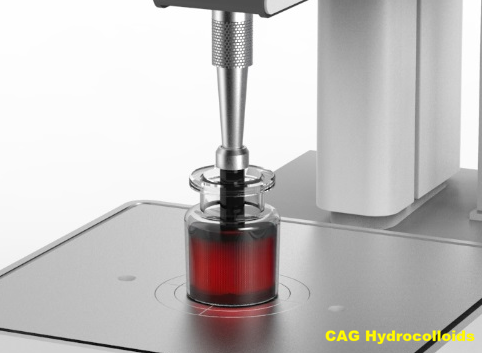
Probe Specification: 12.7 mm Standard Cylindrical Probe
A cylindrical probe with a diameter of 12.7mm ± 0.01mm must be used. The probe surface must be smooth with sharp edges. This specification aligns with the national standard GB 6783-2013. The Bloom value is highly dependent on the pressure area; a 5% deviation in probe area can result in a measurement error of up to 10%. Therefore, the accuracy of the probe specification is fundamental for ensuring data comparability.
Compression/Penetration Speed: 0.5-1.0 mm/s
The probe descent speed must be adjustable within the range of 0.5 to 1.0 mm/s. Excessively high speed can cause inertial effects, leading to falsely high strength readings, while excessively low speed may cause stress relaxation in the gel, resulting in lower readings. Equipment featuring a closed-loop control system is recommended to ensure stability of the speed output.
Penetration Depth: 4 mm
The probe must penetrate to a fixed depth of 4mm below the initial gel surface. This fixed depth replaces the previous imprecise method of stopping upon "observed gel rupture." The displacement measurement accuracy must reach 0.01mm to ensure precise and controllable penetration depth.
Gelation Temperature: 10°C ± 0.1°C
For standard samples like pharmaceutical gelatin, the gel strength is determined under conditions of 10°C ± 0.1°C. The constant temperature water bath must have a temperature control precision of ±0.1°C and must be level with the test platform. Studies show that a temperature increase from 10°C to 10.5°C can cause a 5%-8% decrease in the Bloom value, making temperature control precision a critical factor affecting test results.
Sample Concentration: 6.67%
The standard sample preparation concentration for pharmaceutical gelatin is 6.67%. This is achieved by precisely weighing 7.5g of the sample and adding 105ml of water. Any deviation in concentration directly affects the quality of the gel network formation, thereby influencing the strength measurement result.
III. Complete Sample Preparation Process
Precise Weighing and Swelling
Using an analytical balance with a precision of at least 0.1mg, accurately weigh 7.5g of gelatin sample. Add 105ml of distilled water. Cap and let stand for 1-4 hours to allow the gelatin to fully swell.
Dissolution and Homogenization
Place the swollen sample in a water bath at 65 ± 2°C and heat for 15 minutes. Stir slowly during this process to ensure complete dissolution and homogeneity of the solution. The dissolution temperature should not exceed 70°C, as higher temperatures may cause degradation of the gelatin molecular chains, leading to lower strength values.
Deaeration Treatment
After dissolution, deaeration must be performed using vacuum degassing or ultrasonication to remove tiny bubbles from the solution. Bubbles act as stress concentration points, causing abnormal fluctuations in the force reading during penetration, which severely impacts the repeatability of test results.
Filling and Gelation
Transfer the prepared solution into a standard sample bottle, cap it, and place it in a constant temperature bath at 10.0 ± 0.1°C. Let it stand for 17 ± 1 hours to allow the gelatin to fully form a stable three-dimensional gel network. The gel thickness must be ≥ 30mm, and the gel surface should be smooth and free of bubbles.
IV. Standardized Test Operation Procedure
Step 1: Equipment Preparation and Warm-up
Turn on the gel strength tester and allow it to warm up for 30 minutes to reach thermal equilibrium. Check that the probe is clean and unworn. Confirm the constant temperature bath is stable at 10°C ± 0.1°C.
Step 2: Probe Calibration
Perform zero-point calibration to ensure the force sensor reads zero when the probe is not in contact with the sample. Zero-point error should be ≤ 0.1g. Simultaneously, perform multi-point verification using standard weights to confirm the force sensor accuracy meets the 0.5% Full Scale (FS) requirement.
Step 3: Parameter Setting
On the equipment's touch screen, select the "Gel Strength Test" mode. Set the penetration speed (recommended 0.5-1.0 mm/s), penetration depth (4mm), and data sampling frequency (recommended ≥ 200Hz).
Step 4: Sample Mounting
Remove the gelled sample bottle from the constant temperature environment. Quickly place it on the test platform, ensuring the center of the bottle is aligned with the probe axis. The test must be completed within a specified time after removal from the constant temperature environment to prevent gel temperature rise from affecting the result.
Step 5: Test Execution
Start the test program. The probe descends vertically at the set speed, penetrating the gel surface until the 4mm depth is reached. The equipment automatically collects the force-displacement curve and records the maximum force value during penetration.
Step 6: Data Recording and Replicate Testing
Perform 3-5 replicate tests for each sample batch. Calculate the average value and relative standard deviation. The relative standard deviation should be ≤ 10%; otherwise, samples must be re-prepared, or equipment status checked.
V. Result Expression and Unit Conversion
Test results are typically reported in Bloom grams (g), which is consistent with the Bloom g unit commonly used in the gelatin industry. The force per unit area can also be calculated based on the probe area (approximately 1.27 cm²) and expressed in g/cm²
VI. Key Considerations
Elimination of Bubble Interference
Deaeration during the sample preparation stage is crucial. Bubbles act as stress concentration points, causing abnormal force fluctuations during penetration, which severely affects data repeatability.
Stringency of Temperature Control
Temperature is a key variable affecting gel strength. Studies indicate that a 1°C increase in temperature can decrease the gelatin Bloom value by 3%-5%. Therefore, strict temperature control at 10°C ± 0.1°C is essential during both the gelation stage and the testing stage.
Compatibility of Sample Bottle Specifications
The 2025 edition of the Pharmacopoeia categorizes sample bottles into Type A and Type B, suitable for low-bubble/smooth-surface samples and high-bubble/uneven-surface samples, respectively. The appropriate bottle type must be selected based on sample characteristics to ensure a smooth gel surface and avoid test deviations.
Timing of the Test
When the gelation temperature is lower than the ambient temperature, the test must be completed within 5 minutes of removing the gel from the constant temperature environment. This prevents softening of the gel structure due to temperature recovery, which would affect the strength measurement result.
Regular Maintenance of the Probe
The probe undergoes wear during use, especially a gradual loss of edge sharpness. Regularly check that the probe diameter meets the 12.7mm ± 0.01mm specification. Worn probes must be replaced promptly. It is recommended to perform comparative tests quarterly using a standard gelatin sample to verify equipment performance.


Email: info@cagcolloids.com
Tel: 0086-19884908291 / 0086-573- 88067623
Website: www.cagcolloids.com
Address: No. 399, East Tongfu Road, Tongxiang City, Zhejiang Province. China.