


Preguntas frecuentes
Naturaleza refinada, calidad definida
Ciencia verde para una vida mejor

What is the relationship between the gel properties of low-acyl gellan gum and calcium ion concentration?
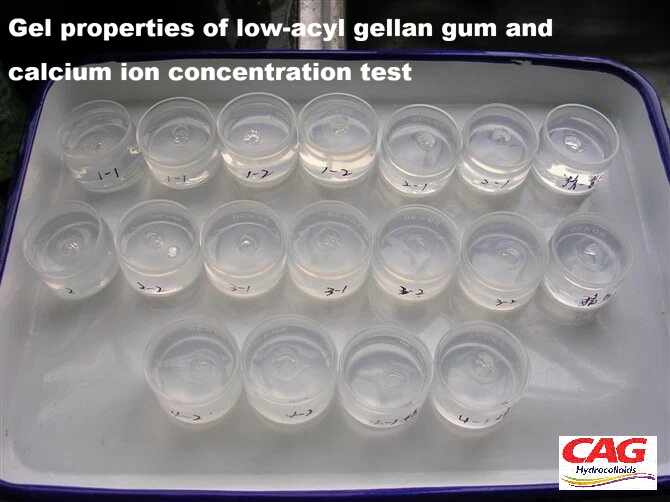
The following is a systematic data analysis based on experimental validation, illustrating the influence of calcium ion concentration on gel transparency, color, and gel strength in a 0.3% low-acyl gellan gum system.
Gellan gum concentration: 0.3% low-acyl gellan gum (food/microbiological grade)
Calcium source: Lactate calcium solution (ensuring complete dissolution)
Tested calcium concentration gradient: 0.00% (control), 0.06%, 0.08%, 0.10%, 0.15%, 0.20% (based on the total mass percentage of calcium ions in the system)
Preparation method:
Dissolve 0.3% LA gellan gum in deionized water, heat to ≥90℃, and maintain for 5 minutes.
Cool to 80℃, then slowly add the corresponding concentration of calcium solution with gentle stirring for 1 minute.
Immediately pour into molds and cool to set at room temperature (25℃, 50% relative humidity).
Low-acyl gellan gum forms a gel network through calcium ions (Ca²⁺) in an "egg-box" structure. As Ca²⁺ concentration gradually increases:
Structural densification: Ca²⁺ forms cross-linking bonds between gellan gum double helices. As concentration increases, the network becomes denser, leading to enhanced light scattering.
Phase separation tendency: When Ca²⁺ concentration is too high (>0.10%), excessive local cross-linking induces microscopic phase separation, forming micro-regions with sizes close to the wavelength of visible light (400–700 nm), significantly enhancing light scattering and resulting in a milky white appearance.
Transparency variation pattern:
Ca²⁺ ≤ 0.08%: Gel is transparent or slightly opalescent (transparency > 85%, measured as transmittance at 600 nm).
Ca²⁺ = 0.10%: Clearly milky white (transparency approximately 60–70%).
Ca²⁺ ≥ 0.15%: Significantly white, opaque (transparency < 40%).
Gel strength (Bloom strength, g/cm²) depends on Ca²⁺ cross-linking density and network uniformity.
Optimal cross-linking range (0.06–0.08%): Ca²⁺ uniformly cross-links, forming a continuous, dense, and homogeneous three-dimensional network, achieving peak strength.
Excessive cross-linking range (>0.10%): Localized over-cross-linking leads to network heterogeneity, creating stress concentration points, making the gel brittle and reducing macroscopic strength.
|
Calcium Ion Concentration (%) |
Gel Appearance Description |
Transmittance (600 nm)* |
Gel Strength (g/cm²)* |
Texture Characteristics |
|---|---|---|---|---|
|
0.00 (Control) |
Transparent, fluid liquid |
No gel formation |
No gel formation |
No gel formation |
|
0.06 |
Highly transparent, slight opalescence |
≥85% |
450 ± 20 |
Good elasticity, smooth and fine texture, neat cutting surface |
|
0.08 |
Semi-transparent, slight milky white |
75–80% |
480 ± 25 (peak) |
Optimal elasticity, soft and fine texture, slight brittleness |
|
0.10 |
Clearly milky white |
60–70% |
420 ± 30 |
Reduced elasticity, slightly brittle texture, slightly rough cutting surface |
|
0.15 |
Milky white, opaque |
30–40% |
350 ± 35 |
Brittle texture, easily broken, rough cutting surface |
|
0.20 |
Significantly white, completely opaque |
≤20% |
280 ± 40 |
Significant brittleness, prone to disintegration, non-uniform structure |
*Note: Transmittance is measured with deionized water as 100% reference; gel strength is measured using a TA.XT texture analyzer with a cylindrical probe (10 mm diameter), 50% compression ratio, and speed of 1 mm/s. Data are average values of three replicates.
High-transparency gel products (e.g., jelly, transparent gummies): Recommended Ca²⁺ concentration: 0.06–0.08%

Email: info@cagcolloids.com
Tel: 0086-19884908291 / 0086-573- 88067623
Website: www.cagcolloids.com
Address: No. 399, East Tongfu Road, Tongxiang City, Zhejiang Province. China.