


Preguntas frecuentes
Naturaleza refinada, calidad definida
Ciencia verde para una vida mejor

What is the optimized Comparison Test for Low-Acyl Gellan Gum Quality?
To evaluate the performance of different sourced low-acyl gellan gum, a suspension speed test can be conducted. The method is designed to compare gelation efficiency and molecular weight indirectly by observing the suspension behavior of fruit particles in a standardized system.
Formula
0.025% low-acyl gellan gum + 0.08% calcium carbonate+0.05% Sodium Citrate
Fully dissolve gellan gum with heating to 100°C, keep it for at least 5 mins, then cool to around 80°C and adjust pH to 4.2 by adding citric acid.
At ~80°C, pour the gellan gum solution into bottles pre-filled with 5% (by volume) fruit pulp (orange pulp, aloe vera ) .
Procedure
Seal the bottles and immediately place them in an ice-water bath.
Retrieve samples hourly and compare:
Observe which bottle shows fruit pulp suspension first.
Faster suspension indicates better gellan gum quality.
Interpretation
Higher molecular weight gellan gum typically forms a stronger gel network, leading to faster and more stable suspension.
Suspension speed serves as a proxy for gelation efficiency and molecular integrity.
Sensitivity to Molecular Weight: Faster gelation at low temperature correlates with higher gum purity and molecular weight.
Simulates Real Applications: Mimics the behavior of gellan gum in acidified beverage systems with particulate matter.
Rapid and Practical: Results are visible within hours, enabling quick batch-to-batch or supplier comparisons.
Control all variables:
Use identical fruit pulp type and particle size.
Maintain precise temperature during solution transfer.
For quantitative comparison, measure the time to full suspension or use a standard suspension height scale.
This test provides a reliable, application-oriented indicator of low-acyl gellan gum functionality, especially for products requiring particle suspension in acidic beverages.
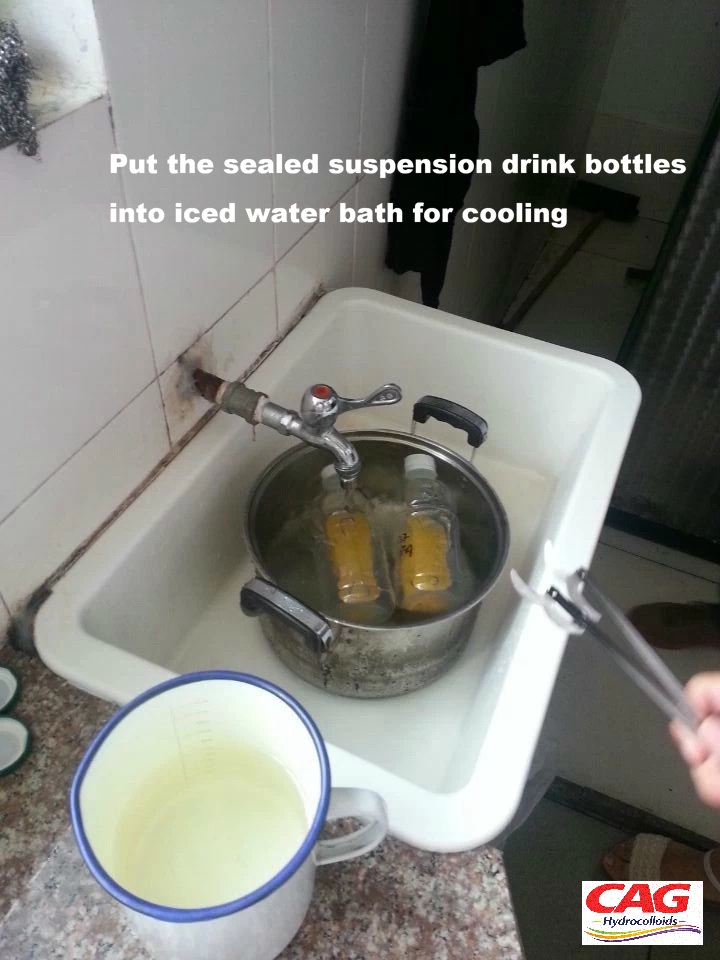
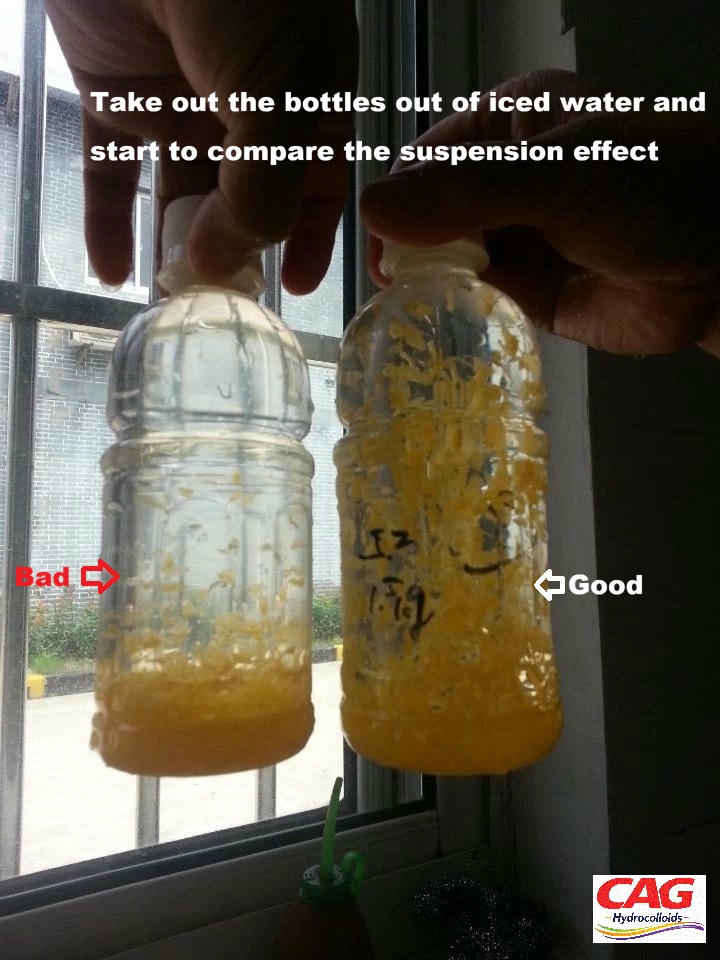
CAG hydrocolloids offers high quality low acyl gellan gum which can suspend the fruit pulp faster.

Email: info@cagcolloids.com
Tel: 0086-19884908291 / 0086-573- 88067623
Website: www.cagcolloids.com
Address: No. 399, East Tongfu Road, Tongxiang City, Zhejiang Province. China.