


Preguntas frecuentes
Naturaleza refinada, calidad definida
Ciencia verde para una vida mejor

What are the economic benefits of plant tissue culture using CAG agar for papaya?
Plant tissue culture using CAG agar offers significant economic advantages in commercial papaya production, transforming cultivation into a more profitable and sustainable enterprise:
Enhanced Yield Stability and Quality Consistency
Traditional seed propagation leads to high genetic variability (~50% segregation), causing inconsistent harvests.
Tissue-cultured seedlings maintain 100% genetic stability, ensuring uniform growth, predictable yields, and standardized high-quality fruit production.
Substantial Cost Reduction Through Disease Control
Apical meristem culture combined with CAG agar achieves 100% virus-free plantlets, effectively eliminating mosaic virus threats.
This prevents field infections, reduces pesticide use, avoids crop loss, and lowers long-term cultivation costs.
Accelerated and Scalable Propagation
The method enables rapid mass production of elite cultivars, shortening the time from lab to field.
High explant treatment success rates (~92%) and efficient rooting support quick scaling, helping meet market demand without compromising genetic integrity.
Market Competitiveness and Sustainability
Early fruiting, extended productive lifespans, and premium fruit quality increase market value.
Reduced chemical inputs and resilient planting material align with sustainable agriculture trends, appealing to modern consumers and export markets.
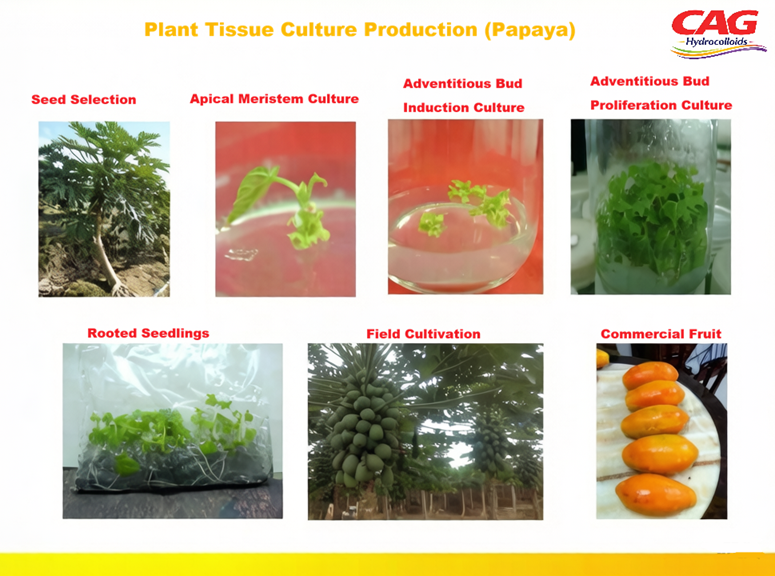
In summary, CAG agar-based tissue culture provides a scientifically robust and commercially viable pathway to maximize papaya profitability through higher yields, lower risks, and faster returns on investment.

Email: info@cagcolloids.com
Tel: 0086-19884908291 / 0086-573- 88067623
Website: www.cagcolloids.com
Address: No. 399, East Tongfu Road, Tongxiang City, Zhejiang Province. China.