


Preguntas frecuentes
Naturaleza refinada, calidad definida
Ciencia verde para una vida mejor

Textural Comparison of High-Acyl (HA) and Low-Acyl (LA) Gellan Gum in Water-Based Gels
The images show water-based gel samples with different gellan gum formulations (from left to right):
Left: 0.3% Low-Acyl (LA) Gellan Gum
Middle: 0.2% LA + 0.2% High-Acyl (HA) Gellan Gum (blend)
Right: 0.5% High-Acyl (HA) Gellan Gum
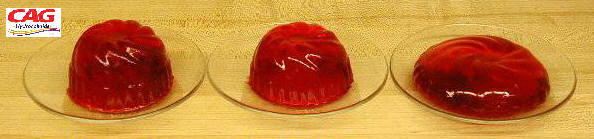
Low-Acyl (LA) Gellan Gum (left sample): Forms a firm, brittle, and thermally stable gel. It resists melting (e.g., at 55°C) and maintains a defined, non-sticky structure. This rigidity comes from LA gellan’s ability to create a strong, double-helical network that traps water tightly. The gel is clear and holds its shape well under thermal stress.
High-Acyl (HA) Gellan Gum (right sample): Produces a soft, elastic, and creamy gel with a slight stickiness. While offering good clarity and smooth mouthfeel, it is less thermally stable than LA gellan and may soften or lose structure more readily under heat. The higher acyl content results in a more flexible gel network with lower firmness but enhanced elasticity.
Blend (middle sample): Combines the structural stability of LA gellan with the soft, smooth texture of HA gellan. The 0.2% LA + 0.2% HA blend provides a balanced gel that is both heat-resistant (from LA) and pleasantly elastic (from HA), suitable for applications requiring moderate firmness and improved mouthfeel.
Summary:
In water-based gels, LA gellan gum provides high thermal stability and firm, brittle texture, while HA gellan gum delivers soft, elastic, and creamy consistency. Blending both types allows for customized gel textures that meet specific stability and sensory requirements.

Email: info@cagcolloids.com
Tel: 0086-19884908291 / 0086-573- 88067623
Website: www.cagcolloids.com
Address: No. 399, East Tongfu Road, Tongxiang City, Zhejiang Province. China.