


Preguntas frecuentes
Naturaleza refinada, calidad definida
Ciencia verde para una vida mejor

Production of Popping Boba with Sodium Alginate + Low-Acyl Gellan Gum
Individual hydrocolloids possess inherent limitations that are difficult to overcome. However, their strategic combination achieves a perfect synergy, complementing each other's weaknesses.
|
Hydrocolloid |
Core Limitations When Used Alone |
Role and Contribution in the Composite System |
|---|---|---|
|
Sodium Alginate |
1. Excessively Fast and Brittle Film Formation: It reacts almost instantaneously with calcium ions, forming a very brittle membrane prone to cracking and lacking a pleasant, elastic chewiness. |
1. Foundation for Rapid Film Formation: Its instantaneous reaction with calcium ions ensures a primary gel network forms the moment the droplet contacts the setting bath. This provides critical initial shape fixation, drastically reducing the risk of "tailing" or misshapen droplets. |
|
Low-Acyl Gellan Gum |
1. Relatively Slow Film Initiation: Gelation relies entirely on calcium ion diffusion. Surface setting at the critical moment of droplet descent may be too slow, leading to deformation. |
1. Master of Texture and Mechanical Strength: Following the initial network formation, gellan gum and calcium ions create a high-strength, thermally irreversible "egg-box" structure. This layer provides the boba membrane with exceptional toughness, a crisp-yet-elastic mouthfeel, high mechanical strength, and excellent stability against heat and acid. |
Synergy Analogy:
Sodium Alginate acts like "rapid-setting cement"—it solidifies almost instantly upon contact with calcium ions, immediately capturing and fixing the droplet's shape to prevent spreading or tailing.
Low-Acyl Gellan Gum acts like "high-performance composite reinforcement"—building upon the "rapid-set" foundation, it forms a tough and resilient primary structure that defines the product's core mouthfeel and physical integrity.
The combination delivers "instant shape setting" + "structural reinforcement and toughening", achieving a true synergistic effect (1+1 > 2).
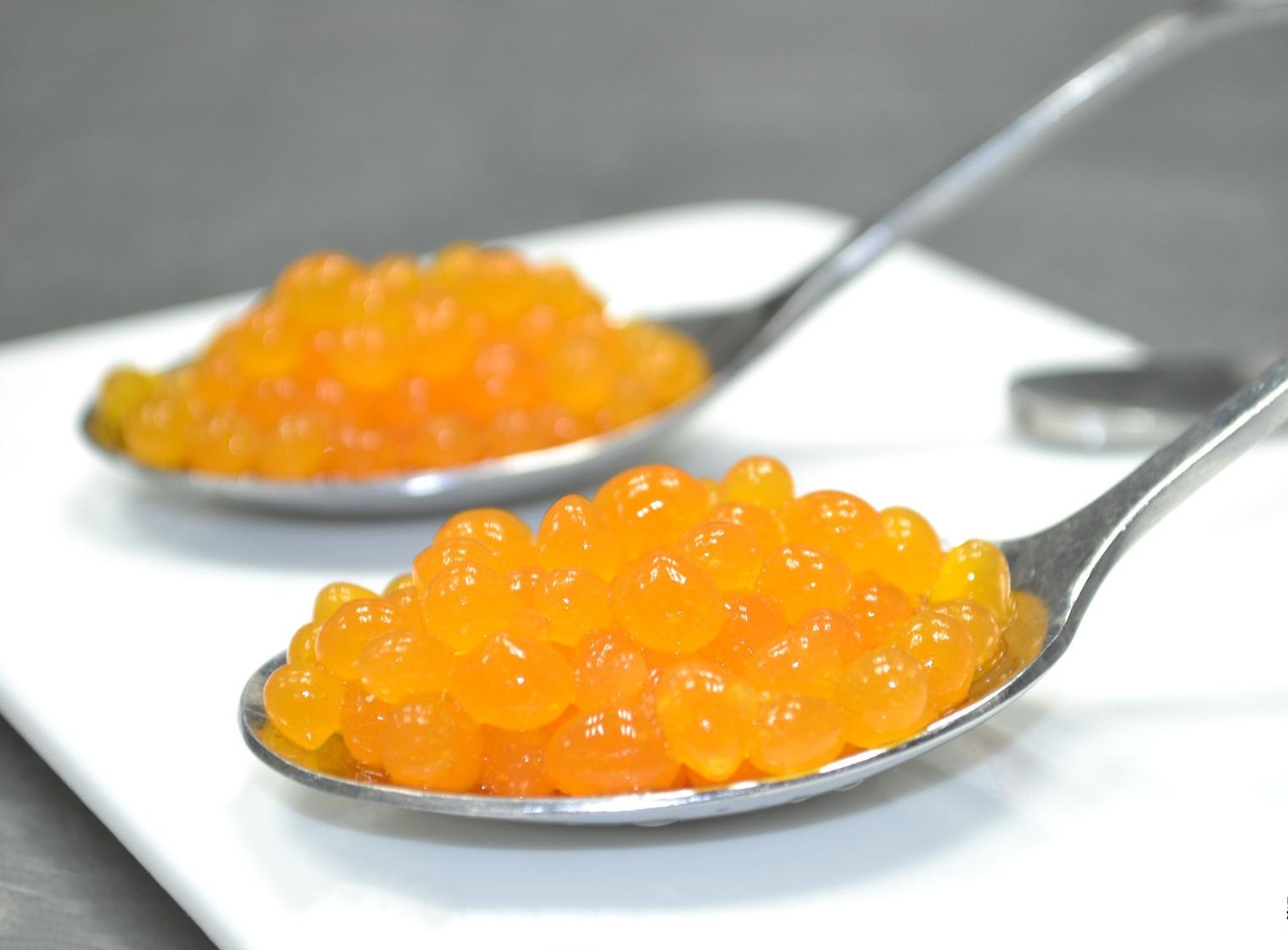
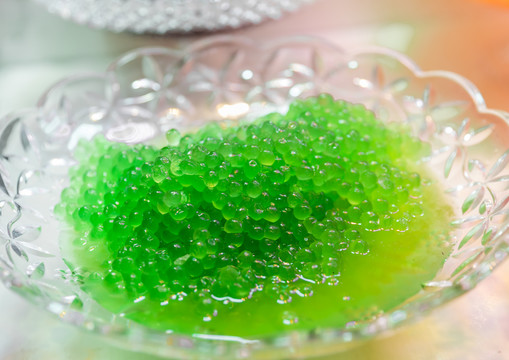
1. Example Membrane Solution Formulation:
Sodium Alginate: 0.4% – 0.8%
Low-Acyl Gellan Gum: 0.3% – 0.7%
Sugar / Plasticizer (e.g., glycerin): 5% – 15% (modifies brittleness, adjusts solution density)
Buffer / Sequestrant (e.g., Sodium Citrate): 0.1% – 0.2% (controls gelation kinetics, prevents premature gelation in the stock solution)
Water: Balance (Must use deionized or purified water)
2. Core Process Adjustments and Mechanism:
Dissolution Protocol: The two hydrocolloids can be dry-blended first, then dispersed into cold water under high-shear agitation, followed by heating to 85–90°C with stirring until fully dissolved. Gellan gum requires this high temperature for complete hydration, while sodium alginate also dissolves effectively under these conditions.
Setting Bath: A 1–2% (w/v) Calcium Chloride (CaCl₂) solution is used. Calcium ions serve as the cross-linking agent for both polymers.
Forming Mechanism: Within milliseconds of entering the calcium bath, sodium alginate at the droplet surface reacts first, forming an ultra-thin foundational gel film that "locks" the shape. Subsequently, calcium ions continue to diffuse inward, reacting with the gellan gum and the remaining alginate to build the main, robust gel layer. This two-stage process significantly improves forming reliability and tolerance to process variations.
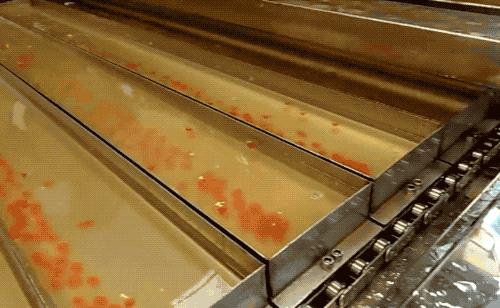
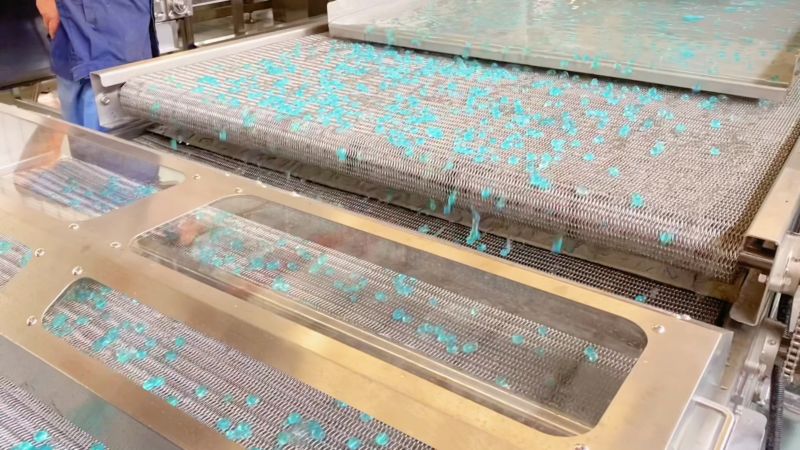
Poping Boba Production Line
|
Characteristic |
Sodium Alginate Only |
Low-Acyl Gellan Gum Only |
Sodium Alginate + Low-Acyl Gellan Gum (Composite) |
|---|---|---|---|
|
Forming Success / Yield |
High (instant gelation) |
Lower (highly parameter-sensitive) |
Very High (rapid initial set + reinforced structure) |
|
Membrane Mouthfeel |
Brittle, prone to rupture, can be chalky |
Crisp-elastic, good toughness, but hard to optimize consistently |
Optimal crisp-elastic texture, full-bodied, highly adjustable |
|
Membrane Strength |
Moderate, easily damaged |
High, but can be brittle if over-crosslinked |
High strength with excellent toughness |
|
Process Tolerance / Robustness |
Wide |
Very Narrow |
Good, suitable for scale-up and consistent production |
|
Thermal & Acid Stability |
Poor (thermoreversible, acid-labile) |
Excellent (thermally irreversible, acid-stable) |
Good to Excellent (largely inherits gellan gum's stability) |
|
Relative Ingredient Cost |
Low |
High |
Moderate, offering the best cost-to-performance ratio |
Adopt the Composite System: For developing commercial Popping Boba, the "Sodium Alginate + Low-Acyl Gellan Gum" composite is the strongly recommended starting point, backed by extensive industrial validation for reliability and performance.
Fine-Tune the Ratio: The optimal ratio between alginate and gellan gum (e.g., from 1:1 to 2:1) should be determined experimentally based on specific targets for mouthfeel (crispness vs. elasticity), final product cost, and the acidity of the core liquid. Increasing the gellan gum fraction generally enhances toughness and cost.
The Buffer is Essential: The inclusion of a small amount of a chelating agent like sodium citrate is critical. It sequesters trace multivalent ions in the water, preventing slow, undesirable pre-gelation in the membrane solution tank, thereby ensuring consistent viscosity and reliable droplet formation.
Comprehensive Process Optimization: Even with a fixed formula, the final bead characteristics (size, membrane thickness, texture) are co-determined by dropper geometry, drop height, setting bath temperature and Ca²⁺ concentration, and curing time. A full factorial design of experiments (DOE) is recommended to lock in robust production parameters

Email: info@cagcolloids.com
Tel: 0086-19884908291 / 0086-573- 88067623
Website: www.cagcolloids.com
Address: No. 399, East Tongfu Road, Tongxiang City, Zhejiang Province. China.