


Preguntas frecuentes
Naturaleza refinada, calidad definida
Ciencia verde para una vida mejor

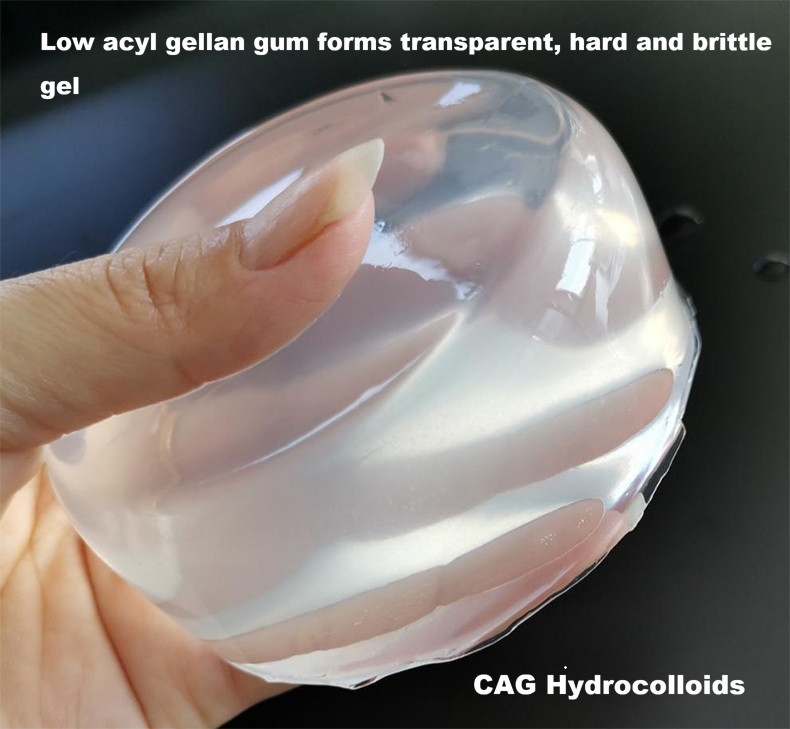
How can the characteristic brittle texture of low-acyl gellan gum be modified, and what is the functional principle behind effective texture-modifying blends?
The inherent brittleness of low-acyl gellan gum gels, while desirable in some applications, can be a limitation in others. Effective texture modification is not achieved by blending with other brittle gelling agents (e.g., agar or k-carrageenan), as such blends largely preserve the brittle character. Successful modification requires the introduction of a second, cohesive/elastic structural element. Two primary strategies are documented:
Blending with the Xanthan/Locust Bean Gum (LBG) Synergistic System: This combination itself forms a weak, elastic, cohesive gel. When added to low-acyl gellan gum, it creates a composite or interpenetrating network. The xanthan/LBG system imparts elasticity and cohesiveness, progressively reducing the blend's overall brittleness and hardness while increasing its elasticity as its proportion rises.
Blending with High-Acyl (Native) Gellan Gum: Since native gellan gum forms soft, elastic gels, blending it with the deacylated form allows for precise, continuous textural engineering across the entire spectrum from elastic to brittle. This is a particularly clean-label solution.
The underlying principle is that these additives interfere with the dense, orderly aggregation of the low-acyl gellan gum double helices, introducing discontinuities and a more deformable, secondary network that disrupts catastrophic brittle fracture.

Email: info@cagcolloids.com
Tel: 0086-19884908291 / 0086-573- 88067623
Website: www.cagcolloids.com
Address: No. 399, East Tongfu Road, Tongxiang City, Zhejiang Province. China.