


Preguntas frecuentes
Naturaleza refinada, calidad definida
Ciencia verde para una vida mejor

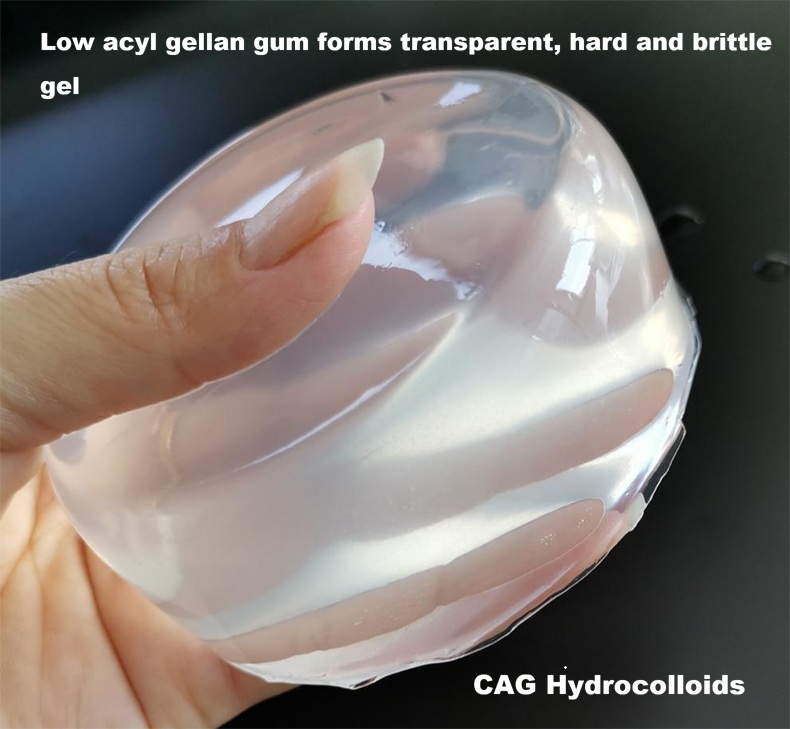
Explain the solubility, hydration, and ion-dependent gelation mechanisms of low-acyl gellan gum.
Low-acyl gellan gum exhibits distinctive solution behavior critical for its application. It is not readily soluble in cold water, a property exacerbated by the presence of dissolved ions. Complete hydration and dissolution require heating an aqueous dispersion to a minimum of 70°C, with higher temperatures needed in systems with elevated ionic strength. This characteristic is advantageous for processing, as it allows for easy, lump-free dispersion in cold formulations before thermal activation. Gelation is a two-stage process triggered by cooling in the presence of cations. Upon cooling from a hot solution, the disordered polymer chains undergo a conformational transition to form double helices. Subsequently, these helices aggregate into a three-dimensional network, a process mediated and stabilized by cations—particularly divalent ions like calcium (Ca²⁺) and magnesium (Mg²⁺)—which form ionic cross-links between the carboxyl groups of glucuronic acid residues on adjacent helices. Monovalent ions like potassium (K⁺) and sodium (Na⁺) are also effective but require approximately 25 times the molar concentration to achieve similar gelling efficacy. The type and concentration of these ions are the master variables controlling final gel texture, setting temperature, and thermal stability.

Email: info@cagcolloids.com
Tel: 0086-19884908291 / 0086-573- 88067623
Website: www.cagcolloids.com
Address: No. 399, East Tongfu Road, Tongxiang City, Zhejiang Province. China.