


Preguntas frecuentes
Naturaleza refinada, calidad definida
Ciencia verde para una vida mejor

Ash content is a key quality indicator for seaweed hydrocolloids (carrageenan, agar). What does it reflect, and how do high or low values impact product performance?
Ash content primarily reflects the total inorganic salt (mineral) content remaining after high-temperature incineration. It is a direct indicator of the purity and processing level of the raw material. Ash content significantly influences gel strength, solubility, and ionic sensitivity.
For seaweed gums, ash is not just "impurity" but a core quality marker:
|
Aspect |
What It Indicates |
|---|---|
|
Purity & Processing |
Low ash = Extensive purification (washing, dialysis). High ash = Crude extract or unrefined material. |
|
Ionic Composition |
Ash contains K⁺, Ca²⁺, Na⁺ (for carrageenan) or Mg²⁺, Ca²⁺ (for agar), which are critical for gelation. |
|
Raw Material Origin |
Reflects seaweed species, harvest region, and mineral content of the seawater. |
Gel Performance: Can be beneficial or detrimental, depending on the ion type.
Beneficial: High K⁺ content is essential for kappa-carrageenan to form strong, brittle gels.
Detrimental: Excess Ca²⁺ or impurities can cause premature gelling, cloudiness, or sandy texture.
Processing Issues:
Reduced solubility (especially in cold water).
Higher risk of syneresis (water weeping) if ion balance is wrong.
May introduce off-colors or odors.
Typical Use: Often found in cheaper, semi-refined carrageenan used in meat injection brines or pet food, where specific ions are needed.
Gel Performance: "Blank slate" behavior.
Gels are clearer, more neutral in flavor.
Requires external ions: Refined kappa-carrageenan with low ash will not gel properly unless potassium chloride (KCl) is added during production.
Processing Advantages:
Excellent cold/hot solubility.
Better compatibility with dairy systems (less risk of protein flocculation).
Typical Use: High-end desserts, pharmaceutical capsules, and applications requiring precise ionic control.
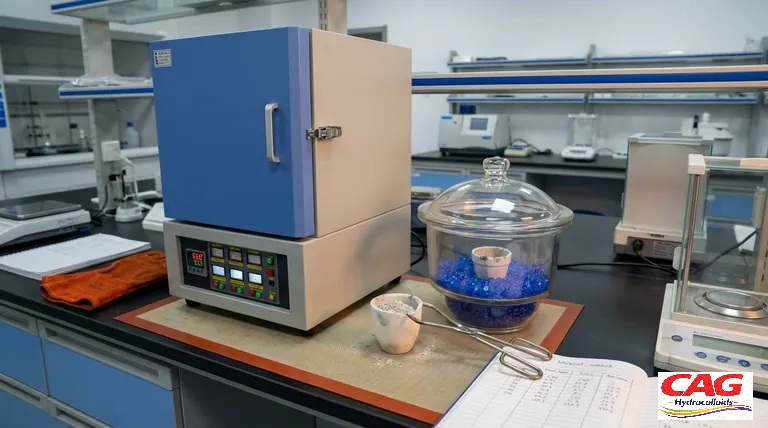
Ash Content test
|
Product Type |
Typical Ash Level |
Rationale |
|---|---|---|
|
Refined Agar |
2% - 5% |
Needed for clear jelly layers, microbiological media. |
|
Refined Carrageenan |
8% - 15% |
Standard for dairy desserts, toothpaste. |
|
Semi-refined Carrageenan |
18% - 25% |
Used in water gels, ham processing for cost efficiency. |
|
Crude Agar |
>30% |
Generally not food-grade; used for non-critical industrial applications. |
Ash is not just "dirt" – it is functional. High ash is not inherently bad if the ionic composition is correct for the application (e.g., K⁺ for carrageenan gels).
Low ash = high purity + high dependency. Refined low-ash gums offer cleaner labels and better solubility but require formulators to add back specific salts to activate gelling.
Always check ash content alongside gel strength and viscosity when selecting a grade

Email: info@cagcolloids.com
Tel: 0086-19884908291 / 0086-573- 88067623
Website: www.cagcolloids.com
Address: No. 399, East Tongfu Road, Tongxiang City, Zhejiang Province. China.