


Preguntas frecuentes
Naturaleza refinada, calidad definida
Ciencia verde para una vida mejor

How to determine the degree of esterification (DE value) and degree of amidation (DA value) of pectin? How do these parameters guide its application?
Determining the degree of esterification (DE value) and degree of amidation (DA value) of pectin is crucial for controlling its functionality and application. Below is a detailed explanation of standard and rapid testing methods, as well as how these parameters guide application.
I. Testing Methods: Degree of Esterification and Degree of Amidation
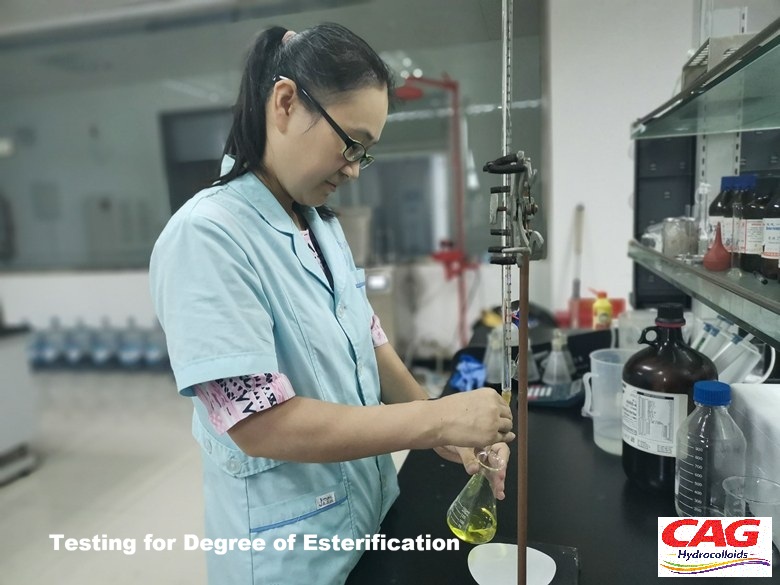
1. Testing for Degree of Esterification
Principle: The degree of esterification is defined as the molar percentage of esterified galacturonic acid units relative to the total galacturonic acid units. The standard method is based on saponification reaction and titration.
Standard Method (Chemical Titration - Internationally Recognized)
Saponification Reaction: Precisely weighed pectin sample is dissolved, and an excess of a known concentration of sodium hydroxide standard solution is added. The alkali reacts with the methoxyl groups on the pectin molecule, generating methanol and sodium pectinate.
Back Titration: After the reaction is complete, an excess of hydrochloric acid standard solution is added to neutralize the remaining sodium hydroxide.
Titration for Methanol: The methanol released in the first saponification step is distilled off, oxidized to formic acid using potassium permanganate, and the remaining oxidant is titrated with sodium thiosulfate. The total ester content is calculated from the methanol content.
Calculation:
An alternative, more direct method is: calculating the ester content directly by measuring the amount of sodium hydroxide consumed in the saponification reaction.
DE (%) = (Number of esterified galacturonic acid residues / Total number of galacturonic acid residues) × 100%
Instrumental Analysis (Faster, Modern)
Fourier Transform Infrared Spectroscopy (FTIR): By analyzing the ratio of the characteristic absorption peak areas of the ester group (~1740 cm⁻¹) and carboxylate group (~1600 cm⁻¹) in the pectin molecule, combined with a standard curve, the DE value can be estimated quickly.
Proton Nuclear Magnetic Resonance Spectroscopy (¹H-NMR): This is the most accurate and authoritative method, requiring no calibration. By comparing the signal peak areas of characteristic hydrogen atoms such as methoxyl (-OCH₃, ~3.8 ppm) and amide (-CONH₂, if present), the DE and DA values can be calculated directly and precisely.
2. Testing for Degree of Amidation
Principle: The degree of amidation is defined as the molar percentage of amidated galacturonic acid units relative to the total galacturonic acid units. The standard method is also based on hydrolysis and titration.
Standard Method (Chemical Titration)
Acid Hydrolysis to Release Ammonia: The pectin sample is heated under reflux with a strong acid (e.g., sulfuric acid) to completely hydrolyze the amide groups, releasing ammonium ions.
Ammonia Determination: The reaction mixture is made alkaline, and the released ammonia is distilled off and absorbed in a boric acid solution.
Titration: The absorbed ammonia is titrated with a standard acid solution. The ammonia content is calculated, from which the amide group content is deduced.
Calculation: DA (%) = (Number of amidated galacturonic acid residues / Total number of galacturonic acid residues) × 100%
Instrumental Analysis
¹H-NMR Method: As mentioned above, it is the gold standard for determining the DA value, allowing for direct quantification.
II. How Parameters Guide Application: The Functional Significance of DE and DA Values
The performance of pectin (especially its gelling properties) is highly dependent on the DE and DA values, which directly determine its application areas in the food industry.
1. Degree of Esterification is the Core Basis for Pectin Classification and Application
High-Ester (High-Methoxy) Pectin: DE > 50%
Gelling Mechanism: Forms gels under conditions of high sugar (>55% soluble solids) and low pH (~2.8-3.5). Gelation relies on hydrogen bonds and hydrophobic interactions, with sugar acting as a dehydrating agent and acid neutralizing charges to promote molecular chain aggregation.
Gel Characteristics: The gel is thermally irreversible (does not melt upon heating), with a firm, brittle texture.
Typical Applications:
Traditional jams, jellies, marmalades: Leverages the fruit's own high-sugar, high-acid environment.
Confectionery fillings: Provides a chewy texture.
Bakery fillings: Maintains structure without liquefying during baking.
Low-Ester (Low-Methoxy) Pectin: DE < 50%
Gelling Mechanism: Forms gels in the presence of divalent cations (mainly Ca²⁺), forming an "egg-box" model. It has low dependence on sugar and acid.
Gel Characteristics: The gel is thermally reversible (melts upon heating, re-forms upon cooling), with a soft, elastic texture.
Typical Applications:
Low-sugar/no-sugar-added jams: Meets healthy diet demands.
Dairy desserts (yogurt, pudding): Forms stable gels in near-neutral pH and low-sugar environments.
Fruit preparations: Used in fruit layers for yogurt or ice cream to prevent fruit settling and color bleeding.
2. Degree of Amidation Further Optimizes the Performance of Low-Ester Pectin
Amidated pectin is a type of low-ester pectin where some carboxyl groups are amidated.
Functional Impact:
Reduced Sensitivity to Calcium Ions: The introduction of amide groups makes gel formation more tolerant to variations in calcium ion concentration, resulting in broader, easier-to-control gelling conditions.
Improved Gel Texture: Gels formed by amidated pectin are softer, more elastic, and less prone to syneresis (weeping).
Typical Applications: Primarily used in low-sugar dairy desserts and fruit products requiring excellent texture and stability.
III. Application Selection Quick-Reference Table
|
Pectin Type |
DE Value Range |
DA Value Range |
Gelling Conditions |
Gel Characteristics |
Typical Application Areas |
|---|---|---|---|---|---|
|
High-Ester Pectin |
> 50% |
0% |
High sugar (>55%), Low pH (~3.0) |
Thermally irreversible, Firm, Brittle |
Traditional jams, jellies, high-sugar confectionery |
|
Standard Low-Ester Pectin |
< 50% |
0% |
Requires Ca²⁺, Low sugar/acid requirement |
Thermally reversible, Soft, Elastic |
Low-sugar jams, dairy desserts, fruit preparations |
|
Amidated Low-Ester Pectin |
< 50% |
10-25% |
Requires Ca²⁺, but conditions are broader, easier to control |
Thermally reversible, Very soft, Elastic, Syneresis-resistant |
High-quality yogurt, pudding, jellies, sauce stabilization |
Summary
Testing: Traditional chemical titration is the standard method, while ¹H-NMR spectroscopy is the most precise, efficient, and preferred method for determining DE and DA values, especially suitable for R&D and quality control.
Application Guidance:
The DE value determines the basic type of pectin and its gelling conditions (high sugar/acid or requiring calcium ions).
The DA value is used in low-ester pectin to optimize gel texture and processing tolerance.
By precisely controlling the DE and DA values, manufacturers can "customize" pectin to meet the specific texture requirements of various foods, from traditional high-sugar jams to modern low-sugar dairy products. Selecting the correct pectin type is the critical first step for successful application.


Email: info@cagcolloids.com
Tel: 0086-19884908291 / 0086-573- 88067623
Website: www.cagcolloids.com
Address: No. 399, East Tongfu Road, Tongxiang City, Zhejiang Province. China.