


FAQs
Nature Refined, Quality Defined
Green Science for better living

Why Low‑Acyl Gellan Fails in Hard Water — and How to Solve It with Chelating Agents
Ionic sensitivity is the most misunderstood property of low‑acyl gellan. Once the molecular mechanism is understood, chelator design becomes straightforward.
Low‑acyl (LA) gellan gum is one of the most powerful gelling agents available to food formulators. It forms self‑supporting gels at concentrations below 0.1%, delivering exceptional clarity and zero syneresis. However, it carries a critical formulation constraint: extreme sensitivity to dissolved ions, especially divalent cations such as calcium and magnesium.
The origin lies in molecular structure. During deacylation, carboxylate groups on the polymer backbone are fully exposed. Calcium and magnesium ions bind strongly to these sites, forming ionic crosslinks between chain segments before the polymer is fully hydrated. This prevents the formation of a uniform network and reduces gel strength well below its theoretical potential.
This effect intensifies sharply with water hardness. In deionized water, LA gellan hydrates fully at ~75 °C. At 100 ppm CaCO₃ equivalent, hydration requires ~88 °C. Above 200 ppm, full hydration is impossible under atmospheric boiling—exactly the range found in much of Europe, the Middle East, and Asia.
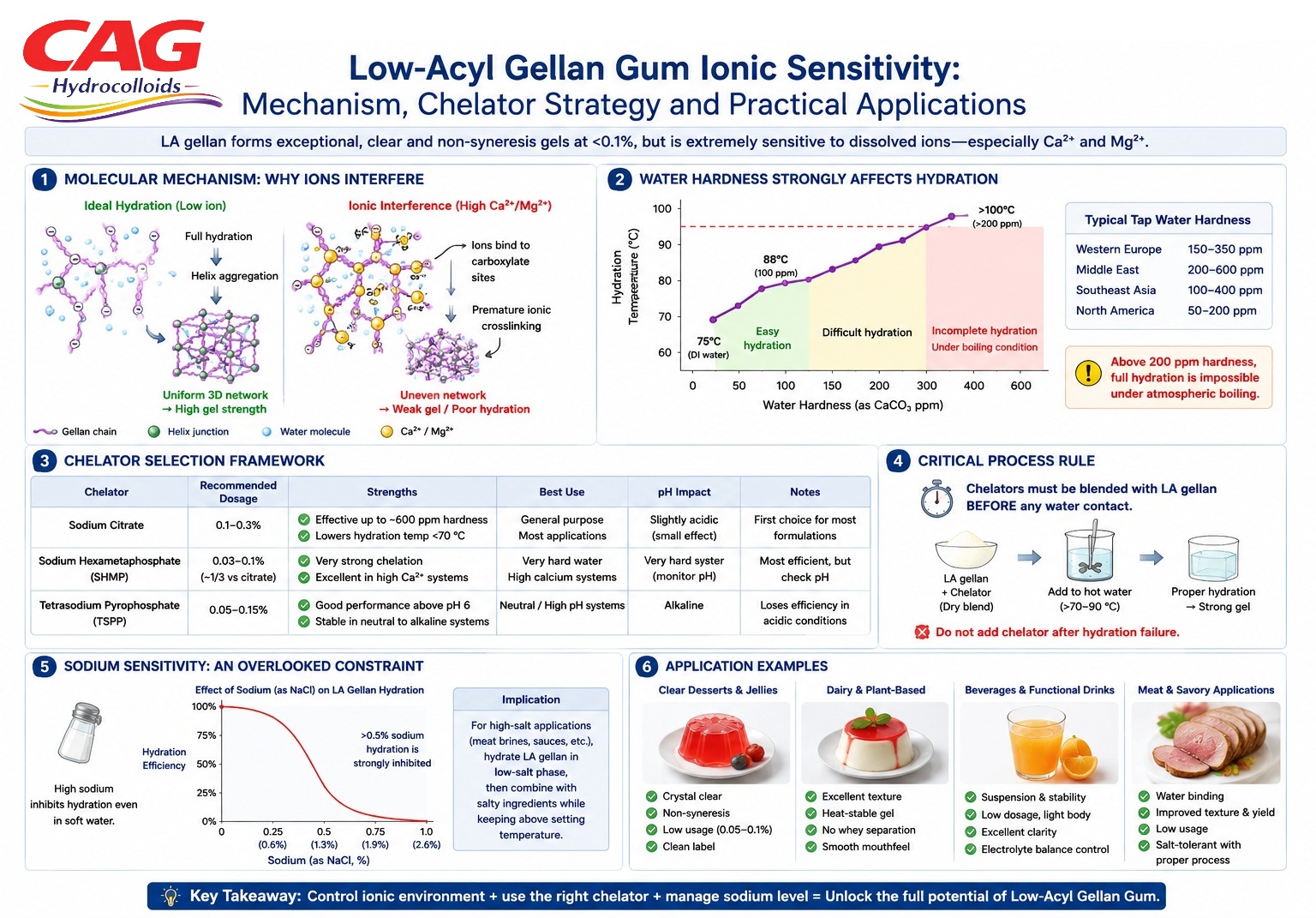
Sodium citrate (0.1–0.3%) is the standard first choice: it lowers hydration temperature below 70 °C even in waters up to 600 ppm hardness. For very hard or high‑calcium systems, sodium hexametaphosphate (SHMP) is more efficient—requiring roughly one‑third the dosage—but monitor pH, as SHMP shifts systems acidic. Tetrasodium pyrophosphate (TSPP) performs well above pH 6 but loses efficacy under acidic conditions. Key rule: chelators must be blended with LA gellan before any water contact, never added after hydration failure.
A frequently overlooked constraint is sodium concentration. When sodium exceeds ~0.5% (≈1.3% NaCl), LA gellan hydration is inhibited even in soft water. This imposes strict limits for high‑salt applications such as meat injection brines and savory sauces: the colloid must be hydrated in a low‑salt phase, then combined with salty components while kept above its setting temperature.


Email: info@cagcolloids.com
Tel: 0086-19884908291 / 0086-573- 80890620
Website: www.cagcolloids.com
Address: No. 399, East Tongfu Road, Tongxiang City, Zhejiang Province. China.