


FAQs
Nature Refined, Quality Defined
Green Science for better living

Why Kappa-2 Carrageenan Cannot Be Extracted by KCl Precipitation
Commercial carrageenan manufacturers use two principal recovery processes after extraction and clarification. The first — alcohol precipitation using isopropanol (IPA) — is a universal physical dewatering method applicable to all carrageenan types. The second — potassium chloride (KCl) gel-press precipitation — is faster and cheaper, but only works for carrageenan grades with sufficient kappa character. Kappa-2 cannot use it, and the reason is structural.
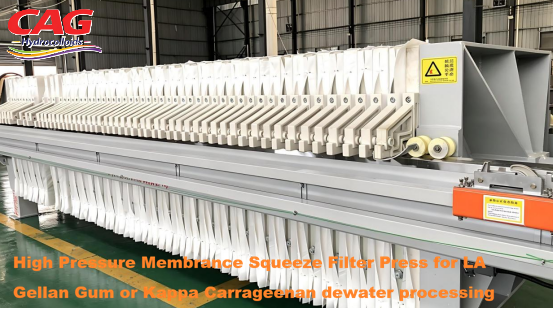
The KCl gel-press method exploits the highly specific affinity of kappa carrageenan for potassium cations. When a kappa carrageenan solution is extruded into a concentrated KCl bath, the potassium ions associate with the sulfate groups along the polymer backbone, triggering ordered double-helix formation and gel-phase separation. The precipitated fibrous mass is then pressed to expel free water, dried, and ground. The entire process depends on the carrageenan's ability to form a coherent, pressable gel in response to potassium.
The additional C2-position sulfate ester in kappa-2 disrupts the regularity of double-helix stacking. This structural irregularity substantially weakens potassium-ion-driven gelation — the precipitate formed is too soft and diffuse to be efficiently pressed. The gel-press route therefore produces poor yields and inconsistent quality when applied to κ2-rich extracts.
Isopropanol precipitation, by contrast, operates purely on physical solubility principles. It is indifferent to carrageenan type, sulfation pattern, or gelling behavior. This universality comes at a cost: IPA must be recovered and recycled to make the process economically viable, and the capital and energy requirements are higher than for gel-press facilities. Products made via the alcohol route also tend to show higher clarity and purity, as the precipitation step removes more residual salts and non-carrageenan material.
For dairy-specific carrageenan blends that incorporate κ2 for its protein-reactive properties, the alcohol route is therefore non-negotiable. This partly explains why such specialty grades command a price premium over standard kappa carrageenan, which can be efficiently recovered by the lower-cost gel-press method.
| Parameter | KCl Gel-Press | IPA Alcohol Precipitation |
|---|---|---|
| Mechanism | Ion-triggered gelation | Physical solubility reduction |
| Applicable types | Kappa only (high-κ blends) | All types incl. κ2, ι, λ |
| Product K⁺ content | High (residual KCl) | Low |
| Cold-water dispersibility | Good (delayed hydration) | Requires hot dispersion |
| Product clarity | Moderate | High |
| Processing cost | Lower | Higher (solvent recovery) |

Email: info@cagcolloids.com
Tel: 0086-19884908291 / 0086-573- 80890620
Website: www.cagcolloids.com
Address: No. 399, East Tongfu Road, Tongxiang City, Zhejiang Province. China.