


FAQs
Nature Refined, Quality Defined
Green Science for better living

Why is My Tissue Culture Media Cloudy? CAG LA Gellan Gum vs. Commercial Grades
In plant tissue culture and micropropagation, the clarity and strength of your gelling agent directly impact root development visibility, contamination detection, and nutrient uptake. While Low Acyl (LA) Gellan Gum is a premium alternative to agar, many laboratory technicians ask: "Why does my gellan gum form a hazy or cloudy gel in MS media after autoclaving?"
The answer lies in solubility and polymer structure. Below, we provide a detailed technical comparison between CAG Plant Tissue Culture Grade LA Gellan Gum and standard commercial-grade alternatives to show how to achieve a crystal-clear gel matrix.
A common frustration in micropropagation is spending time preparing Murashige and Skoog (MS) media, only to end up with a foggy gel after sterilization.
CAG Plant Tissue Culture Grade: Delivers excellent optical transparency, achieving a light transmittance of over 76% in MS media. This high clarity ensures unobstructed visual inspection of root systems and early contamination.
Standard Commercial Grade: Frequently results in a turbid, cloudy, or milky appearance, with light transmittance dropping to around 50%, making precise observation difficult.
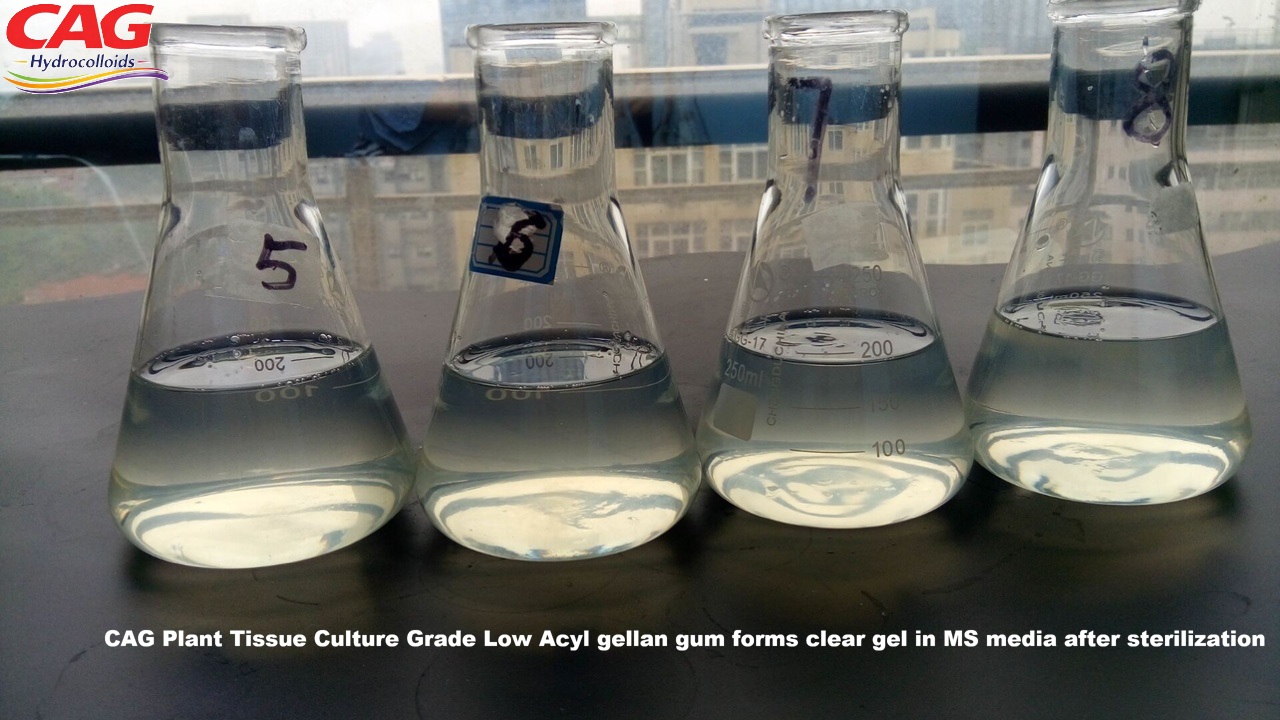
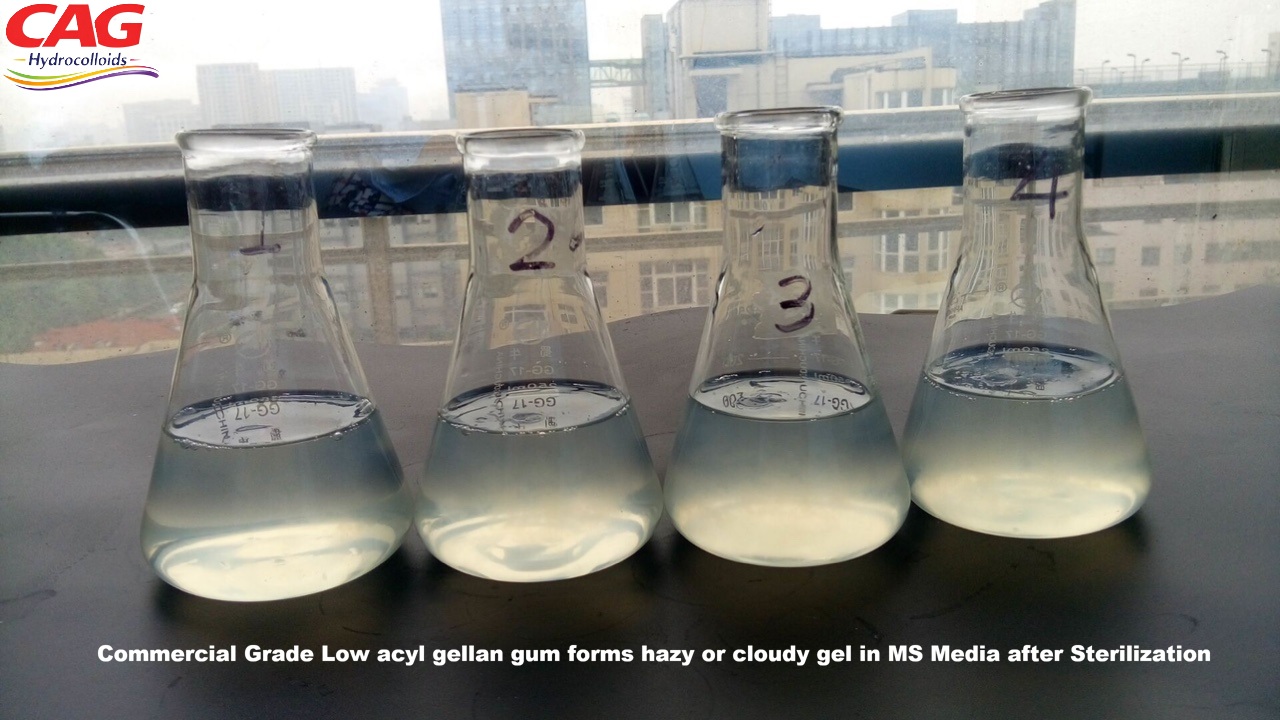
Why does standard gellan gum turn cloudy? The root cause is the dissolution temperature during media preparation.
CAG Formulation (Hydrates at 80°C): Our specialized plant tissue culture grade fully dissolves and hydrates smoothly when heated to just 80°C. Because it forms a completely homogenous solution before entering the autoclave, the polymers do not react poorly with the high concentration of divalent cations (like $Ca^{2+}$ and $Mg^{2+}$) in the MS formulation.
Standard Commercial Grade (Requires 100°C Boiling): Standard grades require reaching a full boil (100°C) for complete dissolution. If the media does not reach a full boil before autoclaving, undissolved polymer aggregates react with the media nutrients during the heating cycle, causing foggy precipitation and a hazy final gel.
A robust gel network is crucial to provide structural support for plant explants and prevent them from sinking into the medium.
CAG LA Gellan Gum: Achieves a robust gel strength of 79 g/cm² at a standard concentration of 0.25% (sterilized at 121°C for 30 minutes).
Standard Commercial Grade: Yields a gel strength of only 40 g/cm² under the exact same parameters.
By upgrading to CAG's formulation, you achieve nearly double the structural integrity, allowing you to optimize application costs without compromising gel stability.
Technical Data & Comparison Summary
Parameter (Tested in MS Media @ 0.25% Concentration, Autoclaved at 121°C for 30 mins)
CAG Plant Tissue Culture Grade LA Gellan Gum
Standard Commercial Grade LA Gellan Gum
Visual Appearance After Autoclave
Crystal Clear / Fully Transparent
Hazy / Cloudy / Foggy
Light Transmittance (%)
> 76%
~ 50%
Gel Strength (g/cm²)
79 g/cm²
40 g/cm²
Complete Dissolution Temp.
80°C
100°C (Boiling)


Email: info@cagcolloids.com
Tel: 0086-19884908291 / 0086-573- 80890620
Website: www.cagcolloids.com
Address: No. 399, East Tongfu Road, Tongxiang City, Zhejiang Province. China.