


FAQs
Nature Refined, Quality Defined
Green Science for better living

Why is Iota carrageenan safer and more stable than Kappa and Lambda in dairy desserts and infant formula thickening
Iota (ι) carrageenan carries two sulphate groups per disaccharide repeating unit (κ carries one; λ carries three) and uses calcium ions (Ca²⁺) rather than K⁺ as its preferred gelling cation. These two characteristics jointly define its unique suitability for dairy and infant food applications.
Structural advantage: elastic gel + outstanding freeze-thaw stability. Ca²⁺ is a divalent cation capable of bridging two carrageenan chains simultaneously, forming a more uniform and elastic cross-linked network. Compared to the rigid, brittle gel of κ-carrageenan, ι-carrageenan produces a thixotropic gel — it deforms under pressure and recovers on release — and shows almost no syneresis after freeze-thaw cycling (<5% water release, vs. 20–30% for κ).
Synergistic mechanism in dairy systems. Whole milk naturally contains approximately 120 mg Ca²⁺ per 100 mL (~30 mM), which falls within the optimal gelling range for ι-carrageenan (20–50 mM Ca²⁺). This means ι-carrageenan gels spontaneously in milk without any supplementary calcium salt — in direct contrast to κ-carrageenan, which requires added KCl. For mousse and milk jelly applications, as little as 0.3–0.6% ι-carrageenan in full-fat milk produces a smooth, syneresis-free, elastic gel.
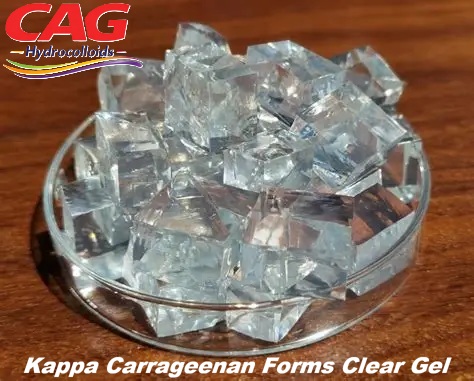
Fig. Kappa Carrageenan forms clear and relatively brittle gel
Industrially precise control of calcium synergy. If extra calcium salts are added (e.g., in calcium-fortified products), total Ca²⁺ must not exceed 80 mM. Above this threshold, excessive cross-linking hardens and embrittles the gel, shifting it toward the character of a κ+Ca²⁺ gel. Factory best practice: first measure the actual Ca²⁺ content in the calcium-containing ingredients (e.g., concentrated milk), then add ι-carrageenan accordingly — never add blindly.
Thickening application in infant formula. The thixotropy of ι-carrageenan (thick at rest, thin under shear) makes it particularly well-suited for anti-reflux (AR) infant formulas — the feed remains viscous in the stomach to reduce reflux while the shear exerted through the teat reduces viscosity sufficiently to maintain normal flow rate. Regulatory note: the EU infant and follow-on formula regulation specifies an upper limit of 300 mg/L for carrageenan in formulas for infants below 12 months; formulators should verify the current applicable regulation before commercialisation.
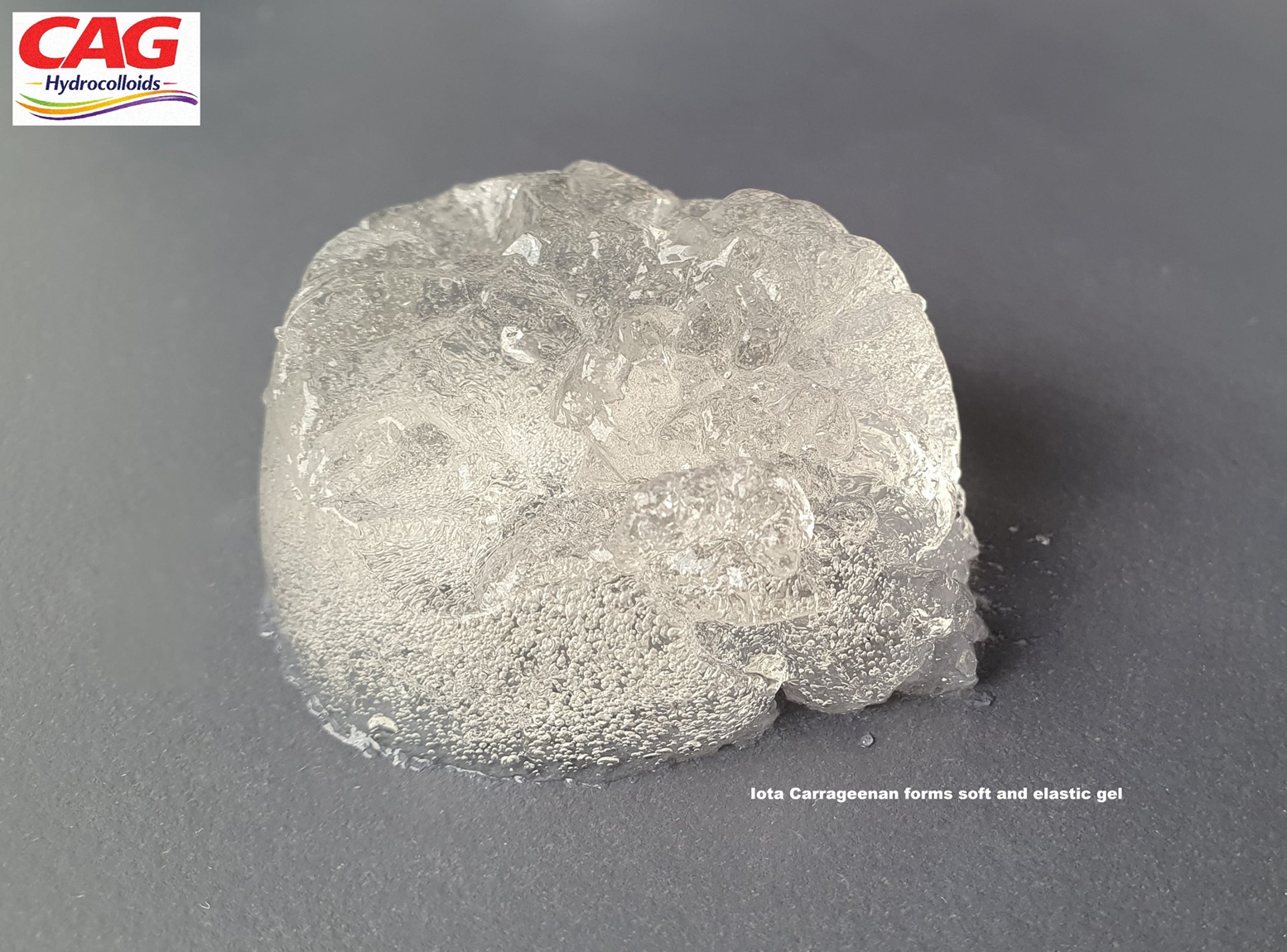
Fig. Iota Carrageenan forms elastic gel


Email: info@cagcolloids.com
Tel: 0086-19884908291 / 0086-573- 80890620
Website: www.cagcolloids.com
Address: No. 399, East Tongfu Road, Tongxiang City, Zhejiang Province. China.