


FAQs
Nature Refined, Quality Defined
Green Science for better living

Why High Acyl Gellan Gum Forms a Paste During Hydration — And How Industry Solves It
Then something unexpected happens.
As the temperature continues to increase and reaches approximately 80–90°C, the viscosity suddenly collapses and the system turns into a smooth, clear, fluid solution.
Many processors initially assume this behavior indicates a formulation problem, poor mixing, or equipment failure. In reality, it is a natural two-stage hydration mechanism of High Acyl Gellan Gum, and understanding this behavior is essential for successful industrial processing.
Unlike Low Acyl Gellan Gum, High Acyl Gellan Gum contains glycerate and acetate substituent groups attached to its polymer backbone. These groups provide the molecule with a unique balance of hydrophilic and hydrophobic characteristics.
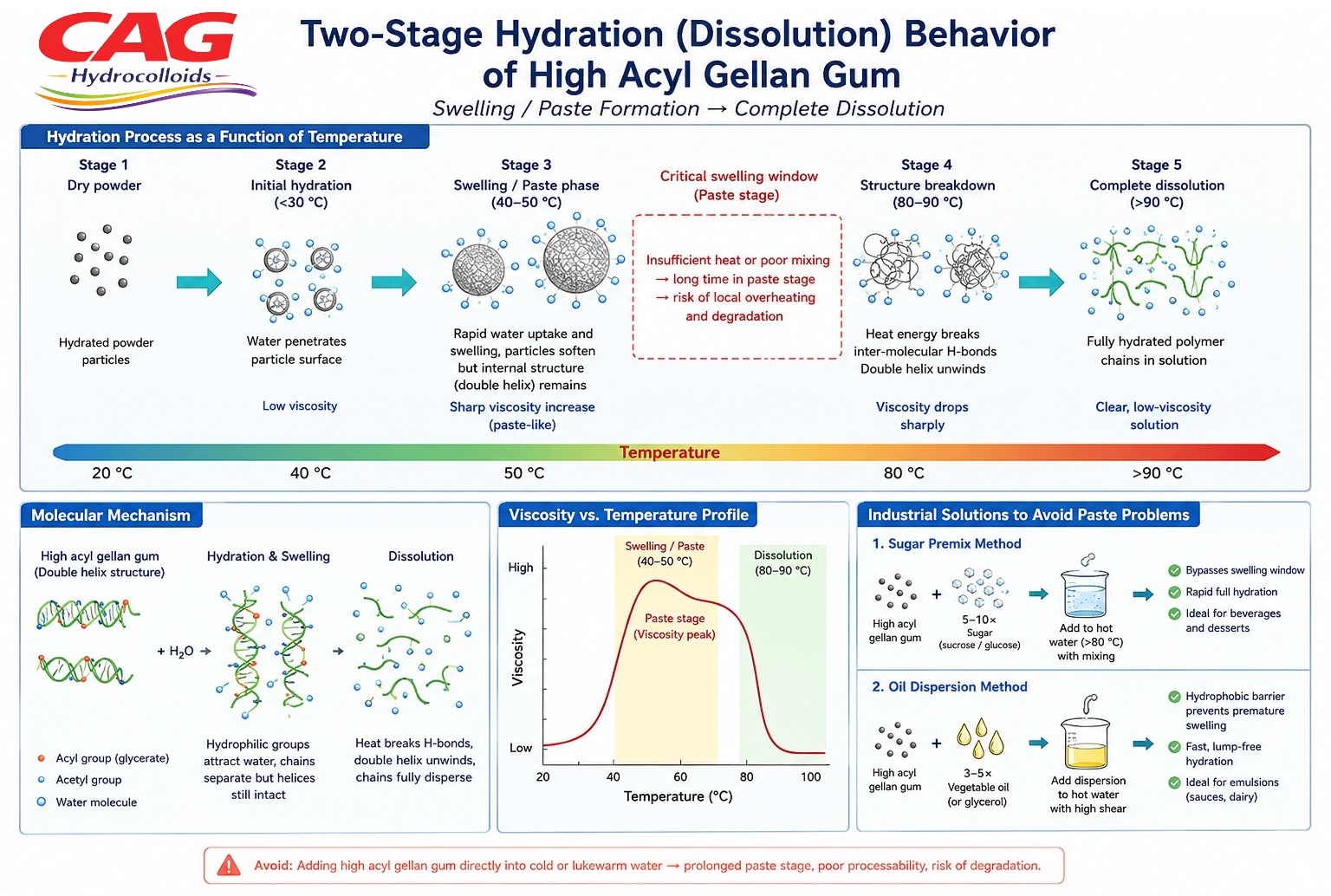
When HA Gellan particles are dispersed in water and heated, water rapidly penetrates the particle surface.
The particles begin to absorb large quantities of water and swell dramatically.
However, at this stage, the internal molecular structure remains largely intact:
As a result, the particles become highly swollen and soft, creating a dense, paste-like network throughout the system.
This is often referred to as the swelling window or paste stage.
Typical observations include:
✔ Rapid viscosity increase
✔ Poor flowability
✔ Increased mixer torque
✔ Reduced heat transfer efficiency
✔ Apparent premature gelation
As heating continues, sufficient thermal energy becomes available to disrupt the hydrogen-bonded double-helix structure.
At this point:
Once this transition occurs, viscosity drops dramatically and a clear solution is obtained.
The process can be summarized as:
Dry Powder → Hydration → Swelling/Paste Formation → Helix Unwinding → Complete Dissolution
The paste stage itself is not harmful.
The problem occurs when the system remains trapped in this stage for an extended period.
This commonly happens when:
Under these conditions, processors may experience:
For large-scale production, minimizing residence time within the swelling window is often critical.
The most widely used approach in beverage and dessert applications is the sugar premix method.
The sugar particles physically separate individual gellan particles, preventing localized concentration and excessive swelling.
As a result, the particles hydrate more uniformly and rapidly pass through the swelling window before a paste network can develop.
For emulsified systems, an alternative approach is the oil dispersion method.
The oil layer acts as a temporary hydrophobic barrier around each particle.
This prevents immediate water uptake and uncontrolled swelling, allowing particles to disperse before hydration begins.
The paste stage observed with High Acyl Gellan Gum is not a processing defect but rather a natural consequence of its two-stage hydration mechanism.
The apparent viscosity peak between 40–50°C results from rapid particle swelling while the internal double-helix structure remains intact. Only after heating to approximately 80–90°C do the helices unwind completely, allowing full dissolution and a dramatic reduction in viscosity.
For reliable industrial processing, manufacturers should avoid adding High Acyl Gellan Gum directly into cold or warm water. Instead, use proven techniques such as sugar premixing or oil dispersion to bypass the swelling window and achieve rapid, uniform hydration.
High Acyl Gellan Gum, HA Gellan Gum Hydration, Gellan Gum Dissolution, Gellan Gum Paste Formation, Hydrocolloid Processing, Gellan Gum Manufacturing, Gellan Gum Hydration Mechanism, Gellan Gum Swelling Behavior, Beverage Stabilizers, Food Hydrocolloids, Industrial Hydrocolloid Processing, Gellan Gum Application Technology, Gellan Gum Dispersion Methods, Hydrocolloid Troubleshooting, Food Texture Solutions.

Email: info@cagcolloids.com
Tel: 0086-19884908291 / 0086-573- 80890620
Website: www.cagcolloids.com
Address: No. 399, East Tongfu Road, Tongxiang City, Zhejiang Province. China.