


FAQs
Nature Refined, Quality Defined
Green Science for better living

Why Gel Strength Is Not the Most Important Indicator of Bacteriological Agar Quality
For decades, gel strength has dominated bacteriological agar specifications. Experienced culture media manufacturers know it is only one piece of a far larger puzzle.
For decades, gel strength has been one of the most widely quoted specifications for bacteriological agar. It is easy to understand why. Gel strength is simple to measure, easy to compare, and often appears prominently on product specification sheets.
As a result, many buyers assume that a higher gel strength automatically indicates a superior agar.
However, experienced culture media manufacturers often reach a very different conclusion. Some agars with exceptionally high gel strength perform poorly during production, while other products with more moderate gel strength consistently produce high‑quality culture media with excellent biological performance.
The reason is simple: culture media manufacturers are not purchasing gel strength. They are purchasing production reliability, biological consistency, and process stability.
Gel strength is important, but it is only one part of a much larger picture.
Culture media manufacturers evaluate agar not as a laboratory curiosity, but as a raw material that must survive sterilization, holding, filling, transport, and final laboratory use without deviation. Gel strength alone cannot guarantee this.
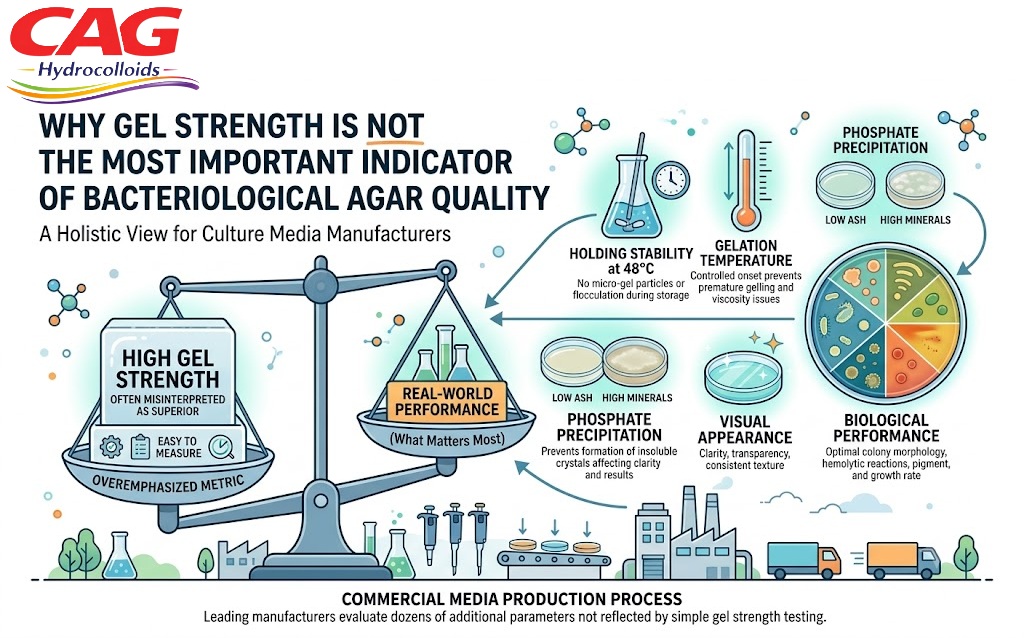
Laboratory gel strength testing evaluates the force required to penetrate a standardized agar gel under controlled conditions. While this provides useful information about gel firmness, it does not reflect the full range of conditions encountered during commercial media production.
A typical production process involves sterilization, cooling, holding, dispensing, storage, transportation, and final use by laboratories.
Throughout this process, agar must remain stable and predictable.
Agar that performs well during a simple gel strength test may still create serious problems during production.
For this reason, leading culture media manufacturers evaluate many additional parameters that are not reflected by gel strength alone.
One of the most critical tests performed by many culture media manufacturers is the holding stability test.
After sterilization, liquid media are often maintained at approximately 48 °C prior to plate pouring or automated dispensing.
Under ideal conditions, the medium should remain homogeneous and free‑flowing throughout the holding period.
Unfortunately, not all agars behave this way.
Some products begin forming microscopic gel particles during prolonged holding. These particles gradually aggregate into visible flocs or suspended fragments. Although the gel strength of the finished medium may remain acceptable, the production consequences can be significant.
Common problems include inconsistent fill volumes, uneven plate surfaces, blocked dispensing equipment, and reduced production efficiency.
For manufacturers operating high‑speed filling lines, holding stability often has a greater practical impact than gel strength itself.
Gelation temperature is another property that is frequently overlooked.
Many agar specifications emphasize melting temperature, yet gelation temperature can have a much greater influence on manufacturing operations.
When gelation temperature approaches the holding temperature used during production, the risk of premature gel formation increases significantly.
Even before visible gelation occurs, partial molecular association may increase viscosity and reduce flowability.
As a result, production becomes less predictable and process windows become narrower.
For this reason, experienced media manufacturers evaluate gelation behavior carefully rather than focusing exclusively on final gel strength.
Another challenge frequently encountered in culture media production is phosphate precipitation.
Many microbiological media contain phosphate buffering systems. If agar contains excessive levels of residual calcium or magnesium, insoluble phosphate salts may form during sterilization.
The resulting precipitates may appear as fine white particles or suspended crystals within the medium.
Although these precipitates do not always inhibit microbial growth, they can negatively affect transparency, visual appearance, and customer perception.
In chromogenic media, blood agar, and antimicrobial susceptibility testing media, even minor reductions in clarity can interfere with interpretation.
Consequently, ash content and residual mineral levels are often more important than gel strength when evaluating agar quality.
Regardless of how impressive a specification sheet may appear, the final assessment of bacteriological agar always comes from microbial performance.
Parameters such as colony size, colony morphology, hemolytic reactions, pigment production, and diffusion characteristics provide the most meaningful indication of agar suitability.
Two agars with similar gel strength may produce markedly different microbiological results due to differences in sulfate content, electroendosmosis, residual impurities, or mineral composition.
For this reason, many leading media manufacturers prioritize biological performance above all other specifications.
Gel strength remains an important quality parameter for bacteriological agar. However, it should not be viewed as the single defining characteristic of product quality.
A truly high‑performance bacteriological agar must also provide excellent holding stability, controlled gelation behavior, low precipitation tendency, high clarity, and consistent biological performance.
Ultimately, culture media manufacturers are not searching for the hardest gel. They are searching for an agar that performs reliably throughout the entire production and application process.
In modern microbiological media manufacturing, gel strength may determine whether an agar qualifies for consideration, but overall performance determines whether it becomes the preferred choice.
bacteriological agar quality, agar gel strength myth, culture media agar selection, agar holding stability, agar gelation temperature, phosphate precipitation agar, agar biological performance, microbiology QC agar


Email: info@cagcolloids.com
Tel: 0086-19884908291 / 0086-573- 80890620
Website: www.cagcolloids.com
Address: No. 399, East Tongfu Road, Tongxiang City, Zhejiang Province. China.