

FAQs
Nature Refined, Quality Defined
Green Science for better living

Why does lambda-carrageenan fail to form a gel network despite having a similar carbohydrate backbone to kappa and iota?
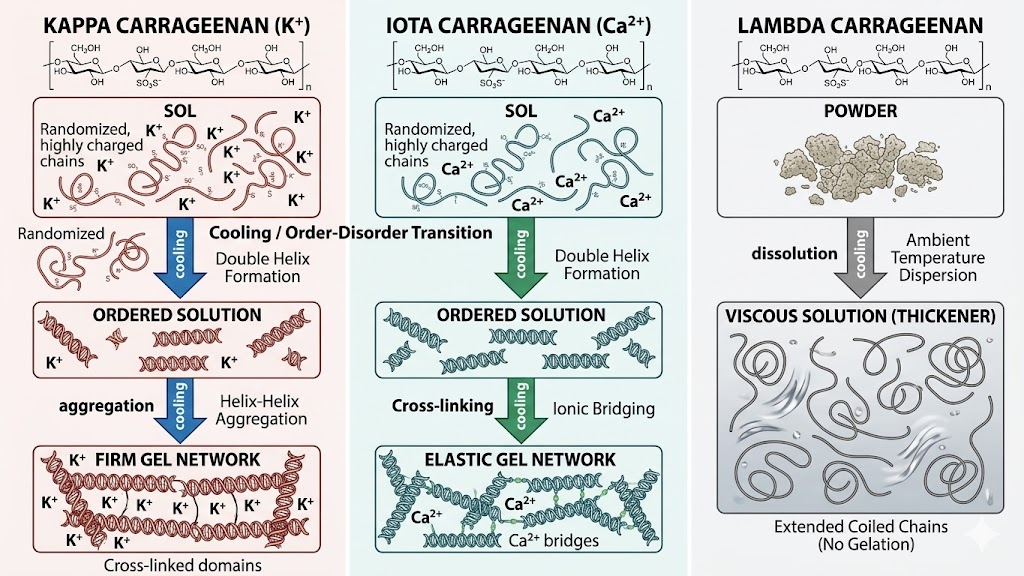
Gelation in carrageenan requires the formation of ordered double helices followed by their aggregation. Lambda-carrageenan possesses three ester sulfate groups per repeating unit, resulting in an extremely high negative charge density along its polymer backbone. Thermodynamically, the electrostatic repulsion between these highly charged chains is too intense to allow the random coils to transition into ordered double helices during cooling. Consequently, lambda-carrageenan remains as fully extended, highly hydrated macromolecular chains in solution, functioning purely as a non-gelling thickening polymer with excellent shear-thinning rheology.


Email: info@cagcolloids.com
Tel: 0086-19884908291 / 0086-573- 80890620
Website: www.cagcolloids.com
Address: No. 399, East Tongfu Road, Tongxiang City, Zhejiang Province. China.