


FAQs
Nature Refined, Quality Defined
Green Science for better living

Why do some low-acyl gellan gums fail to perform well in multi-layered jellies or artificial fruit pulp?
Currently, low-acyl gellan gum is widely used in transparent suspended beverages, artificial fruit pulp, high-end jellies, and other applications. However, we have found that not all factories' low-acyl gellan gums deliver satisfactory results in these areas. For example, some factories' low-acyl gellan gums may melt after high-temperature sterilization treatment, leading to the collapse of the edges of artificial fruit pulp and altering the product’s shape, which is unacceptable for the product. The reason for this lies in the different extraction methods used by different gellan gum factories, resulting in variations in the thermal stability of low-acyl gellan gum. If the thermal stability of the low-acyl gellan gum does not meet requirements, the situation shown in the figure below may occur.
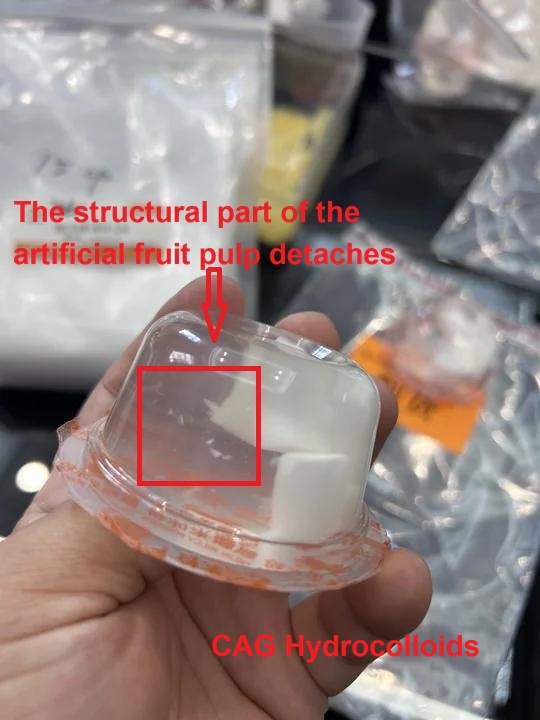
Fig. Bad heat stability of low acyl gellan gum causes pulp detaches from the water jelly or artificial fruit pulp.
If the factory employs sound processing techniques, the product’s thermal stability will meet standards, and the artificial fruit pulp produced can maintain its complete shape with neat and clear edges after high-temperature sterilization.
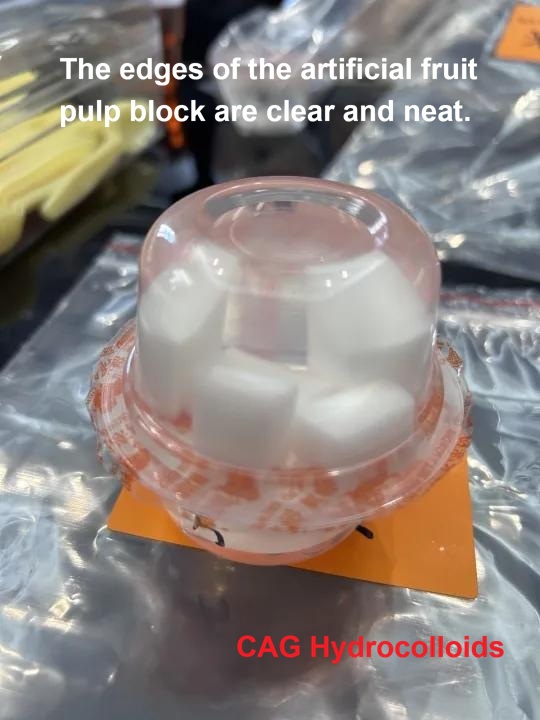
Fig. Good Heat stability of low acyl gellan gum keeps water jelly and artificial pulp keeps clear and neat
CAG Company conducts application tests on every batch of low-acyl gellan gum and has designed a thermal stability testing method for the product. This method has been communicated and aligned with many renowned jelly factories in China, and the test results are highly consistent with user feedback. Therefore, CAG Company can provide highly stable, high-quality low-acyl gellan gum products suitable for multi-layered jellies, and artificial fruit pulp.
For the best hydrocolloid solution tailored to your specific product, please feel free to contact our technical support team at info@cagcolloids.com.

Email: info@cagcolloids.com
Tel: 0086-19884908291 / 0086-573- 80890620
Website: www.cagcolloids.com
Address: No. 399, East Tongfu Road, Tongxiang City, Zhejiang Province. China.