


FAQs
Nature Refined, Quality Defined
Green Science for better living

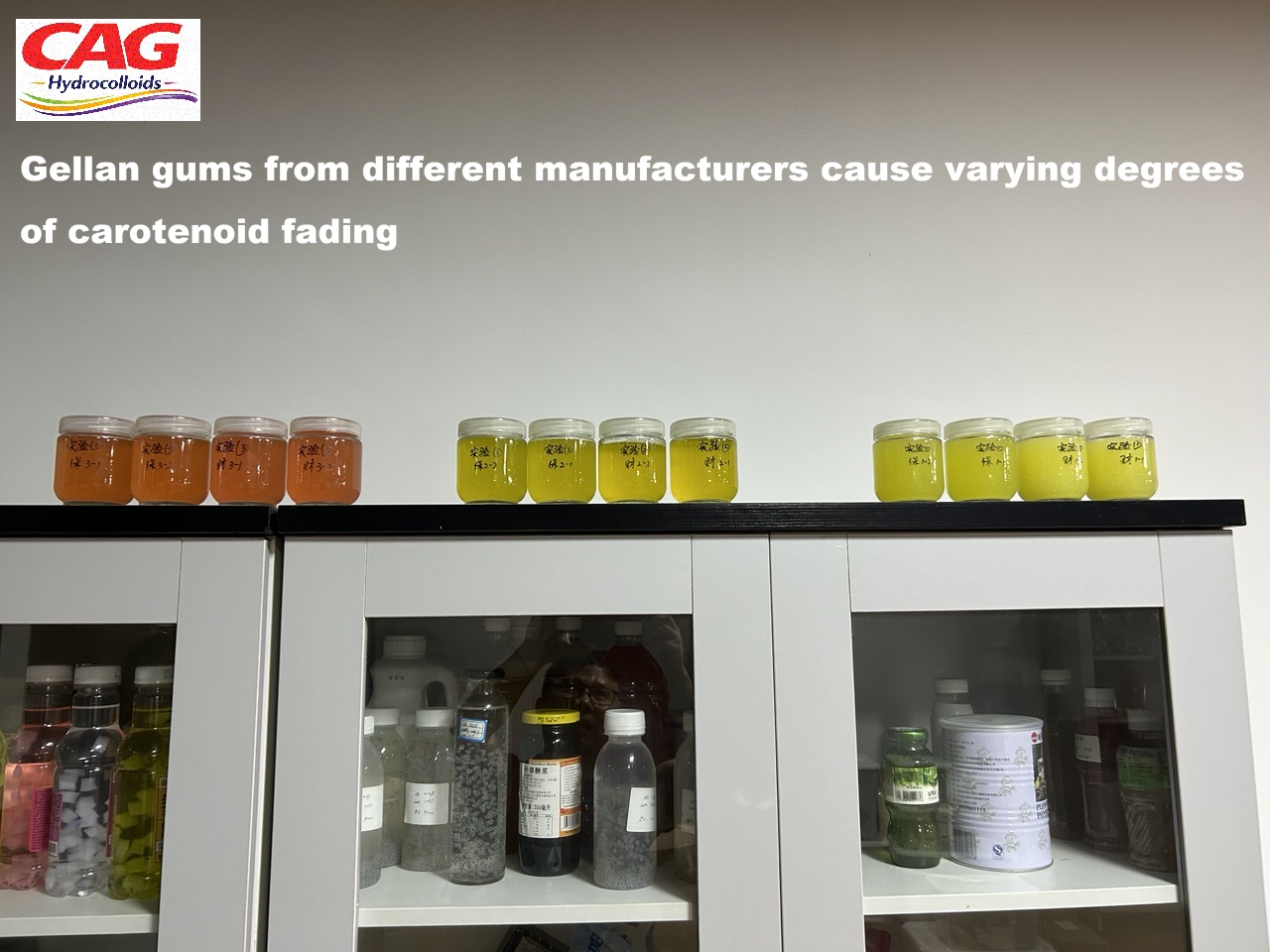
Why do gellan gums from different manufacturers cause varying degrees of carotenoid fading?
Core Reasons Analysis
The primary cause of carotenoid fading is oxidation. Differences in gellan gum from various manufacturers affect the oxidation rate in the following aspects:
1. Key Factors: Metal Ions and Impurities
Metal Ions: Ions such as iron (Fe) and copper (Cu) are strong pro-oxidants. If a manufacturer’s purification process is inadequate, excessive residues of these ions can significantly accelerate pigment oxidation.
Organic Impurities: By-products from fermentation may alter the system’s pH or redox environment, indirectly promoting fading.
2. Differences in Gel Structure
Even for the same type (high-acyl or low-acyl), gellan gums from different manufacturers vary in molecular weight distribution and substituent groups, leading to differences in the density and water-holding capacity of the formed gel network.
A denser, more uniform gel with better water retention can more effectively "lock in" and "isolate" pigment molecules, reducing their exposure to oxygen and thus delaying fading. Conversely, a loose, easily dehydrated gel makes pigments more susceptible to oxidation.
3. pH and Additives
pH Value: Carotenoids are highly unstable under alkaline conditions. Differences in the pH of products from different manufacturers can lead to varying fading rates.
Anti-Caking Agents: To prevent powder clumping, some manufacturers add anti-caking agents (e.g., phosphates). If these agents have chelating properties, they may help stabilize pigments; if used improperly, they may have the opposite effect.
Troubleshooting and Solutions
Identify the Problematic Raw Material:
Conduct a controlled variable experiment: Prepare samples using identical formulations and processes (same pH, ionic strength, heat treatment, cooling conditions, and pigment dosage), only changing the gellan gum supplier. Store the samples under identical conditions (e.g., accelerated testing at 40°C) and observe fading differences to scientifically confirm the source of the issue.
Request Key Data:
Ask suppliers for more detailed product specification sheets, focusing on:
Heavy Metal Content (especially iron and copper)
Ash Content
pH Value (at a specific concentration)
Gel Strength/Rheological Data
Process Optimization Directions:
Add Chelating Agents: Adding trace amounts of EDTA disodium or sodium citrate to the formulation is the most direct and effective solution, as it chelates pro-oxidative metal ions and protects pigments.
Control System pH: Ensure the final product’s pH remains in the neutral to slightly acidic range (e.g., pH 6.0–7.0).
Use Antioxidants: Consider combining Vitamin C (ascorbic acid) or Vitamin E (tocopherol).
Optimize Packaging: Use light-blocking, oxygen-barrier packaging materials as a fundamental external protective measure.
Conclusion: This issue is essentially driven by "impurities" and "micro-environmental differences". It is recommended to first identify the problematic raw material through comparative experiments, then address it by communicating key technical indicators with suppliers and adding chelating agents to your formulation in a dual approach.


Email: info@cagcolloids.com
Tel: 0086-19884908291 / 0086-573- 80890620
Website: www.cagcolloids.com
Address: No. 399, East Tongfu Road, Tongxiang City, Zhejiang Province. China.