

FAQs
Nature Refined, Quality Defined
Green Science for better living

Where Does the Carrageenan Safety Controversy Come From? What Is the Fundamental Difference Between Food-Grade Carrageenan and Degraded Carrageenan (Poligeenan)?
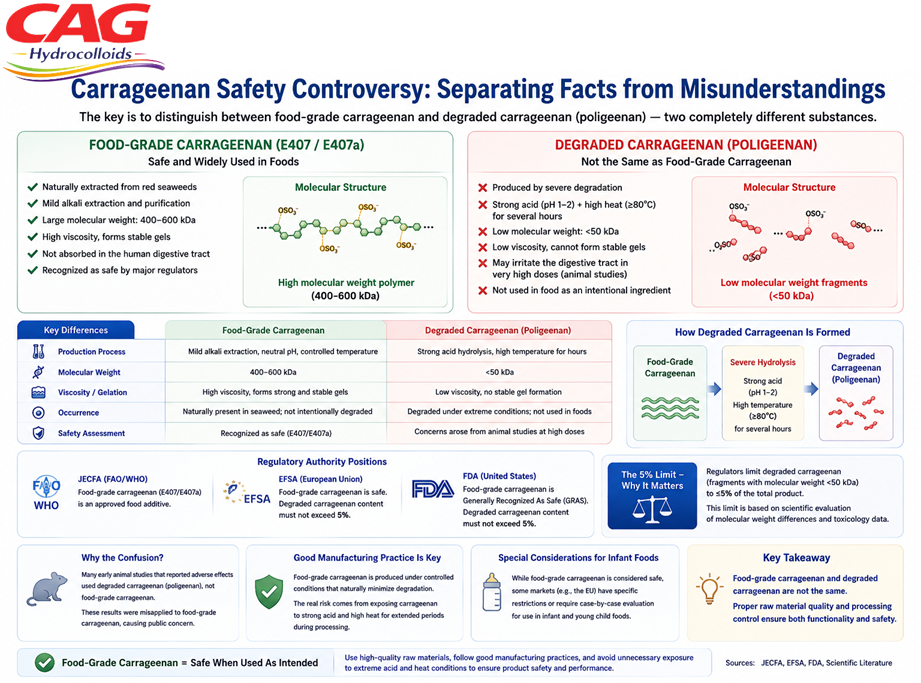
Carrageenan is one of the most controversial hydrocolloids in the food industry from a public perception standpoint. However, much of the debate stems from a fundamental misunderstanding between two completely different substances: food-grade carrageenan and degraded carrageenan (poligeenan). Understanding this distinction is essential for accurately evaluating carrageenan safety.
Degraded carrageenan, known scientifically as poligeenan, is produced by subjecting natural carrageenan to strong acidic conditions (pH 1–2) and elevated temperatures (above 80°C) for several hours. This treatment breaks down the polymer chains into low-molecular-weight fragments, typically below 50 kDa, which is substantially lower than the molecular weight of food-grade carrageenan, generally ranging from 400–600 kDa.
Most of the early animal studies that raised safety concerns about carrageenan actually used poligeenan, not food-grade carrageenan. At high doses, poligeenan has been shown to cause intestinal irritation in experimental animals. Unfortunately, some researchers and media reports incorrectly extrapolated these findings to food-grade carrageenan, creating decades of confusion and public concern.
Major international regulatory authorities continue to recognize the safety of food-grade carrageenan:
All of these organizations maintain the approval of food-grade carrageenan (E407 and E407a) for food use.
However, they also require that the content of degraded carrageenan (poligeenan) remain below specified limits. In practice, this is commonly controlled by limiting the proportion of low-molecular-weight fractions (typically fragments below 50 kDa) within food-grade carrageenan products.
The rationale behind these limits is directly related to the significant molecular-weight differences between food-grade carrageenan and poligeenan and the different biological properties associated with those molecular structures.
The manufacturing process for food-grade carrageenan is specifically designed to minimize degradation.
Typical production involves:
As a result, food-grade carrageenan naturally contains only very small amounts of degraded material.
The most important quality-control consideration is preventing carrageenan from being exposed to high temperatures under strongly acidic conditions for extended periods, as these conditions can promote molecular degradation. This is also why proper process control is critical not only for maintaining product functionality but also for preserving safety margins.
Good manufacturing practices serve two purposes simultaneously:
In other words, proper process control protects both product quality and product safety.
Although food-grade carrageenan is generally recognized as safe for conventional food applications, some jurisdictions impose additional restrictions for infant and young-child nutrition products.
For example:
Therefore, infant nutrition products should always be evaluated independently and should not automatically follow the regulatory framework applicable to standard food products.
The carrageenan safety controversy largely originates from confusion between food-grade carrageenan and degraded carrageenan (poligeenan).
These are not the same material:
| Property | Food-Grade Carrageenan | Poligeenan (Degraded Carrageenan) |
|---|---|---|
| Molecular Weight | Typically 400–600 kDa | Typically <50 kDa |
| Production Method | Controlled alkaline extraction | Strong acid hydrolysis and heat treatment |
| Food Use | Approved food additive (E407/E407a) | Not approved as a food additive |
| Safety Assessment | Recognized as safe by major regulators | Associated with adverse effects in high-dose animal studies |
| Functional Performance | Excellent gelling and stabilization | Poor functional properties |
Understanding this distinction is essential for interpreting the scientific literature, evaluating regulatory positions, and making informed decisions about carrageenan use in food applications. Proper raw-material selection and process control remain the most effective ways to ensure both functionality and safety.


Email: info@cagcolloids.com
Tel: 0086-19884908291 / 0086-573- 80890620
Website: www.cagcolloids.com
Address: No. 399, East Tongfu Road, Tongxiang City, Zhejiang Province. China.