

FAQs
Nature Refined, Quality Defined
Green Science for better living

When Kappa II carrageenan is used as a gelling agent in pet food cans and wet food, what are the degradation mechanisms caused by retort sterilisation
The commercial sterilisation process used for wet pet food (121°C / 30–45 min) is among the most severe thermal treatments that carrageenan encounters in any food application. Degradation proceeds through two independent but synergistic pathways:
① Acid-catalysed hydrolysis (pH-dependent). Canned pet food typically contains meat proteins (which release organic acids, bringing pH to approximately 5.8–6.5) and added phosphates (which can further depress pH). Below pH 6.0, 121°C sustained for more than 20 minutes significantly accelerates glycosidic bond hydrolysis in κ-carrageenan, reducing molecular weight and causing gel strength losses of 25–45%.
② High-temperature helix dissociation + competing metal ions. During sterilisation the double helices fully unwind at 121°C, then re-aggregate on cooling. If excess Na⁺ is present (from added salt, typically 0.5–1.5%), it competes with K⁺ for sulphate binding sites, suppressing helix bundle re-assembly and reducing the strength of the reconstituted gel well below the pre-sterilisation level.
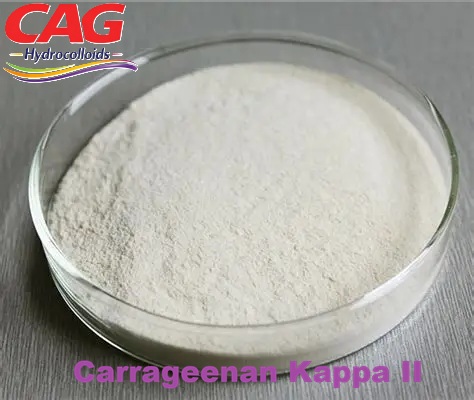
Fig. Carrageenan Kappa II
Systematic compensation strategies:
① Increase KappaII dosage by 20–30% to buffer hydrolytic loss. Factor the expected hydrolysis loss into the formulation design. If the target finished-product gel strength is 400 g/cm², design the pre-fill solution to reach 520–550 g/cm².
② pH control. Maintain system pH at 6.5 or above (via potassium bicarbonate or monopotassium phosphate adjustment) to reduce the hydrolysis rate by approximately 50%.
③ K⁺/Na⁺ ratio management. When NaCl is present, simultaneously add an equimolar quantity of KCl (~0.1–0.2%) to compensate and maintain sufficient K⁺ drive for helix re-assembly on cooling.
④ Co-formulate with locust bean gum (LBG). LBG galactomannan forms an interpenetrating network (IPN) with κ-carrageenan. Even if κ-carrageenan helices partially depolymerise during sterilisation, the LBG scaffold maintains partial gel integrity and accelerates network reconstruction on cooling. Recommended ratio: κ-II:LBG = 2:1 to 3:1.
| High-risk formulation profile | pH <6.0 + NaCl >1.0% + sterilisation >35 min — when all three are present, gel-strength loss can exceed 50% |
| Validation method | Mini-can simulation test: seal carrageenan solution in 50 mL cans, retort at 121°C for 40 min, cool and rest 24 h, then measure gel strength vs. unsterilised control |


Email: info@cagcolloids.com
Tel: 0086-19884908291 / 0086-573- 80890620
Website: www.cagcolloids.com
Address: No. 399, East Tongfu Road, Tongxiang City, Zhejiang Province. China.