What is the typical bulk density of Gellan Gum, and how can it be adjusted during the production process?
The bulk density (tapped density) of Gellan Gum varies significantly depending on its chemical type (Acyl content) and the specific dehydration/precipitation parameters used during extraction.
1. Typical Bulk Density Values
Based on industrial testing and standard grades:
Low-Acyl (LA) Gellan Gum: Generally ranges from 0.65 to 0.68 g/cm³. LA gellan forms a more compact, crystalline-like powder structure.
High-Acyl (HA) Gellan Gum: Generally ranges from 0.50 to 0.60 g/cm³. The presence of acetyl and glyceryl groups creates more spatial hindrance, leading to a "fluffier" or less dense powder.
2. The Impact of Extraction Strategy (Alcohol Concentration)
The bulk density is highly sensitive to the Alcohol Precipitation stage:
High Alcohol Concentration: When using high-purity ethanol/isopropanol for precipitation, the gellan gum dehydrates rapidly. This "flash" dehydration traps more air within the fibrous structure, resulting in a lower bulk density (a lighter, high-volume powder).
Low Alcohol/High Water Concentration: If the alcohol concentration is slightly lower (increased water content), the polymer chains have more time to relax and align before fully hardening. This results in a more compact particle and a higher bulk density.
3. Technical Optimization: The "Pre-Drying Spray" Method
If a manufacturer needs to increase the bulk density (to reduce packaging volume or improve flowability), a common process adjustment is used:
Process: Just before the final drying stage, a controlled amount of water is sprayed into the alcohol-saturated cake.
Mechanism: This slightly reduces the local ethanol concentration, causing the "swollen" fibers to partially collapse and contract.
Result: The final dried granules become smaller and more solid, effectively raising the density of the finished powder.
4. Application to Other Hydrocolloids (Pectin)
This density-adjustment technique is not limited to Gellan Gum. In Pectin production, the same principle applies. By adjusting the alcohol-to-water ratio during the washing or pressing stage, manufacturers can fine-tune the bulk density of pectin to meet specific customer requirements for dissolution speed and storage efficiency.
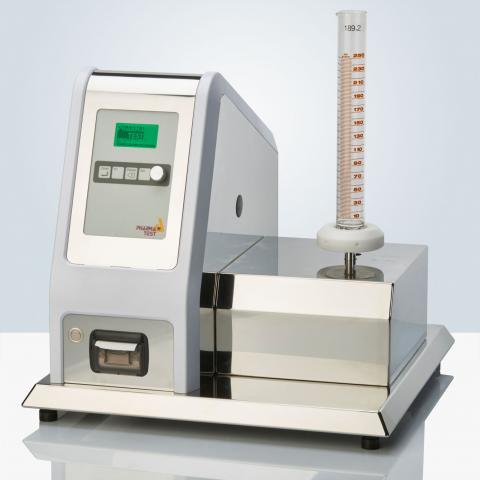
The instrument for bulk density testing
Technical Summary Table
|
Material
|
Typical Bulk Density
|
Impact of High Alcohol
|
How to Increase Density
|
|
LA Gellan
|
0.65 – 0.68 g/cm³
|
Becomes lighter/fluffier
|
Spray water before drying
|
|
HA Gellan
|
0.50 – 0.60 g/cm³
|
Significant volume increase
|
Spray water before drying
|
|
Pectin
|
Varies by grade
|
Lower density
|
Adjust solvent ratio
|