

FAQs
Nature Refined, Quality Defined
Green Science for better living

What is the root cause of carrageenan precipitation and gel failure in low-pH acidic beverages
Low-pH carrageenan failure is the most frequently reported technical complaint in acidic beverage formulation. The root cause involves two independent but mutually aggravating mechanisms:
Mechanism 1 — Acid-catalysed sulphate ester hydrolysis leading to polysaccharide degradation. The C–O–S (sulphate ester) bonds in carrageenan break under acidic conditions, releasing sulphate groups and cleaving the polysaccharide chain into low-molecular-weight fragments that have completely lost their gelling and thickening functionality. The hydrolysis rate accelerates sharply as pH drops and temperature rises: at pH 4.0 + 90°C, κ-carrageenan can lose more than 50% of its gel activity within 30 minutes.
Mechanism 2 — Protein–carrageenan complex precipitation (specific to protein-containing acid systems). Below the isoelectric point of casein (approximately pH 4.6), casein acquires a net positive charge. In fermented milk beverages at pH 3.5–4.5, positively charged casein undergoes electrostatic flocculation with negatively charged carrageenan, forming the visible white floc that is the hallmark complaint. κ-carrageenan, having the lowest sulphate content and hence the lowest negative charge density, shows the least tendency to flocculate; λ-carrageenan, with the highest sulphate content, flocculates most severely.
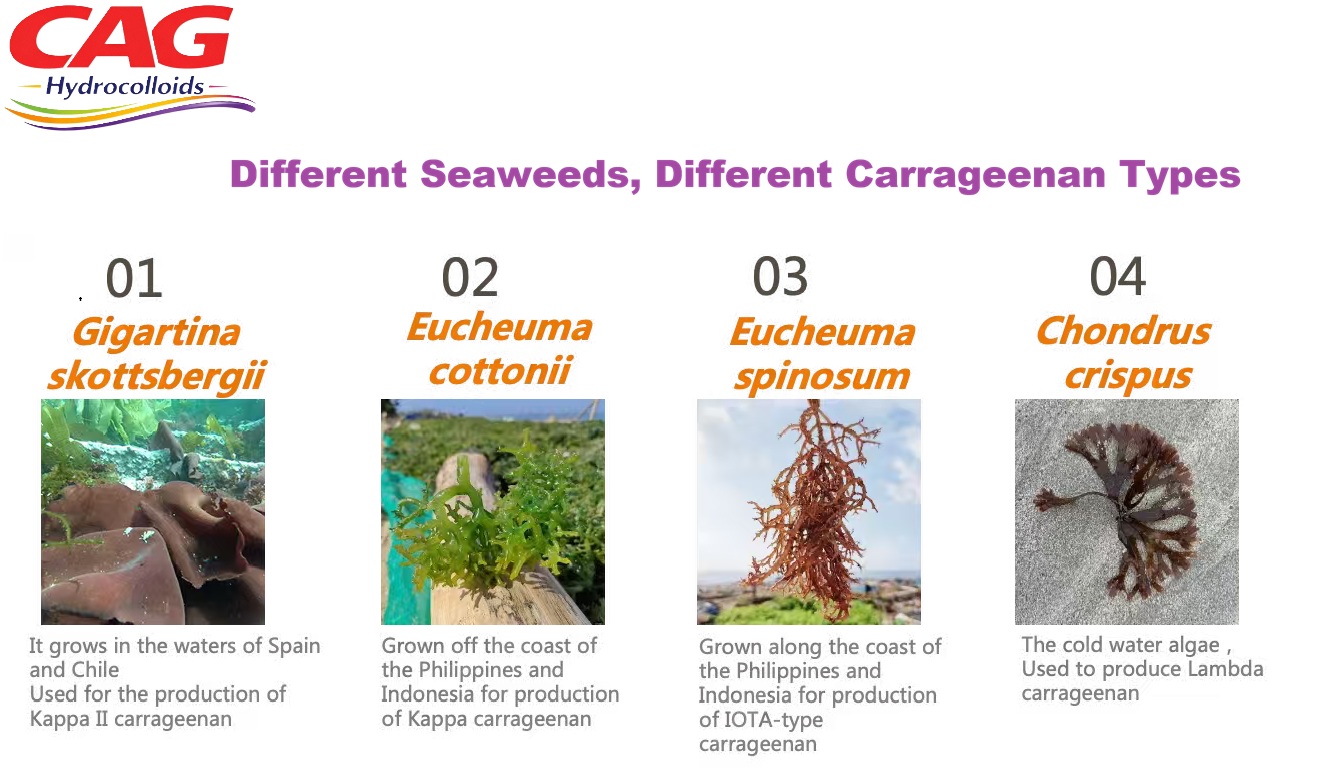
Acid resistance ranking, strongest to weakest:
Process solutions, ranked by effectiveness:
① Separate sterilisation process (optimal). Sterilise carrageenan separately in neutral water (pH 6.5–7.0); sterilise the acidic juice or yoghurt base separately; combine aseptically after both streams have cooled to target temperature. This decouples high-temperature exposure from low-pH exposure, minimising hydrolytic loss.
② Low-temperature short-time (LTST) pasteurisation + cold chain. Reduce sterilisation from 121°C to 85°C / 30 s (HTST), paired with refrigerated distribution. This reduces hydrolysis rate by more than 80% and supports a refrigerated shelf life of 3–6 months.
③ Replace or co-formulate with a more acid-stable hydrocolloid. For beverages at pH <3.8 (e.g., acidic carbonated juice), consider replacing carrageenan with high-methoxyl pectin (which is stable in acidic conditions), or use pectin as the primary stabiliser with carrageenan as a secondary component at <30% of total hydrocolloid usage.
In fermented milk beverages (pH 3.8–4.2) where carrageenan must be used, CAG Hydrocolloids recommends food-grade Kappa carrageenan at 0.02–0.04% (as a stabilisation aid only), in combination with 0.3–0.5% high-methoxyl pectin as the primary stabiliser. Please contact our technical team for a tailored formulation recommendation.


Email: info@cagcolloids.com
Tel: 0086-19884908291 / 0086-573- 80890620
Website: www.cagcolloids.com
Address: No. 399, East Tongfu Road, Tongxiang City, Zhejiang Province. China.