


FAQs
Nature Refined, Quality Defined
Green Science for better living

What is the mechanistic basis of hyperhydricity (vitrification) in micropropagated plantlets
Hyperhydricity (formerly called vitrification) is one of the highest-loss quality problems in commercial micropropagation; incidence rates exceeding 20% have been recorded in orchids, carnations and chrysanthemums. The underlying pathology is uncontrolled water accumulation within plant cells, resulting in waterlogged intercellular spaces, disrupted chloroplast ultrastructure and absent epicuticular wax layers — giving plantlets a glassy, water-soaked appearance.
Mechanistic basis (multi-factor convergence):
The root cause is loss of turgor regulation — when three factors converge: medium water potential too high (excessive free water supply), vessel relative humidity near 100% (inadequate gas exchange), and excessive cytokinin (BA or TDZ) concentration. Under these combined conditions, cells actively over-accumulate water beyond their capacity to regulate.
Intervention strategies — from agar to environment:
① Increase agar concentration (primary intervention): Raise from the standard 6–7 g/L to 8–9 g/L. This shifts medium water potential from approximately −0.05 MPa to −0.10 MPa, significantly slowing free water uptake by the explant. Effects can be evaluated within 1–2 subculture cycles.
② Add osmotic regulators: Supplementing the medium with sorbitol (2–4%) or mannitol (2–3%) further reduces water potential and acts synergistically with higher agar concentration. Monitor for growth suppression at excessive osmotic pressure.
③ Improve gas exchange: Replace solid lids with gas-permeable membrane closures (e.g., Milliseal film) or increase ventilation cycle frequency. This can reduce vessel relative humidity from 99% to 85–90%, directly improving epicuticular wax development on leaf surfaces.
④ Reduce cytokinin dosage: Decrease BA concentration by 30–50%, or substitute high-dose BA with low-dose TDZ (0.01–0.05 mg/L). For severely hyperhydric batches, withdrawing cytokinins entirely for 1–2 subculture cycles has been reported to restore normal morphology.
⑤ Supplement calcium nitrate: Calcium ions reinforce pectin structures in cell walls, reducing intercellular water leakage. Supplementing MS with an additional 1–3 mM CaCl₂ has reported efficacy in the literature.
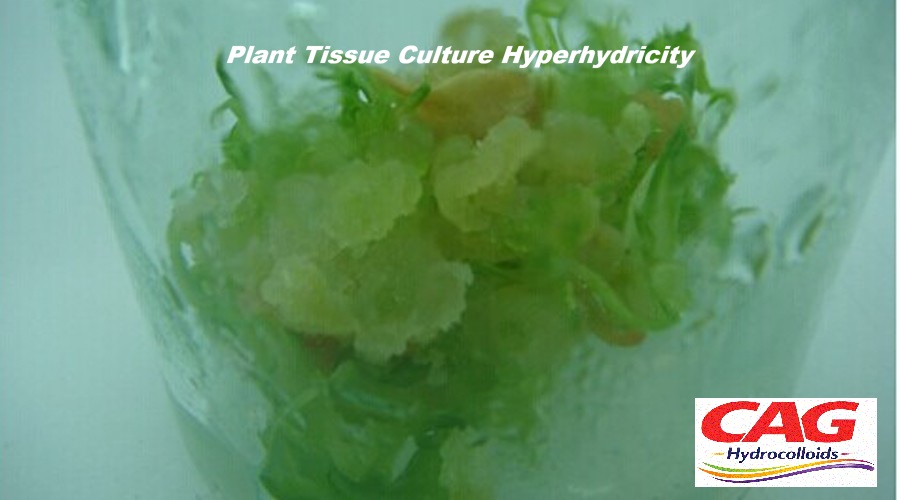
Fig. Plant tissue culture Hyperhydricity


Email: info@cagcolloids.com
Tel: 0086-19884908291 / 0086-573- 80890620
Website: www.cagcolloids.com
Address: No. 399, East Tongfu Road, Tongxiang City, Zhejiang Province. China.