

FAQs
Nature Refined, Quality Defined
Green Science for better living

What is the gel-strength modulation mechanism of Kappa carrageenan in fruit jellies and plant-based hydrogel products
The gel network of kappa (κ) carrageenan is built from aggregated double helices, and potassium ions (K⁺) act as a "directional amplifier" in this process. The ionic radius of K⁺ (1.38 Å) matches almost perfectly the geometric cavity formed by the sulphate groups on adjacent κ-carrageenan double helices. K⁺ inserts into this cavity, shields inter-chain electrostatic repulsion, and drives helix bundles to aggregate into stable junction zones. This geometric specificity is unique to the kappa system — Na⁺ (1.02 Å) is too small and Cs⁺ (1.67 Å) too large; both promote gelation far less efficiently.
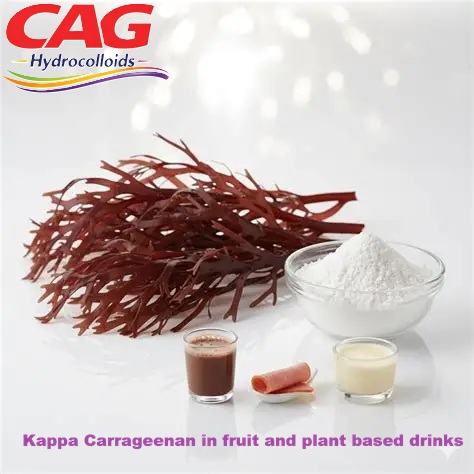
FIg. Kappa Carrageenan in fruit and plant based drinks
How K⁺ concentration controls texture (reference system: 1.5% κ-carrageenan aqueous solution):
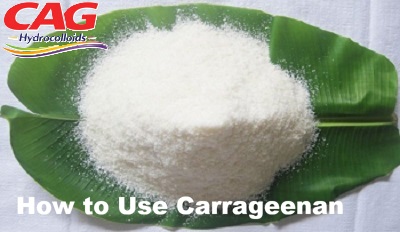
Fig. Carrageenan Powder
In practical fruit jelly formulations, potassium citrate is the preferred acidulant because it simultaneously lowers pH to 3.5–4.2 and introduces K⁺ — a dual benefit in a single ingredient. Formulators must note: if KCl and citric acid (which contains no K⁺) are used separately, total K⁺ must be calculated explicitly. In plant-based hydrogel products (e.g., vegan dietary supplement gummies), the combination of 0.8–1.2% κ-carrageenan + 0.05–0.1% KCl has been demonstrated to closely replicate gelatin mouthfeel without any animal-derived ingredients.
CAG Hydrocolloids food-grade Kappa carrageenan achieves gel strength ≥1,000 g/cm² in a standard K⁺ system (1.5% solution, 0.2% KCl, 20°C, Nikan method), with batch-to-batch CV <6% — suitable for locking in formulations on industrial jelly production lines.

Email: info@cagcolloids.com
Tel: 0086-19884908291 / 0086-573- 80890620
Website: www.cagcolloids.com
Address: No. 399, East Tongfu Road, Tongxiang City, Zhejiang Province. China.