


FAQs
Nature Refined, Quality Defined
Green Science for better living

What is the FCC standard for Gellan Gum?
Gellan Gum
INS: 418 CAS: [71010-52-1]
DESCRIPTION
Gellan Gum occurs as an off white powder. It is a highmolecular-weight polysaccharide gum produced by fermentationof a carbohydrate with a pure culture of Pseudomonas elodea, purified by recovery with isopropyl alcohol, dried, and milled. It is a heteropolysaccharide comprising a tetrasaccharide repeating unit of one rhamnose, one glucuronic acid, and two glucose units. The glucuronic acid is neutralized to mixed potassium, sodium, calcium, and magnesium salts. It may contain acyl (glyceryl and acetyl) groups as the O-glycosidically linked esters. It is soluble in hot or cold deionized water.
Function Stabilizer; thickener.
REQUIREMENTS
Identification
A. Prepare a 1% solution by dissolving 1 g of sample in 99 mL of deionized water. Using a motorized stirrer and a propeller-type stirring blade, stir the mixture for about 2 h.(Save part of this solution for Identification Test B). Draw a small amount of the solution into a wide-bore pipet, and transfer it into a solution of 10% calcium chloride. A tough, wormlike gel forms instantly.
B. Add 0.5 g of sodium chloride to the 1% deionized water solution prepared for Identification Test A, heat the solution to 80°, stirring constantly, and hold the temperature at 80° for 1 min. Stop heating and stirring the solution, and allow it to cool to room temperature. A firm gel forms.
Assay A sample yields not less than 3.3% and not more than 6.8% of carbon dioxide (CO2), calculated on the dried basis.Isopropyl Alcohol Not more than 0.075%.
Lead Not more than 2 mg/kg.
Loss on Drying Not more than 15.0%.
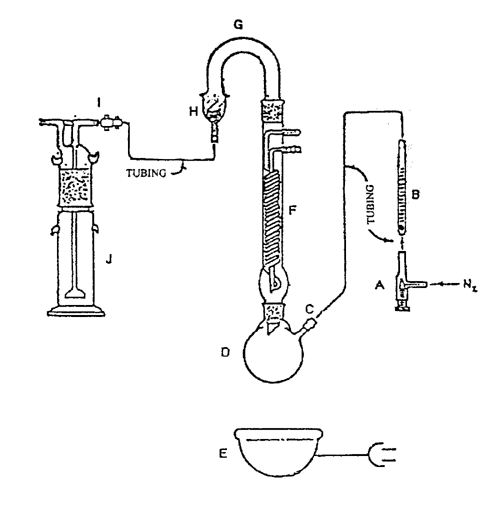
Assay determine method
TESTS
Assay Determine as directed under Alginates Assay, Appendix IIIC, but use about 1.2 g of undried sample, accurately weighed.
Isopropyl Alcohol
IPA Standard Solution Transfer 500.0 mg of chromatographic-quality isopropyl alcohol into a 50-mL volumetric flask, dilute to volume with water, and mix. Pipet 10 mL of this solution into a 100-mL volumetric flask, dilute to volume with water, and mix.
TBA Standard Solution Transfer 500.0 mg of chromatographic-quality tert-butyl alcohol into a 50-mL volumetric flask, dilute to volume with water, and mix. Pipet 10 mL of this solution into a 100-mL volumetric flask, dilute to volume with water, and mix.
Mixed Standard Solution Pipet 4 mL each of the IPA Standard Solution and of the TBA Standard Solution into a 125-mL, graduated Erlenmeyer flask, dilute to about 100 mL with water, and mix. This solution contains approximately 40 g each of isopropyl alcohol and of tert-butyl alcohol per
milliliter.
Sample Preparation Disperse 1 mL of a suitable antifoam emulsion, such as Dow-Corning G-10, or equivalent, in 200mL of water contained in a 1000-mL 24/40 round-bottom distilling flask. Add about 5 g of sample, accurately weighed, 192 / Geranium Oil, Algerian Type / Monographs FCC V and shake for 1 h ona wrist-action mechanical shaker. Connect the flask to a fractionating column, and distill about 100 mL, adjusting the heat so that foam does not enter the column.
Add 4.0 mL of TBA Standard Solution to the distillate to obtain the Sample Preparation.
Procedure (See Chromatoghaphy, Appendix IIA.) Inject about 5 _L of the Mixed Standard Solution into a suitable gas chromatograph equipped with a flame-ionization detector and a 1.8-m × 3.2-mm stainless steel column, or equivalent, packed with 80- to 100-mesh Porapak QS, or equivalent.
Maintain the column at 165°. Set the temperature of both the injection port and the detector to 200°. Use helium as the carrier gas, flowing at 80 mL/min. The retention time of isopropyl alcohol is about 2 min, and that of tert-butyl alcohol is about 3 min. Determine the areas of the IPA and TBA peaks, and calculate the response factor, f, by the formula AIPA/ATBA,
in which AIPA is the area of the isopropyl alcohol peak, and ATBA is the area of the tert-butyl alcohol peak. Similarly, inject about 5 _L of the Sample Preparation, and determine the peak areas, recording the area of the isopropyl alcohol peak as SIPA, and that of the tert-butyl alcohol peak as STBA. Calculate the isopropyl alcohol content, in milligrams per kilogram, in the sample taken by the formula
(SIPA × 4000)/(f × STBA × W),
in which W is the weight, in grams, of the sample taken.
Lead Determine as directed under Lead Limit Test, Appendix IIIB, using a Sample Solution prepared as directed for organic compounds, using 2 g of sample, and 4 _g of lead (Pb) ion in the control.
Loss on Drying Determine as directed under Loss on Drying,
Appendix IIC, drying a sample at 105° for 2.5 h.
Packaging and Storage Store in well-closed containers.

Email: info@cagcolloids.com
Tel: 0086-19884908291 / 0086-573- 80890620
Website: www.cagcolloids.com
Address: No. 399, East Tongfu Road, Tongxiang City, Zhejiang Province. China.