


FAQs
Nature Refined, Quality Defined
Green Science for better living

What is the effect of the chelating agent (sodium citrate) on the solubility of low-acyl gellan gum?
Inference of the x-axis and y-axis meanings:
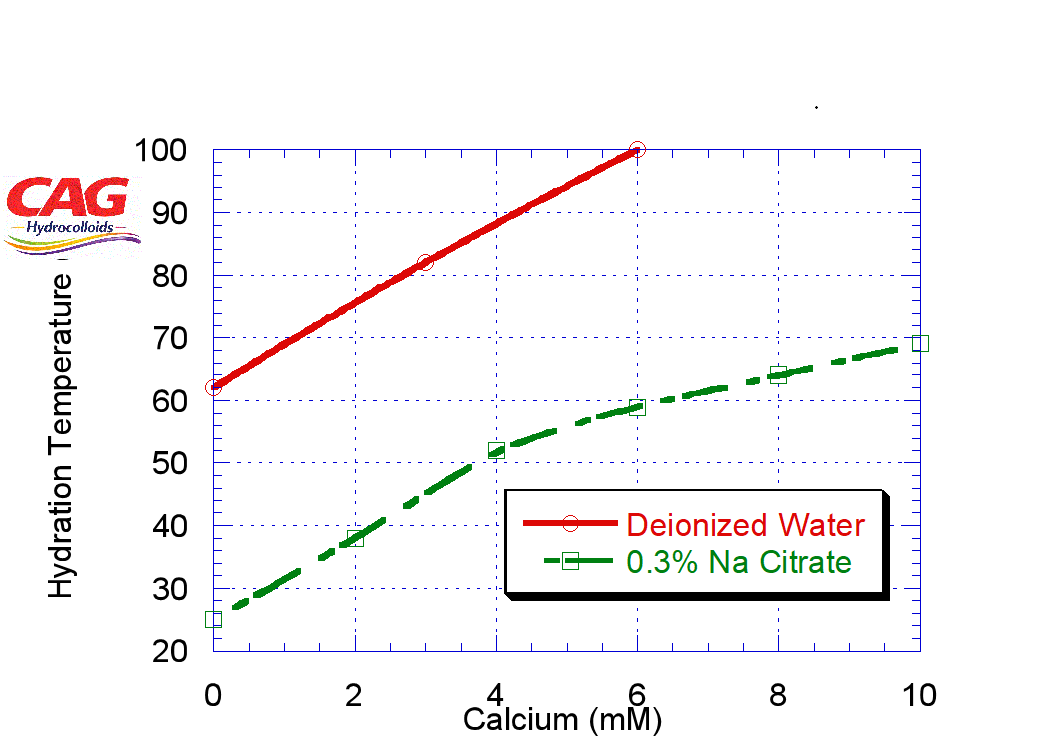
Although the axes in the figure are not explicitly labeled, in studies on the solubility of low-acyl gellan gum, the x-axis typically represents time, while the y-axis represents viscosity (in units such as mPa·s) or the degree of hydration. The upward trend of the curve indicates the dispersion and hydration process of the colloid in water.
Red curve (Deionized Water):
Performance: The steep slope indicates a very rapid increase in viscosity, especially during the initial stage.
Reason: In deionized water, low-acyl gellan gum is free from interference by divalent cations (such as Ca²⁺ and Mg²⁺), allowing its molecular chains to rapidly absorb water, expand, and quickly form a three-dimensional network structure. However, this rapid structure formation can sometimes lead to uneven dispersion or require higher initial energy in the process to disrupt instantaneous flocculation.
Process implication: Although hydration is fast, in the absence of a chelating agent, trace amounts of divalent ions in the water may inhibit complete dissolution or necessitate higher temperatures (typically >75°C) to ensure complete hydration.
Green dashed line (0.3% Sodium Citrate):
Performance: The slope is relatively gentle, and the overall curve shows a stepped or segmented increase, ultimately reaching a high viscosity level.
Core mechanism: Sodium citrate is a strong chelating agent for divalent cations.
Mode of action:
Shielding interfering ions: Natural water sources or ingredients often contain trace amounts of Ca²⁺ and Mg²⁺. These ions can bind to low-acyl gellan gum, hindering hydration and even forming insoluble salts. Sodium citrate binds to these ions (forming stable complexes), "locking" them away and thereby eliminating hydration barriers.
Promoting cold-water dispersion: By eliminating ionic interference, low-acyl gellan gum can achieve slow and thorough hydration at lower temperatures (even at room temperature). The gentle upward curve in the figure reflects this "controlled hydration"—it allows the colloid to dissolve gradually during stirring rather than clumping instantly.
Enhancing clarity: The gel network formed after removing ionic interference is more uniform, typically resulting in products with higher clarity.

Email: info@cagcolloids.com
Tel: 0086-19884908291 / 0086-573- 80890620
Website: www.cagcolloids.com
Address: No. 399, East Tongfu Road, Tongxiang City, Zhejiang Province. China.