


FAQs
Nature Refined, Quality Defined
Green Science for better living

What is the difference between kappa, iota, and lambda carrageenan?
The primary differences between kappa-, iota-, and lambda-carrageenan lie in their sulfate ester content and molecular structure, which directly determine their gelation properties, ion requirements, and typical applications.
Here is a summary of their key characteristics:
|
Feature |
Kappa-Carrageenan |
Iota-Carrageenan |
Lambda-Carrageenan |
|---|---|---|---|
|
Sulfate Ester Content |
Low (~25%) |
Medium (~30%) |
High (~35%) |
|
Gelation Ability |
Strong gelling |
Moderate gelling |
Non-gelling (thickening only) |
|
Gel Texture |
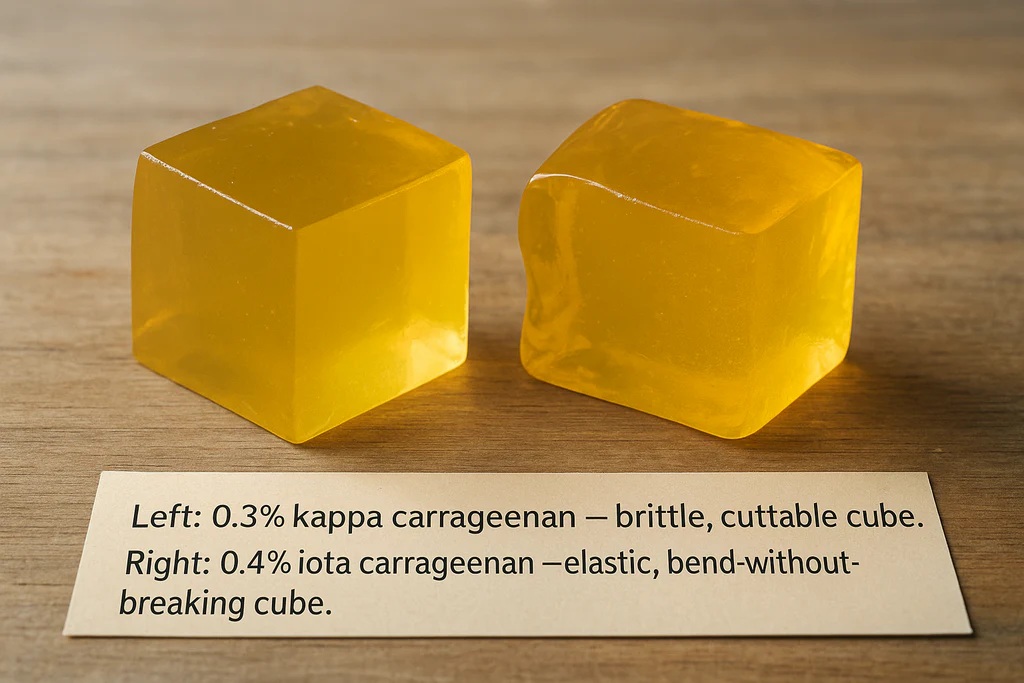
Hard, brittle, prone to syneresis (water separation) |
Soft, elastic, resistant to syneresis |
Not applicable |
|
Key Ion Required |
Potassium ions |
Calcium ions |
None (ion-insensitive) |
|
Clarity |
Slightly opaque |
Relatively clear |
Clear |
|
Interaction with Proteins |
Strong interaction with casein (stabilizes dairy systems) |
Weak interaction |
No specific interaction |
|
Typical Applications |
Meat products (ham, sausages), firm jellies, cheese, pet food |
Yogurt, puddings, soft desserts, plant-based products |
Chocolate milk, sauces, ice cream (for thickening/suspension) |
|
Key Synergistic Blends |
Konjac gum (dramatically improves elasticity and reduces syneresis) |
Locust bean gum (improves texture) |
Often blended with kappa- or iota- to modify texture |
In summary:
For hard, brittle gels (e.g., meat products, firm jellies) → Choose kappa-carrageenan (with potassium ions).
For soft, elastic gels (e.g., yogurt, pudding) → Choose iota-carrageenan (with calcium ions).
For thickening and suspension without gelation (e.g., chocolate milk, sauces) → Choose lambda-carrageenan.
In industrial practice, commercial "carrageenan" is often a blend of these types (from different seaweeds or formulated) to achieve specific textures and processing properties. When selecting, clearly communicate your desired gel type and strength to your supplier
For the best hydrocolloid solution tailored to your specific product, please feel free to contact our technical support team at info@cagcolloids.com.
Email: info@cagcolloids.com
Tel: 0086-19884908291 / 0086-573- 80890620
Website: www.cagcolloids.com
Address: No. 399, East Tongfu Road, Tongxiang City, Zhejiang Province. China.