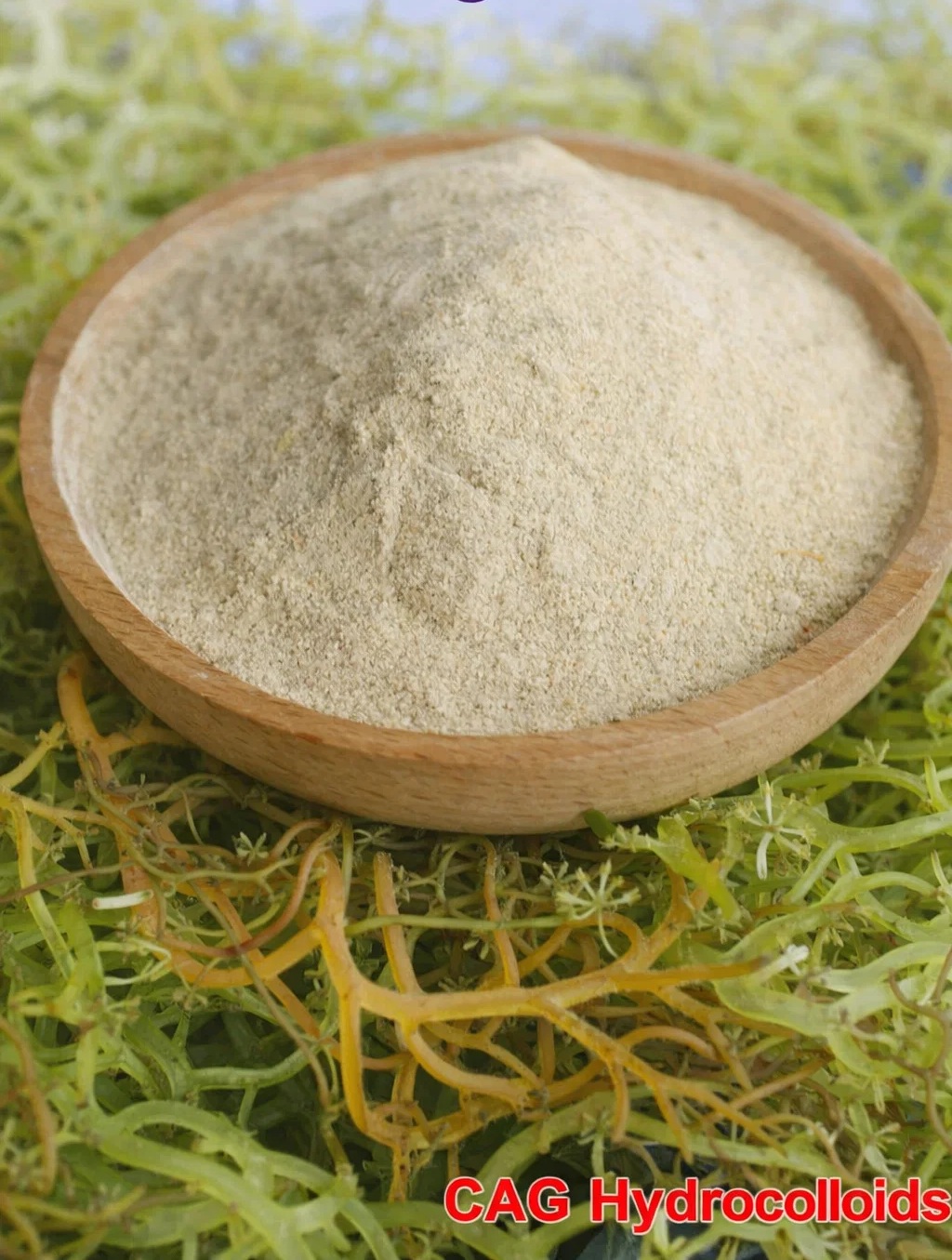
What is the Chinese national standard for Carrageenan products?
National Food Safety Standard of the People's Republic of China
GB 1886.169-2016
Food Additive — Carrageenan
Issued on: August 31, 2016
Implemented on: January 1, 2017
Issued by: National Health and Family Planning Commission of the People's Republic of China
(Note: The standard was revised according to Announcement No. 3 of 2021, effective from February 22, 2021.)
1. Scope
This standard applies to the food additive carrageenan, which is produced by extraction with water or alkali solution, and processing from raw materials of red algae (Rhodophyceae). The common polysaccharides in carrageenan are three basic types: Kappa (K), Iota (I), and Lambda (λ).
2. Technical Requirements
2.1 Sensory Requirements
Sensory requirements shall comply with the stipulations in Table 1.
Table 1 Sensory Requirements
Item Requirement Test Method
Color Off-white or pale yellow to brownish-yellow Place an appropriate amount of the sample on a clean,
dry white porcelain plate. Observe its color and state under natural light.
State Powder or granules
2.2 Physicochemical Indicators
Physicochemical indicators shall comply with the stipulations in Table 2.
Table 2 Physicochemical Indicators
Item Indicator Test Method
Sulfate (as SO₄), w/% 15 ~ 40 Appendix A.3
Viscosity / (Pa·s) ≥ 0.005 Appendix A.4
Loss on Drying, w/% ≤ 12.0 GB 5009.3, Direct Drying Method a
Total Ash, w/% 15 ~ 40 Appendix A.5
Acid-insoluble Ash, w/% ≤ 1 Appendix A.6
Acid-insoluble Matter, w/% ≤ 15 Appendix A.7
pH 8 ~ 11 Appendix A.8
Residual Solvents b (Isopropanol, Methanol), w/% ≤ 0.1 Appendix A.9
Lead (Pb) / (mg/kg) ≤ 5.0 GB 5009.75 or GB 5009.12
Arsenic (As) / (mg/kg) ≤ 3.0 GB 5009.76
Cadmium (Cd) / (mg/kg) ≤ 2.0 GB 5009.15
Mercury (Hg) / (mg/kg) ≤ 1.0 GB 5009.17
Note a: Drying temperature is 105°C, and time is 4 hours.
Note b: Applicable only to products extracted with isopropanol or methanol as solvents.
Annotation 1: Commercial carrageenan products should use carrageenan conforming to this standard as raw material. They may contain sugars for standardization purposes; salts such as potassium chloride (sodium chloride, calcium chloride), sodium citrate, sodium hexametaphosphate, calcium lactate for specific gelling or thickening effects; and thickeners or emulsifiers introduced during the drying process.
Annotation 2: Extraction solvents are ethanol, isopropanol, and/or methanol.
2.3 Microbiological Indicators
Microbiological indicators shall comply with the stipulations in Table 3.
Table 3 Microbiological Indicators
Item Indicator Test Method a
Aerobic Plate Count / (CFU/g) ≤ 5,000 GB 4789.2
Escherichia coli CFU/g < 100 GB 4789.38
MPN/g < 3.0
Salmonella Not detected in 1g GB 4789.4
Note a: Under aseptic conditions, weigh 1.0g of the sample, dissolve it in 100mL of phosphate buffer or saline solution to prepare a 1:100 dilution.
(Summary of Appendix A: Test Methods)
A.2 Identification Tests:
Solubility/Gel Formation (A.2.2.1): A 2% (w/v) aqueous solution heated to ~80°C forms a semi-transparent, viscous liquid that gels upon cooling.
Potassium Chloride Test (A.2.2.2): Adds KCl solution to the 2% solution, reheats, and cools. A brittle gel indicates Kappa (κ) type; a soft/elastic gel indicates Iota (ι) type; no gel indicates Lambda (λ) type.
Methylene Blue Test (A.2.2.3): A drop of methylene blue solution added to the 2% solution produces a fibrous precipitate.
Infrared Absorption Spectroscopy (A.2.2.4): Describes a method to separate gelling (κ- and ι-) and non-gelling (λ-) fractions using KCl solution and analyzes their IR spectra, which show a typical strong, broad polysaccharide band in the 1000 cm⁻¹ ~ 1100 cm⁻¹ range.
A.3 Determination of Sulfate (as SO₄)
A.4 Determination of Viscosity: Describes the method using a rotational viscometer (e.g., NDJ-1 type) to measure the viscosity of a 1.5% (w/w) aqueous solution at 75°C.
A.5 Determination of Total Ash
A.6 Determination of Acid-insoluble Ash
A.7 Determination of Acid-insoluble Matter
A.8 Determination of pH: A 1% (w/v) suspension in carbon dioxide-free water is tested according to GB/T 9724.
A.9 Determination of Residual Solvents (Isopropanol, Methanol): Describes a headspace gas chromatography (GC-FID) method using 3-methyl-2-pentanone as an internal standard.