


FAQs
Nature Refined, Quality Defined
Green Science for better living

What is the application Scenarios and Precautions for Pectin?
In-depth Raw Material Analysis
Source: Derived from the cell walls of fruits such as apple pomace and citrus peels.
Classification (Critically Important):
HM (High Methoxyl) Pectin: Requires high sugar content (>55%) + low pH (<3.5) to set. Used for traditional jams.
LM (Low Methoxyl) Pectin: Requires calcium ions (Ca²⁺) cross-linking to set. Suitable for low-sugar or sugar-free products, as well as mirror glazes.
Form: White to pale yellow powder with strong hygroscopicity (moisture absorption).
2. Detailed Application Scenarios & Ratios
French Confiture (Fruit Jam):
Type: HM Pectin.
Ratio: 0.3% - 0.5% of the fruit weight (must be combined with >60% sugar).
Characteristic: Forms elastic gel blocks after cooking, offering good spreadability.
Mirror Glaze:
Type: Specialized mirror pectin (usually modified pectin or a compound of LM pectin).
Ratio: Strictly follow the product instructions (typically around 1% - 1.5%).
Characteristic: Extremely high gloss; forms a thin film on the surface of mousse cakes without flowing excessively.
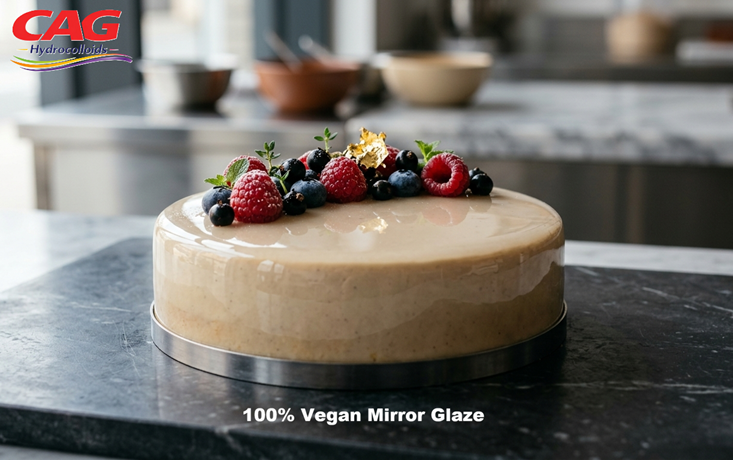
Mirror Glaze from vegan source
Fruit Gummies:
Type: LM Pectin + Calcium Chloride.
Ratio: 1.5% - 2% of the fruit juice volume.
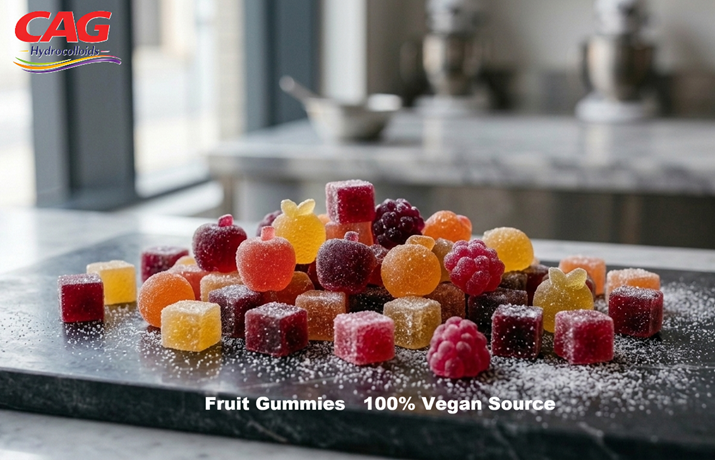
Fruit Gummies from 100% vegan source
3. Standard Operating Procedure (SOP) — Using Mirror Glaze as an Example
Step 1: Pre-mixing (Dry Mixing)
This is the most critical step. The pectin powder must be thoroughly mixed with 3-5 times its weight in fine sugar while dry. If not pre-mixed, the pectin will clump instantly upon contact with water and fail to dissolve properly.
Step 2: Dissolving
Pour the pre-mixed powder into hot water/juice at 80-90°C. Use a hand blender (e.g., Bamix) to blend at high speed to ensure there are no dry particles.
Step 3: Emulsifying
Add chocolate, food coloring, condensed milk, etc., and continue blending to emulsify and create a brilliant mirror effect.
Step 4: Maturing
The prepared glaze usually needs to be covered with plastic wrap directly on the surface (to prevent skin formation) and refrigerated overnight for optimal results.
4. Advanced Precautions
Calcium Activation: When using LM pectin to make gummies, you must first dissolve Calcium Chloride in a separate container (the "calcium bath"). The pectin mixture is then dropped into this solution to cause surface setting.
pH Control: HM pectin is highly sensitive to acidity. If the fruit itself is not acidic enough, lemon juice must be added to adjust the pH to between 3.0 and 3.5.
Storage: Pectin is extremely hygroscopic. Once opened, it must be sealed tightly and stored in the refrigerator; otherwise, it will lose its effectiveness.


Email: info@cagcolloids.com
Tel: 0086-19884908291 / 0086-573- 80890620
Website: www.cagcolloids.com
Address: No. 399, East Tongfu Road, Tongxiang City, Zhejiang Province. China.