


FAQs
Nature Refined, Quality Defined
Green Science for better living

What Is Kappa-2 Carrageenan, and How Does It Differ from Standard Kappa?
Kappa-2 (κ2) carrageenan is a naturally occurring hybrid polysaccharide sourced primarily from Gigartina-family red algae — notably Gigartina skottsbergii and Gigartina radula, harvested from the cold coastal waters off Chile and Peru. Its structure falls between that of standard kappa and iota carrageenan: it carries the characteristic C4-position sulfate ester of kappa, but also bears an additional ester sulfate group at the C2 position — a feature normally associated with iota. This seemingly small structural difference has outsized functional consequences.
| Type | Sulfate position | Water gel strength | Protein reactivity | Syneresis |
|---|---|---|---|---|
| Kappa (κ) | C4 monosulfate | High | Moderate (κ-casein specific) | High |
| Kappa-2 (κ2) | C4 + C2 disulfate | Moderate | High | Low |
| Iota (ι) | C4 + C2 disulfate (regular) | Soft/elastic | High (acid conditions) | Very low |
In practical terms, the C2 sulfate disrupts the regular double-helix stacking that makes standard kappa so effective at forming firm water gels. As a result, κ2 shows measurably lower water-phase gel strength. However, in dairy systems — where carrageenan interacts with the protein matrix rather than relying solely on polysaccharide-polysaccharide junctions — κ2's elevated sulfate content becomes an advantage. The additional anionic groups increase electrostatic affinity with positively charged amino acid residues on the surface of κ-casein micelles, generating a stronger and more stable protein-polysaccharide network.
The ester-2-sulfate level in Gigartina-sourced material typically ranges from around 15% in G. radula to 40–55% in G. skottsbergii. As this level rises, protein reactivity increases while water gel strength falls — a direct trade-off that defines how κ2 should be positioned within a formulation blend.
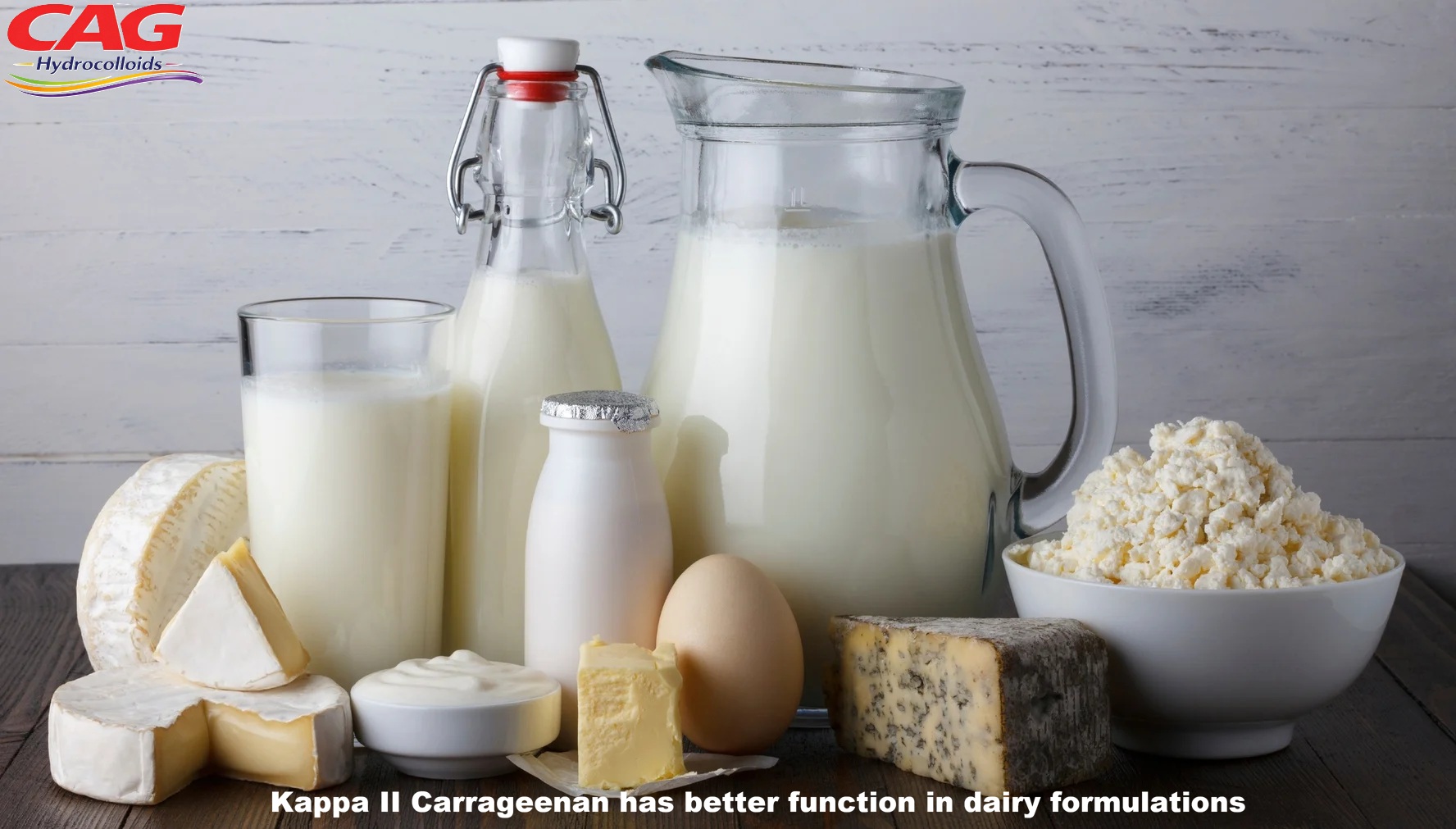
Kappa-2 carrageenan has no independent E-number; it is classified under E407 or E407a depending on whether it is refined or semi-refined. In commercial dairy blends, its presence is rarely declared explicitly on technical datasheets — it must be inferred from algal source, gel-strength profiles in milk versus water, and supplier documentation.


Email: info@cagcolloids.com
Tel: 0086-19884908291 / 0086-573- 80890620
Website: www.cagcolloids.com
Address: No. 399, East Tongfu Road, Tongxiang City, Zhejiang Province. China.