


FAQs
Nature Refined, Quality Defined
Green Science for better living

What Are the Key Factors for Successful Pectin Gummy Production?
I. Core Process Logic: A "Precision Dance" Against Time
The essence of pectin gummy production is a timed "countdown" process requiring precise control of pH, temperature, and time. The core scientific principle is that high-ester pectin can only form a gel under conditions of high soluble solids (≥75%) and an acidic environment (pH below 3.5), and once these conditions are met, gelation occurs very rapidly.
Therefore, the entire process design revolves around a central contradiction: the pectin and sugar must first be completely dissolved under neutral, high-temperature conditions. Then, at the very last moment before depositing, the system must be rapidly switched to an acidic environment, and all subsequent operations must be completed within the short window of 1-3 minutes before gelation begins. This is a "trigger-reaction" system where timing is everything.
II. Ingredient Selection: Success Starts at the Source
1. Pectin – The Soul of the Product
Type: Must use standard slow-set high-ester pectin. Fast-set types can easily lead to production out of control.
Brand & Specification: Pectins from different suppliers (e.g., CP Kelco, Herbstreith & Fox, Andre Pectin) can differ in practical gelation behavior, flavor release, and tolerance, even with similar nominal specs. Do not change suppliers lightly once selected.
Key Specifications:
Gel Strength: Determines final candy firmness. Must be matched with your cooking end point ( sugar solids).
Degree of Esterification (DE): Affects the required pH and speed of gelation.
Particle Size: Finer powder dissolves easier but is also more prone to lumping. Pretreatment is key.
2. Sugar System – The Textural Backbone
White Sugar: Provides sweetness and participates in the gel network. Use refined grade or above with low impurities to avoid off-flavors or graininess.
Glucose Syrup: Core functions are anti-crystallization, moisture retention, and adjustment of sweetness profile and gloss. The choice of DE value (Dextrose Equivalent) is critical:
DE 40-42: Most common, provides good viscosity, moistness, and a tender chew.
Higher DE values (e.g., 63 DE) increase sweetness and anti-crystallizing power but also increase hygroscopicity, potentially leading to softer, stickier candy. Using a consistent supplier and DE value is fundamental for batch-to-batch consistency.
3. Acid & Buffer – The System's "Accelerator and Brake"
Citric Acid: Most commonly used. Must be prepared as a 50% cold solution for use. Concentrated acid locally can cause "pre-gel" particles.
Sodium Citrate: This is not optional, it is essential. Added before the acid, it slightly raises the system pH, buffering the localized drastic change upon acid addition, buying precious, uniform buffer time for operation, and acts as a "safety valve" for smooth depositing.
4. Flavors & Colors – The Final Presentation of Flavor
Must select heat-resistant and acid-resistant types. The acidic environment and high temperature can break down many flavor compounds.
Water-soluble flavors are mainstream. The addition timing must be after cooling but before acid addition. Adding too early causes aroma loss through volatilization.
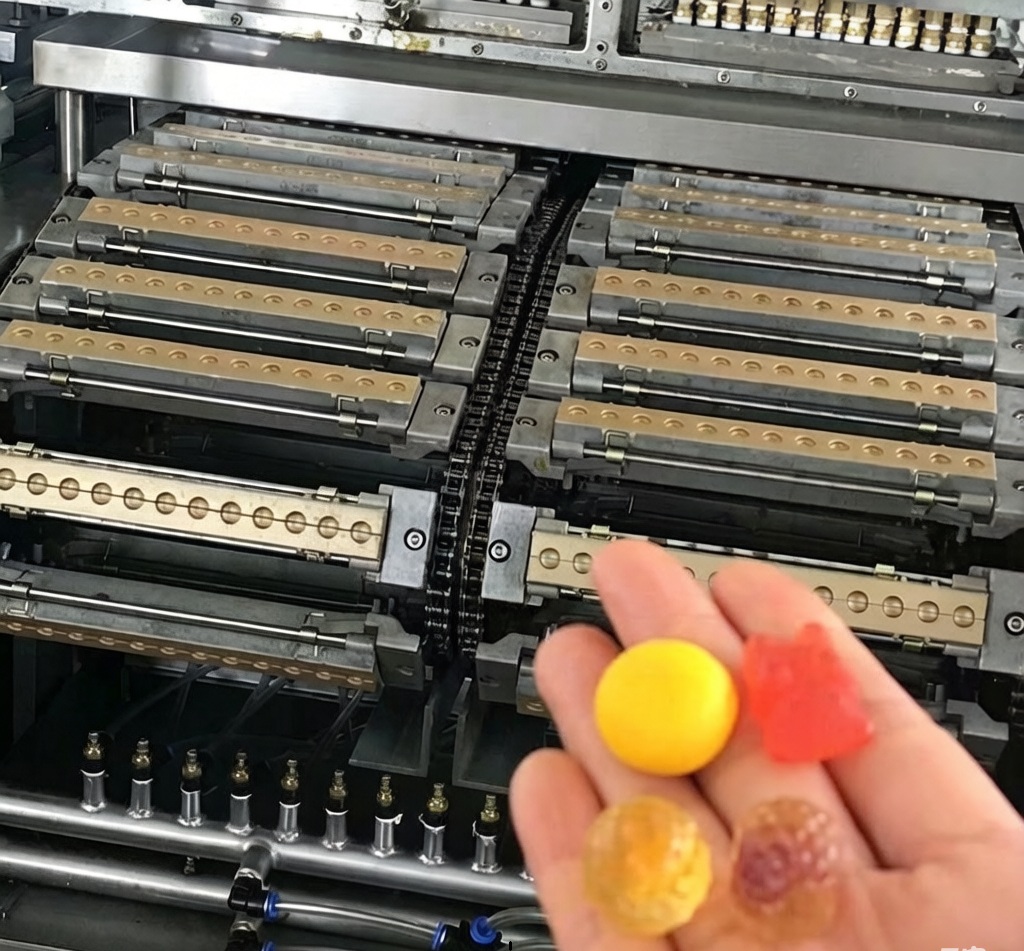
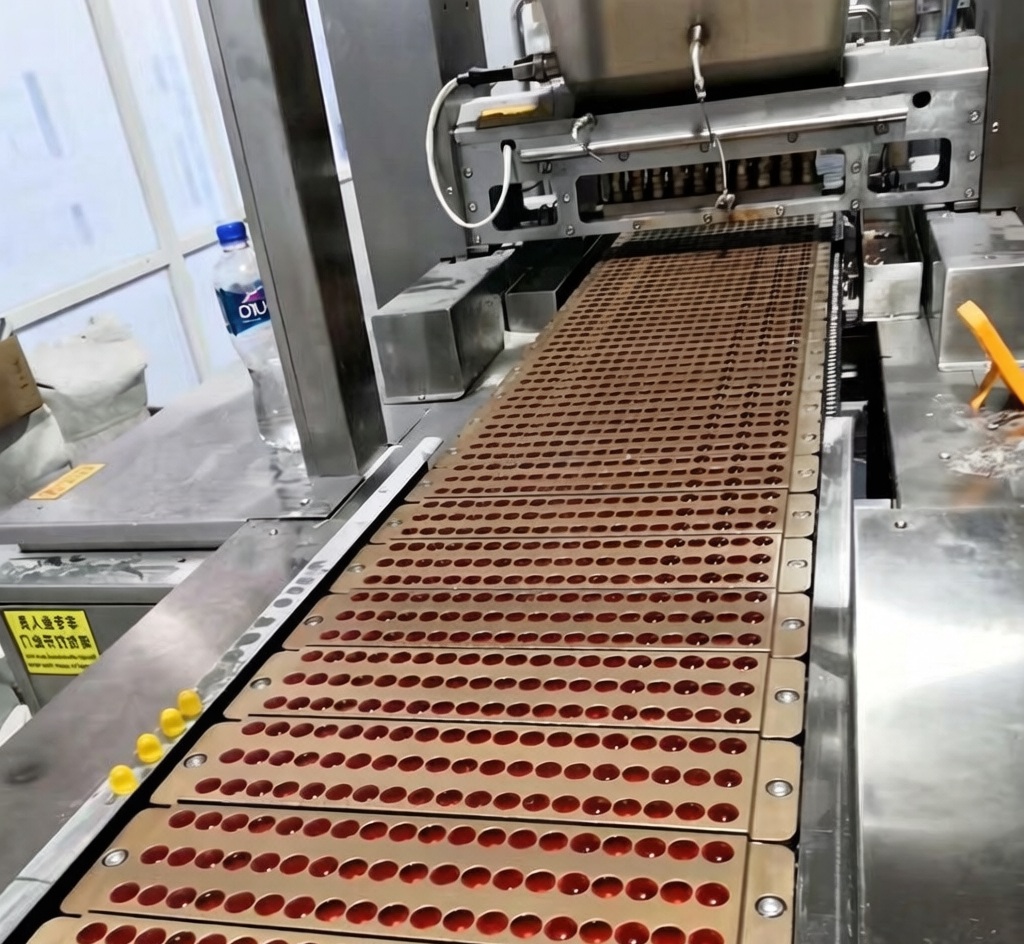
Pectin Soft Candy Production Line
III. The "Devil in the Details" of Operational Process
1. Pretreatment & Pectin Hydration: Eliminate "Fish Eyes"
Pectin Pretreatment: Dry blending with 5-10 times its weight of sugar is the golden rule. A more advanced technique is "oil-film coating" by adding a small amount of edible oil (e.g., coconut oil) or alcohol during mixing, which significantly improves its hydrophilic dispersion, almost completely preventing lumps.
Hydration Temperature & Shear: Heat water to 75-80°C, then sprinkle in the pectin-sugar blend under high-shear agitation. Excessively high temperature (>90°C) may cause premature hydration and lumping. Ensure sufficient hold time (3-5 minutes at 90-95°C) for complete pectin molecular unfolding and dissolution. The solution should be uniformly viscous and smooth, with no gritty feel.
2. Cooking Endpoint: It's About Solids, Not Just Temperature
The cooking endpoint should be determined by soluble solids content, not simply temperature. Atmospheric pressure and syrup composition affect boiling point. Online measurement with a refractometer is a must. Strictly control the endpoint at 76-78% Brix. This is the most critical parameter determining gummy firmness and stickiness.
3. Cooling & Acid Addition: The Critical 3-Minute Window
Cooling Target: Cool the syrup to 80-85°C. This is the optimal temperature window for acid addition. Too high, and acid volatilizes/pectin degrades; too low, viscosity spikes, and flowability plummets.
"Three-Step Addition Sequence" (In order / Do not reverse):
Add Buffer: Add sodium citrate solution first, mix well.
Add Flavor & Color: Mix in quickly.
The Acid Sprint: Engage maximum agitation speed. Stream the cold acid solution into the **vortex


Email: info@cagcolloids.com
Tel: 0086-19884908291 / 0086-573- 80890620
Website: www.cagcolloids.com
Address: No. 399, East Tongfu Road, Tongxiang City, Zhejiang Province. China.