


FAQs
Nature Refined, Quality Defined
Green Science for better living

Troubleshooting LA Gellan Gum: Why Your Formulation Fails to Achieve the Expected Gel Strength
Gellan gum is highly functional at exceptionally low concentrations, but its performance is deeply sensitive to preparation parameters and processing conditions. If your production line encounters issues such as macro-lumping, a complete failure to set, or subpar optical clarity, it is typically caused by overlooking three core processing factors in hydrocolloid chemistry.
1. Water Hardness and Premature Gelation
Gellan gum molecules, particularly the low acyl variant, are highly reactive to divalent cations like calcium (Ca2+) and magnesium (Mg2+). If you attempt to disperse and dissolve the powder directly in hard water, the gellan gum will undergo localized, premature gelation before the polymer chains can fully hydrate and expand. This creates an un-hydrated core trapped inside a gel shell, resulting in severe lumping that cannot be undone by subsequent heating.
The Correct Protocol: Always utilize deionized or soft water for initial dispersion. Alternatively, formulate a sequestering agent, such as 0.05% sodium citrate, into the water beforehand to temporarily chelate existing ions until full hydration is complete.
2. Insufficient Hydration and Dissolution Temperatures
Gellan gum must reach its specific critical temperature threshold to undergo complete macromolecular dispersion and chain unfolding. Merely wetting the powder is insufficient.
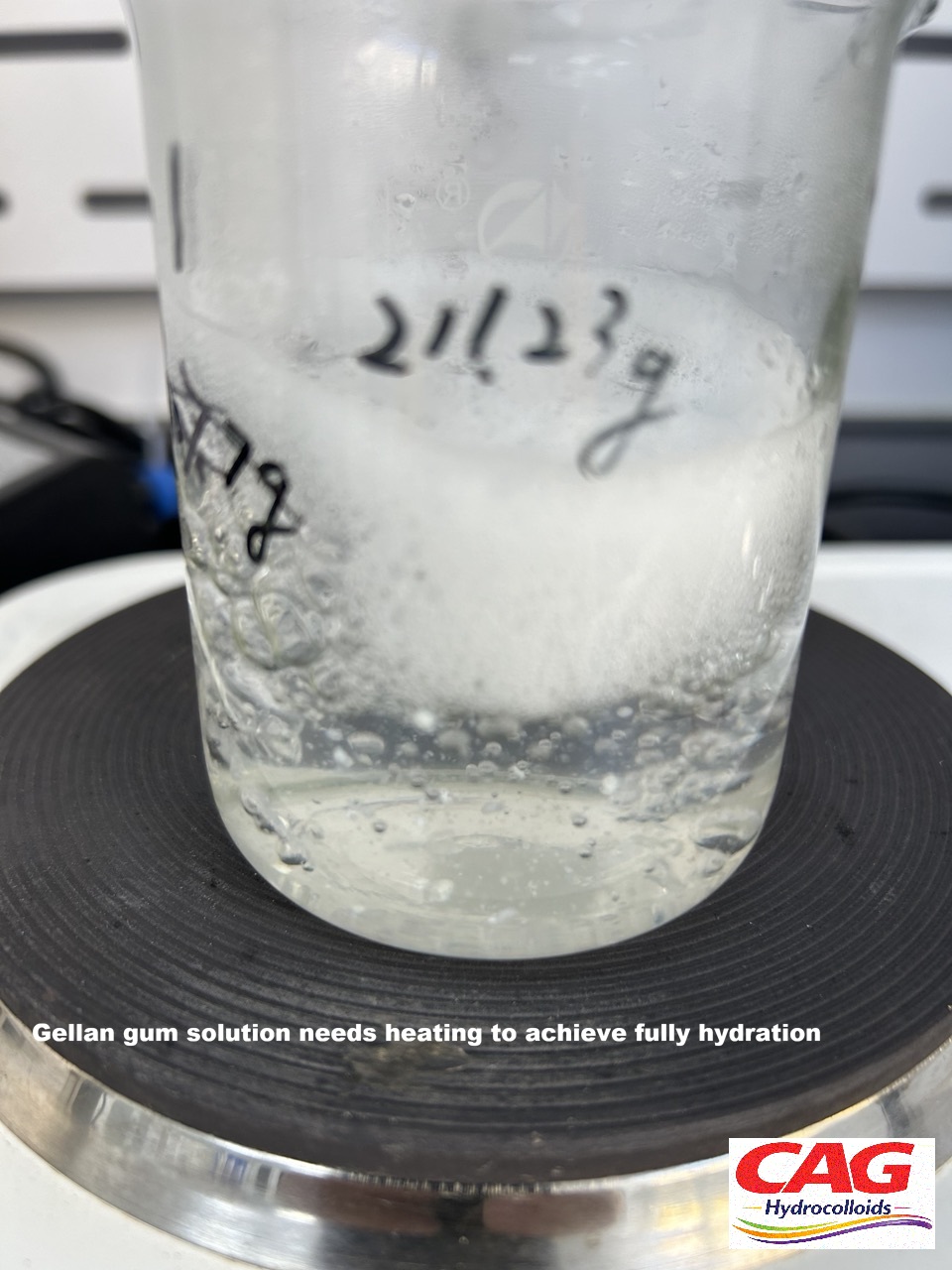
Fig. LA gellan gum solution needs to heat to achieve full hydration
Low Acyl (LA) Gellan Gum: Requires a sustained heating temperature of at least 85°C to achieve full hydration.
High Acyl (HA) Gellan Gum: Requires heating to a range of 75°C to 80°C for complete dissolution.
Failure to reach these exact thermal targets leaves un-hydrated crystalline aggregates in the solution, which drastically reduces the ultimate gel strength and ruins batch transparency.
3. Incorrect Timing of Salt Addition (Specific to Low Acyl Gellan Gum)
The mechanism of triggering a crisp, firm crystalline network through the introduction of salts (such as calcium chloride) applies strictly to Low Acyl (LA) gellan gum. High Acyl (HA) gellan gum forms its soft, elastic, and thermo-reversible network independently upon cooling and does not require this processing step.
The Correct Protocol for LA Gellan Gum: Cationic salts must only be introduced after the gellan gum has completely hydrated and dissolved at high temperatures. Ideally, add the setting salt just before the solution cools down to its specific gelation transition point. Introducing salts too early into a partially dissolved LA solution will instantly shock the system, resulting in a fractured, weak, or completely failed gel matrix.
Technical Support from a Specialized Fermentation Plant
As a primary manufacturer focused on industrial-scale hydrocolloid fermentation, we provide our global partners with more than just raw materials—we deliver comprehensive application engineering. By standardizing our low acyl and high acyl parameters, we help you eliminate production downtime and formulation variability. Contact our technical support department to obtain detailed preparation manuals, rheological data sheets, and evaluation samples for your specific manufacturing setup.


Email: info@cagcolloids.com
Tel: 0086-19884908291 / 0086-573- 80890620
Website: www.cagcolloids.com
Address: No. 399, East Tongfu Road, Tongxiang City, Zhejiang Province. China.