


FAQs
Nature Refined, Quality Defined
Green Science for better living

The gelling properties of gellan gum are highly sensitive to ions. How to detect its calcium ion reactivity?
I. Detection Principle
Gellan gum molecules exist in a random coil state after heating and dissolution, and form double helix structures upon cooling. Calcium ions (Ca²⁺) act as cross-linking agents, forming an "egg-box" structure between the double helices, which significantly enhances gel strength, thermal stability, and hardness. Detecting calcium ion reactivity is essentially evaluating the efficiency of this cross-linking process.
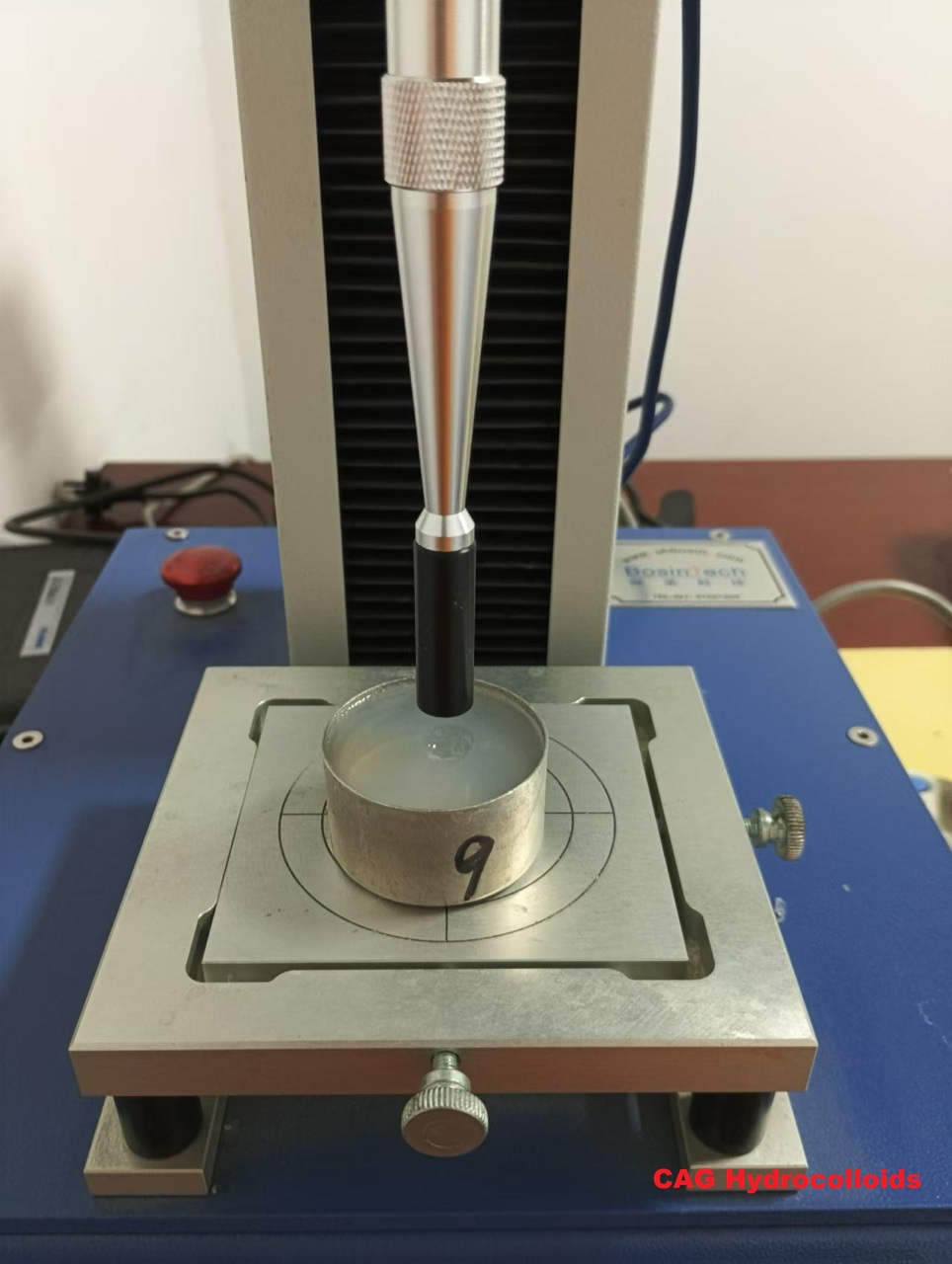
II. Detection Protocol: Calcium Ion Reactivity Test
1. Solution Preparation (Variables Must Be Strictly Controlled)
Gellan Gum Concentration: Typically, a 0.2% - 0.5% (w/w) solution of low-acyl gellan gum is used. High-acyl gellan gum is insensitive to calcium ions and is generally not used for this test.
Solvent: Deionized water must be used to exclude interference from inherent calcium and magnesium ions in the water.
Chelator Pretreatment (Critical Step): When preparing the gellan gum solution, a trace amount of sodium citrate (approx. 0.1%) or EDTA should be added. The purpose is to chelate the trace calcium ions naturally present in the gellan gum raw material, ensuring the initial state is a "gel-free" sol, thereby accurately assessing the effect of exogenous calcium.
2. Calcium Ion Source and Addition
Calcium Source: Use a calcium chloride (CaCl₂) solution due to its high solubility and lack of side effects.
Addition Method: Add the CaCl₂ solution to the gellan gum solution at a high temperature (>80°C) with vigorous stirring to ensure uniform mixing and prevent localized premature gelling which could cause concentration inhomogeneity.
Calcium Ion Concentration Gradient: Typically test a Ca²⁺ concentration range of 0 - 100 mM to plot a "calcium ion concentration vs. gel strength" curve.
3. Gel Formation and Evaluation Indicators
|
Evaluation Dimension |
Detection Method |
Quantifiable Indicators and Significance |
|---|---|---|
|
1. Gel Strength |
Texture Profile Analysis (TPA) |
Rupture Strength (Bloom Strength, g): Reflects the gel's ability to resist external force damage. Gel strength increases in an S-shaped curve with increasing calcium ion concentration until saturation. |
|
Ball Drop Method |
The penetration depth or rupture time of a steel ball on the gel surface. A simple method suitable for rapid QC on the production line. |
|
|
2. Gel Point |
Rheological Testing |
Measures the intersection point of storage modulus (G') and loss modulus (G''). Calcium ions significantly increase the gelation temperature, which is an important manifestation of their reactivity. |
|
3. Texture Characteristics |
Texture Profile Analysis (TPA) |
Hardness, Brittleness, Elasticity: Calcium ions typically make the gel harder, more brittle (low-acyl), and less elastic. |
|
4. Ion Sensitivity |
Minimum Gelling Concentration (MGC) |
Record the minimum calcium ion concentration required to form a self-supporting gel. The lower this value, the more sensitive the gellan gum is to calcium ions
|


Email: info@cagcolloids.com
Tel: 0086-19884908291 / 0086-573- 80890620
Website: www.cagcolloids.com
Address: No. 399, East Tongfu Road, Tongxiang City, Zhejiang Province. China.