


FAQs
Nature Refined, Quality Defined
Green Science for better living

Suspension Application Test Method for 0.03% High Acyl Gellan Gum (HAGG) in Cocoa Milk Systems
To evaluate the ability of 0.03% (w/w) high acyl gellan gum to maintain suspension stability of cocoa particles in a cocoa milk (flavored dairy beverage with insoluble cocoa solids) system, providing data for raw material release and formulation development.
Cocoa milk systems naturally contain free Ca2+/Mg2+ from the dairy base (typically ~30–40 mM free calcium), which promotes ionic bridging aggregation between HAGG double-helix chains. Even at very low concentration, this forms a “weak gel” network with sufficient yield stress to counteract the sedimentation driving force of cocoa particles, while the system remains pourable and smooth.
Cocoa particle density (~1.3–1.5 g/cm³) is substantially higher than the milk phase (~1.03 g/cm³); the sedimentation driving force can be estimated via Stokes' law, and the network's yield stress must exceed this driving force for long-term suspension.
Key point: cocoa milk systems typically undergo high-pressure homogenization (150–200 bar) and UHT sterilization (135–140°C, 4–15 s), both of which impose shear and thermal history on the already-formed weak-gel network. A test that stops at the laboratory hydration stage without simulating actual thermal processing will not reliably reflect shelf-life performance.
For reference only; the client's actual formula takes precedence — only the 0.03% HAGG level should be held fixed.
|
Component |
Amount |
Notes |
|
Reconstituted whole milk powder (or fresh whole milk) |
to 100% |
Base |
|
Cocoa powder (alkalized) |
0.8–1.2% |
— |
|
Sucrose |
6–8% |
— |
|
High acyl gellan gum (HAGG) |
0.03% |
Test item |
If the client's formula is a blended stabilizer system (e.g., HAGG combined with carrageenan for protein reactivity), state clearly whether the test is on HAGG alone or the full blend — the two must not be conflated in the conclusion.
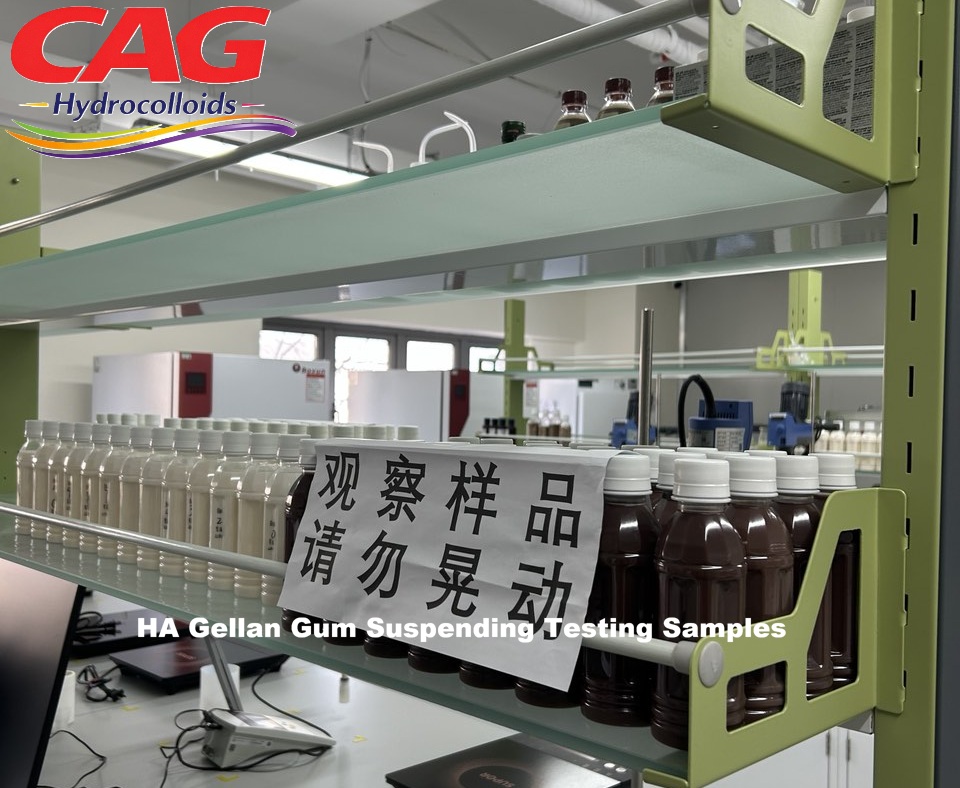
1. Dry-blend sugar, cocoa powder, and HAGG at a ratio of no less than 1:5 to prevent lumping when the gum contacts the water surface directly.
2. Fully reconstitute milk powder in 50–55°C water (skip if using fresh milk).
3. Add the dry blend to the milk under shear agitation; hold at 80–85°C with shear for no less than 10 minutes to ensure full hydration.
4. Two-stage homogenization: 1st stage 150–180 bar, 2nd stage 30–50 bar (use the client's actual process parameters where available, rather than this default).
5. Simulate UHT sterilization: 135–140°C, 4–15 s (tubular UHT or equivalent). Autoclaving is not recommended as it significantly degrades HAGG; results obtained this way are not comparable to UHT-processed commercial products.
6. Fill into pre-sterilized glass bottles under aseptic/clean conditions, seal, and cool.
7. Prepare at least 3 replicates per batch.
Store at 25°C (ambient), 37°C (accelerated), observe at 0 h, 24 h, 7 days, 1 month, and 3 months (extend to labeled shelf life for ambient-stable products). Record clear-layer/sediment-layer heights, calculate sedimentation volume ratio, and photograph.
Flow curve at 25°C over 0.01–100 s⁻¹, focusing on low-shear yield stress (Herschel-Bulkley model). Used to mechanistically explain discrepancies between 5.1 and 5.2, not for routine release.
Blind scoring (5-point scale) of mouthfeel smoothness, particle distribution uniformity, and any perceived sediment or layering.
|
Parameter |
Criterion |
|
24 h static sedimentation volume ratio |
≥95% |
|
End-of-shelf-life sedimentation volume ratio |
≥90%, redispersible by gentle shaking |
|
Sensory — smoothness |
≥4 (5-point scale), no perceived sediment |
This test method evaluates only the suspension stability performance of 0.03% high acyl gellan gum for cocoa particles in a cocoa milk system. The results do not represent, and cannot substitute for, an assessment of flavor stability — particularly the risk of off-flavor/rancid notes in neutral milk systems under long-term room-temperature or high-temperature storage.
If the application system is a neutral milk and the product requires long-term storage at room or elevated temperature, note that conventional high acyl gellan gum may retain residual arylsulfatase activity from its manufacturing process. This enzyme can hydrolyze sulfated flavor precursors in milk to produce off-flavor compounds such as p-cresol, leading to a noticeable off-flavor/rancid character during extended storage, especially at elevated temperatures. This risk is masked in cocoa milk by the strong inherent flavor of cocoa and is easy to overlook, but it becomes pronounced in neutral milk systems.
Therefore, for long-term storage applications in neutral milk, an Enzyme-free grade high acyl gellan gum must be used instead of the standard-grade HAGG used in this test. The suspension performance results in this document cannot be used to justify the use of standard-grade HAGG for long-term neutral milk storage applications.


Email: info@cagcolloids.com
Tel: 0086-19884908291 / 0086-573- 80890620
Website: www.cagcolloids.com
Address: No. 399, East Tongfu Road, Tongxiang City, Zhejiang Province. China.