

FAQs
Nature Refined, Quality Defined
Green Science for better living

Sugar Effects on Low‑Acyl Gellan Gel Strength — Why Sucrose Inhibits More Than Glucose
Sugar influences LA gellan gelation in two opposing ways—one of which surprises most formulators on first encounter.
Sugar affects LA gellan gelation through two distinct mechanisms. The first is widely recognized: increasing sugar concentration reduces the ionic concentration required for optimal gel modulus. In water, optimal gelation requires ~8–10 mM calcium; at 40% sucrose, this drops to 4–5 mM; at 60% sucrose, only 0.5–1.0 mM is needed—roughly a tenfold reduction. In high‑sugar confections, minerals naturally present in water, fruit, or sugar may already exceed this level, requiring no intentional ion addition.
The second effect is counterintuitive: above ~40% sugar, even as ionic sensitivity decreases, LA gellan gels become progressively softer and more elastic. The mechanism is believed to involve competitive inhibition of helix aggregation: sugar molecules insert into the hydration shell surrounding double‑helix junction zones, physically hindering tight packing. The polymer still forms helices, but aggregation efficiency drops. Macroscopically, gels become softer and more deformable at identical gum and ion levels.
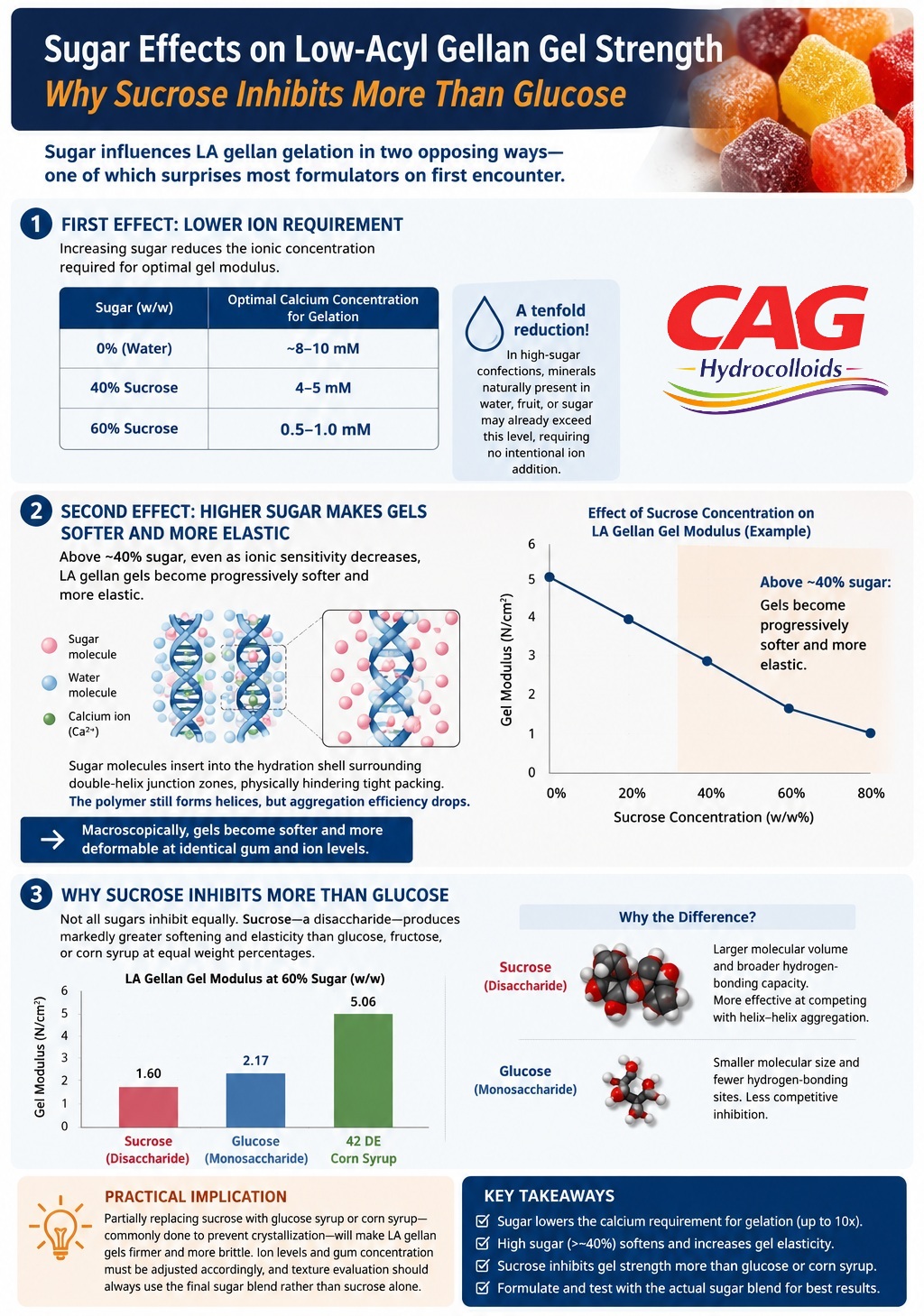
Not all sugars inhibit equally. Sucrose—a disaccharide—produces markedly greater softening and elasticity than glucose, fructose, or corn syrup at equal weight percentages. At 60% w/w, LA gellan gel modulus is ~1.60 N/cm² in sucrose versus 2.17 N/cm² in glucose and 5.06 N/cm² in 42 DE corn syrup. The difference reflects sucrose’s larger molecular volume and broader hydrogen‑bonding capacity, making it more effective at competing with helix–helix aggregation. A practical implication: partially replacing sucrose with glucose syrup or corn syrup—commonly done to prevent crystallization—will make LA gellan gels firmer and more brittle. Ion levels and gum concentration must be adjusted accordingly, and texture evaluation should always use the final sugar blend rather than sucrose alone.
gellan sugar effect, LA gellan high‑sugar systems, gellan confectionery texture, sucrose gellan gel strength, gellan modulus, gellan glucose fructose, high‑sugar gellan formulation
Email: info@cagcolloids.com
Tel: 0086-19884908291 / 0086-573- 80890620
Website: www.cagcolloids.com
Address: No. 399, East Tongfu Road, Tongxiang City, Zhejiang Province. China.