


FAQs
Nature Refined, Quality Defined
Green Science for better living

Semi-Refined (E407a) vs. Refined (E407) Carrageenan — Key Processing and Performance Differences
Processed Eucheuma seaweed (PES) — the commercial form of semi-refined carrageenan classified as E407a — is produced by treating harvested Eucheuma or Kappaphycus algae directly with alkali solution in situ, without extracting the carrageenan into solution. The alkali modifies the native polysaccharide by promoting 3,6-anhydrogalactose bridge formation, which increases gel-forming capacity. The treated seaweed is then washed, bleached, dried, and milled. The entire process bypasses the extraction, filtration, concentration, and precipitation steps that define the manufacture of refined E407 — making it substantially more economical.
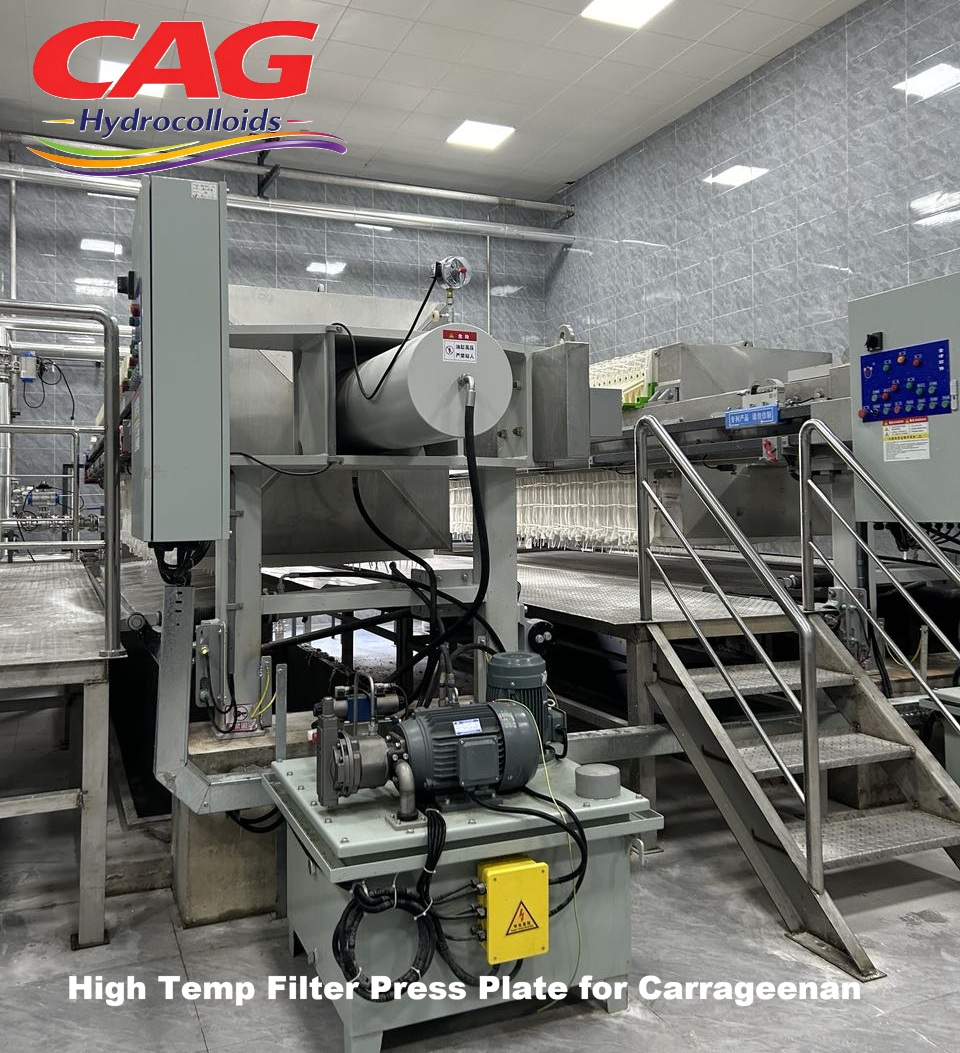
Fig. Refined Kappa Carrageenan need to use high temp filter press plat to remove impurities to get the clear carrageenan gel
The price difference, however, is not without functional trade-offs. E407a retains approximately 8–15% of the original algal cellulose framework from the seaweed cell walls. This residual cellulose network modifies the product in several important ways: it slows hydration during heating (requiring higher temperatures or longer hold times to achieve full dissolution), reduces gel transparency, and produces a somewhat more brittle gel structure compared to a refined equivalent. The cellulose particles also make gels and solutions cloudy — which can be a disadvantage in transparent dessert applications, but is largely irrelevant in opaque dairy products.
In injected cooked meat products, semi-refined carrageenan disperses readily in cold brine without swelling. The fine particles do not expand during injection, causing less tissue damage and allowing more even distribution through the muscle matrix before heat-triggered gelation begins.
| Property | E407 (Refined) | E407a (Semi-Refined) |
|---|---|---|
| Also known as | Carrageenan extract | PES, SRC, ARC, PNG, AMF |
| Cellulose content | <1% | 8–15% |
| Hydration temperature | 60–70 °C | 70–80 °C or higher |
| Solution clarity | High | Turbid |
| Gel texture | Elastic to firm | More brittle |
| Molecular weight (kappa type) | 400–560 kDa | ~615 kDa |
| Relative cost | Higher | Lower |
In dairy applications, both grades are technically suitable, but the choice depends on end-product requirements. Where transparency and precise gel-strength control are paramount — such as in milk puddings or clear gel layers — refined E407 is preferred. Where cost efficiency is the priority and opacity is acceptable (chocolate milks, ice cream, processed cheese), E407a offers comparable stabilizing performance at a lower price point.


Email: info@cagcolloids.com
Tel: 0086-19884908291 / 0086-573- 80890620
Website: www.cagcolloids.com
Address: No. 399, East Tongfu Road, Tongxiang City, Zhejiang Province. China.