


FAQs
Nature Refined, Quality Defined
Green Science for better living

Rapid Evaluation of High Acyl Gellan Gum Acyl Integrity Through Acidified Dairy Stability Testing
The acetyl and glyceryl substituents present in High Acyl Gellan Gum (HA Gellan Gum) play a critical role in preventing protein flocculation in dairy systems. These acyl groups provide steric hindrance along the polymer chain, reducing undesirable interactions with casein micelles under acidic conditions.
During fermentation, purification, or downstream processing, partial deacylation may occur. The resulting low-acyl fractions possess a stronger tendency to interact with dairy proteins, potentially inducing flocculation, aggregation, phase separation, and whey-off in acidified milk beverages.
Direct determination of acyl content typically requires specialized analytical equipment, significant cost, and extended testing time. To overcome these limitations, a rapid screening method has been developed based on a CMC–Low Protein Acidified Milk Stability Stress Model. By monitoring the time required for visible instability to occur, the acyl integrity and quality level of High Acyl Gellan Gum can be evaluated quickly and effectively.
The sensitivity of this evaluation model is positively correlated with the protein concentration in the system.
Higher protein levels increase the probability of interaction between casein and any low-acyl gellan fractions, thereby amplifying instability phenomena and improving detection sensitivity.
A protein concentration of approximately 0.7% has been identified as an effective critical stress point for routine quality evaluation.
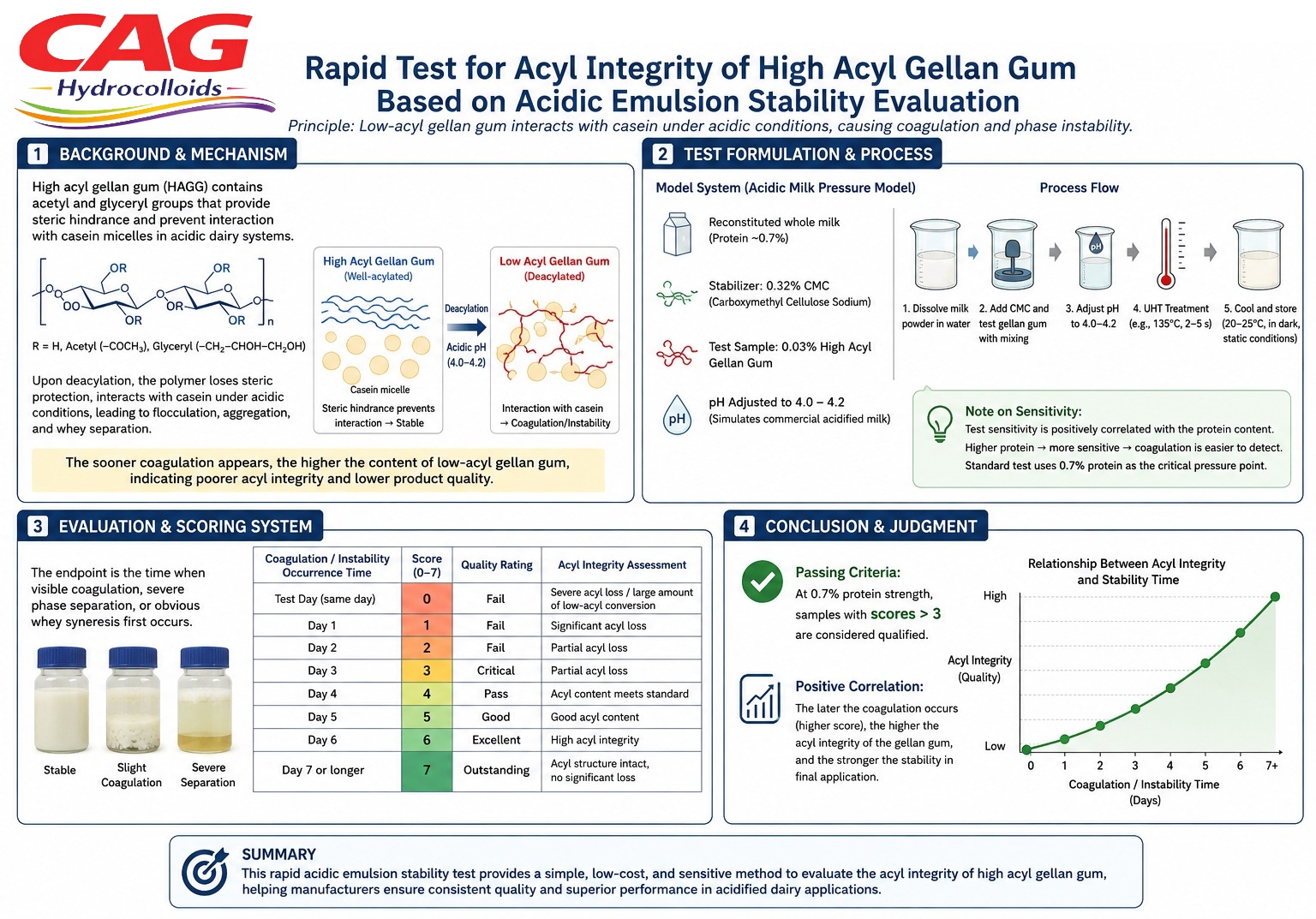
The endpoint is defined as the first appearance of:
A quantitative score from 0 to 7 is assigned according to the time required for instability to occur.
| Time to Flocculation / Instability | Score | Quality Rating | Acyl Integrity Assessment |
|---|---|---|---|
| Same Day | 0 | Fail | Severe acyl loss / extensive low-acyl conversion |
| Day 1 | 1 | Fail | Significant acyl loss |
| Day 2 | 2 | Fail | Partial acyl degradation |
| Day 3 | 3 | Critical Threshold | Moderate acyl loss |
| Day 4 | 4 | Pass | Acyl content meets specification |
| Day 5 | 5 | Good | High acyl retention |
| Day 6 | 6 | Excellent | Very high acyl integrity |
| Day 7 or Longer | 7 | Outstanding | Acyl structure remains essentially intact |
Under the standard testing condition of 0.7% protein concentration, samples achieving a score greater than 3 are considered qualified.
A strong positive correlation exists between instability onset time and acyl integrity.
This method converts a complex chemical characterization problem into a practical application-based performance test.
Compared with direct acyl analysis, the method offers:
As a result, the Acidified Dairy Stability Stress Model provides an efficient quality-control tool for monitoring the acyl integrity and application performance of High Acyl Gellan Gum.
Keywords: High Acyl Gellan Gum, Acyl Integrity, Deacylation, Acidified Dairy Beverage, Casein Interaction, Flocculation Test, Hydrocolloid Quality Control, CMC, UHT Milk Stability, Gellan Gum Evaluation


Email: info@cagcolloids.com
Tel: 0086-19884908291 / 0086-573- 80890620
Website: www.cagcolloids.com
Address: No. 399, East Tongfu Road, Tongxiang City, Zhejiang Province. China.