


FAQs
Nature Refined, Quality Defined
Green Science for better living

Please provide a comprehensive accelerated shelf-life stability testing protocol for hydrocolloids products.
I. Physical Stability Testing (Texture and Phase Separation)
Centrifugal Syneresis Test
Applications: Jams, yogurt, jellies, sauces.
Method: Centrifuge a specified amount of sample under set conditions (e.g., 3000-4000 rpm, at 4°C or 25°C, for 10-20 minutes). Calculate the weight percentage of separated water.
Standard: High-quality jams typically require a syneresis rate of < 3-5%.
Freeze-Thaw Cycle Test
Applications: Ice cream, frozen desserts, frozen sauces, bakery fillings.
Method: One cycle consists of freezing at -18°C for 16-18 hours, then thawing at 4°C or 25°C for 6-8 hours. Typically, 3-5 cycles are performed.
Evaluation: Observe for water separation, ice crystal growth, and texture coarsening. Gellan gum and xanthan gum perform excellently in this test.
Texture Profile Analysis (TPA)
Applications: Gummies, jellies, meat product gels.
Method: Use a texture analyzer to simulate chewing, testing for hardness, elasticity, cohesiveness, and gumminess.
Acceleration: Test after storage at elevated temperatures (e.g., 37°C) for a specified period to assess the rate of gel strength decay.
II. Mechanical Stability Testing (Transportation and Logistics Simulation)
Vibration Test
Purpose: Simulate shaking and impacts during road/rail transport to detect layer separation, sedimentation, and packaging damage.
Method: Place packaged finished products on a vibration table, setting parameters such as frequency (e.g., 5-50 Hz), amplitude, and duration (e.g., 1-4 hours) to simulate long-distance transport.
Evaluation: After standing, observe for irreversible delamination, hydrocolloid settling, or sedimentation of suspended particles.
Drop Test
Purpose: Test packaging seal integrity and the product's impact resistance (especially for gel-type products).
Method: Perform free-fall drops from different heights (e.g., 0.5m, 1m) and angles (corner, flat surface). Check for packaging leakage and gel fracture.
III. Thermodynamic Stability Testing (High-Temperature Acceleration)
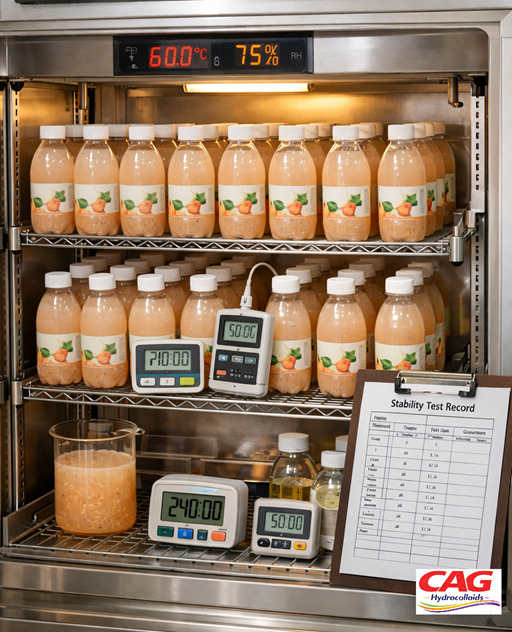
Constant Temperature and Humidity Accelerated Test
Conditions: Typically 37°C/75% RH or more stringent conditions like 45°C/75% RH. Based on the Arrhenius equation, storage at 37°C for approximately 3 months is equivalent to about 1 year at ambient temperature (25°C).
Monitoring Indicators: Viscosity change, pH drift, color change (browning), flavor deterioration.
Thermal Cycling Test
Applications: Temperature-sensitive products (e.g., those containing gelatin).
Method: Alternate storage between high temperature (40°C) and low temperature (4°C), switching every 12 hours, for 1-2 weeks. Test the gel's melting point and recrystallization behavior.
IV. Photochemical Stability Testing (For Transparent Packaging)
Light Chamber Test
Light Source: Simulate full-spectrum light (especially UV region) or use specific wavelength light boxes.
Conditions: Typically set light intensity (Lux) and duration (e.g., continuous exposure for 7-14 days).
Evaluation:
Color Change: Quantify browning or fading using a colorimeter (ΔE value), particularly important for pectin and gelatin products.
Flavor Oxidation: Light exposure can induce fat oxidation or vitamin degradation, requiring sensory evaluation.
Hydrocolloid Degradation: Light may cause molecular chain breakage in certain hydrocolloids (e.g., xanthan gum, konjac gum), manifesting as viscosity decrease.
Testing Protocol Design Template (Example: Transparent Cup-Packed Jam)
|
Test Item |
Test Conditions |
Evaluation Metrics |
Pass Criteria (Example) |
|---|---|---|---|
|
Centrifugal Syneresis |
4000 rpm, 15 min, 25°C |
Syneresis Rate |
≤ 4% |
|
High-Temperature Acceleration |
37°C, 75% RH, 4 weeks storage |
Viscosity Retention Rate, Color Difference ΔE |
Viscosity > 85% initial, ΔE < 2.0 |
|
Light Exposure Test |
5000 Lux, 25°C, 14 days |
Color Change, Off-flavors/Odors |
No visible browning, no off-odors |
|
Vibration Test |
Simulated road transport, 2 hours |
Layer Separation, Packaging Seal Integrity |
No delamination, no leakage |
Key Risk Points and Hydrocolloid Selection Recommendations
Gelatin: Most sensitive to heat and enzymes. Focus on melting point and gel strength decay during high-temperature accelerated tests.
Pectin: Sensitive to pH fluctuations. Improper pH control in jam under high temperatures can easily lead to pectin degradation and water separation.
Carrageenan/Agar: Sensitive to ionic environment changes. Water quality variations or ion migration during shelf life may cause gel brittleness or syneresis.
Xanthan Gum/Gellan Gum: Best tolerance. They typically perform well in high-temperature and freeze-thaw tests and are preferred choices for stability in formulations.


Email: info@cagcolloids.com
Tel: 0086-19884908291 / 0086-573- 80890620
Website: www.cagcolloids.com
Address: No. 399, East Tongfu Road, Tongxiang City, Zhejiang Province. China.