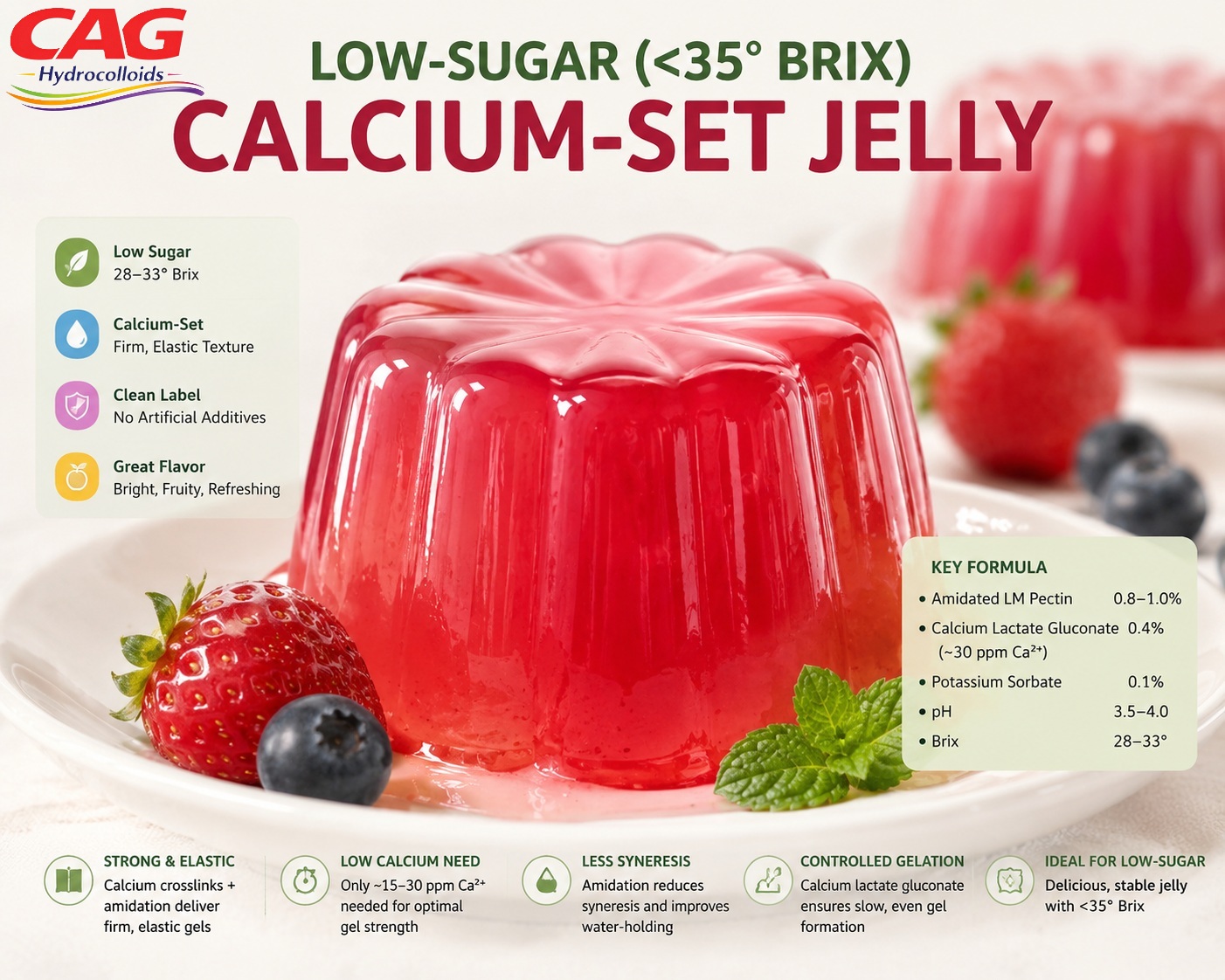
Egg-box model and DA effect: LM pectin gels via Ca²⁺ crosslinks between demethylated galacturonic acid blocks (the "egg-box" model). Amidated LM pectin (DA 15–25%) introduces amide groups that form additional hydrogen bonds with Ca²⁺-bridge neighbors, producing stronger, more elastic gels at lower Ca²⁺ concentrations.
DM/DA/Ca²⁺ interaction table:
• LM pectin DM 28–34%, DA 0%: requires Ca²⁺ 30–50 ppm, gel modulus G' 200–500 Pa
• Amidated LM, DM 22–28%, DA 18–25%: requires Ca²⁺ 15–30 ppm, G' 400–900 Pa, less syneresis
• Very low DM (<20%): strong gels but brittle; excess Ca²⁺ causes irreversible precipitation
✦ Low-sugar calcium jelly: Amidated LM pectin 0.8–1.0% + Calcium lactate gluconate 0.4% (= ~30 ppm Ca²⁺) + Potassium sorbate 0.1% + pH 3.5–4.0, Brix 28–33°
Kinetics: Controlled-release Ca²⁺ sources (calcium lactate gluconate, GLONO) slow gelling and prevent lumping during mixing. Pre-hydrate pectin in hot water (85°C, 5 min) before adding cations.