


FAQs
Nature Refined, Quality Defined
Green Science for better living

Molecular Weight Distribution and Gel Network Stability — Why Low-MW Fragments Are a Hidden Quality Risk
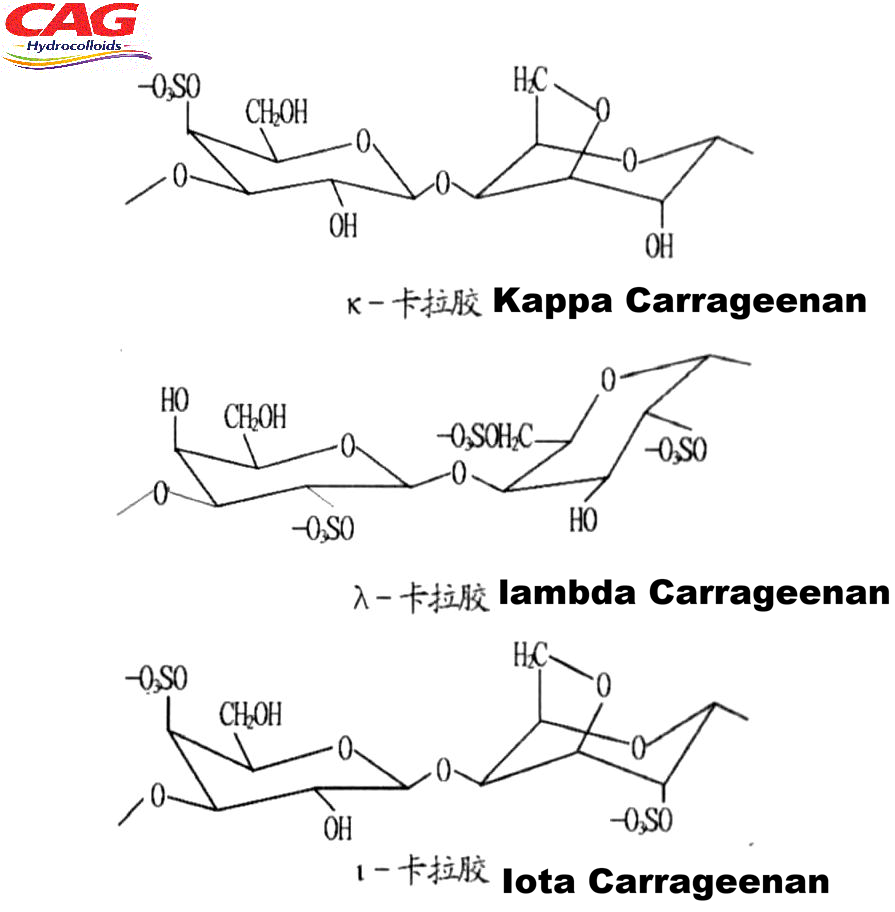
Carrageenan is not a single molecule. It is a high-molecular-weight, polydisperse sulfated polysaccharide whose commercial form spans a broad distribution of chain lengths. Refined kappa-type carrageenan typically ranges from 400 to 560 kDa; semi-refined grades (E407a) sit slightly higher, around 615 kDa, owing to their more intact native structure. Yet within every commercial grade, a small fraction — generally below 5% by weight — consists of chain segments below 100 kDa. Critically, this low-molecular-weight population is not purely an artifact of processing; it is inherent to the native algal material itself.
The practical consequence becomes clear when you consider the gelation mechanism. Carrageenan forms a three-dimensional network through the sequential coiling and aggregation of high-MW chain segments into regular double helices. Low-MW fragments cannot participate in this ordered stacking. Instead, they intercalate between helical junction zones, acting much like a plasticizer: disrupting cross-link density and reducing the overall rupture strength of the gel. The result is that two batches with similar average MW can produce gels differing significantly in firmness if their low-MW fractions are distributed differently.
Standard gel-strength tests under normal conditions may not reveal differences in molecular weight distribution. The failure mode typically surfaces only under stress conditions — prolonged high-temperature processing, or exposure to low-pH environments.
Acid hydrolysis is the most insidious amplifier of this risk. Under acidic conditions, carrageenan undergoes cleavage at the 3,6-anhydrogalactose linkage within the polymer backbone. The rate of this autohydrolysis increases sharply with both temperature and acidity: for every 0.5-unit drop in pH and every 10 °C rise in temperature, the hydrolysis rate approximately triples. At pH 3.0 and 120 °C, gel strength can fall by 25% in just seconds. At pH 4.0 and 90 °C — conditions typical of fruit-based dairy desserts — a 10-minute pasteurization cycle is enough to cause a measurable and irreversible loss of gel-forming capacity.
This shifts the burden onto upstream quality control. For high-MW-sensitive applications such as milk-based gelled desserts — where carrageenan interacts with casein proteins and batch-to-batch consistency is critical — average gel strength alone is an insufficient specification.
When selecting suppliers, request GPC/SEC molecular weight distribution data alongside standard gel strength values. For acidified or heat-intensive dairy systems, design process timelines to minimize carrageenan exposure at low pH and elevated temperature — add acid as late as possible in the production sequence.


Email: info@cagcolloids.com
Tel: 0086-19884908291 / 0086-573- 80890620
Website: www.cagcolloids.com
Address: No. 399, East Tongfu Road, Tongxiang City, Zhejiang Province. China.