Carrageenan is one of the most regulatory-sensitive hydrocolloids in the global food industry. The same formulation may face very different labeling requirements and usage restrictions depending on the target market. For export-oriented dairy manufacturers, multi-market compliance should be considered at the formulation development stage rather than as a post-launch regulatory check.
|
Market
|
Approval Status
|
E Number / Code
|
Usage Limit in Dairy Products
|
Labeling Requirement
|
|
European Union (EU)
|
E407 (Refined), E407a (Semi-refined) approved
|
E407 / E407a
|
Quantum satis (as needed), prohibited in infant formula
|
Must declare the E number
|
|
United States (USA)
|
Refined carrageenan recognized as GRAS; E407a may require separate review
|
No E number; labeled as "carrageenan"
|
GMP (Good Manufacturing Practice); no specific maximum limit (not permitted in organic infant foods)
|
Must use the common name "carrageenan"
|
|
China
|
Approved under GB 2760
|
CNS 20.006
|
Subject to category-specific limits; typically 0.5–5 g/kg in dairy products
|
Must declare as "Carrageenan" (卡拉胶)
|
|
Russia / EAEU
|
Approved under TR CU 029/2012
|
E407 / E407a
|
Category-specific limits, typically ≤5 g/kg
|
Must declare the E number
|
Principles for Multi-Market Formulation Design
To ensure compliance across multiple markets:
-
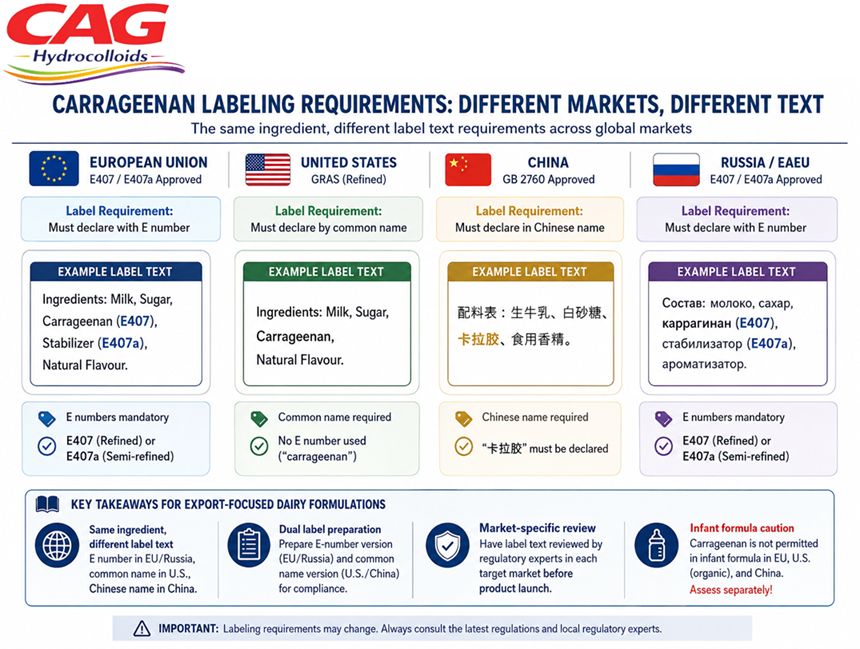
Use the most restrictive usage limit among the target markets as the formulation design ceiling.
-
Prefer raw materials that are approved under both E407 (refined carrageenan) and E407a (semi-refined carrageenan) regulatory frameworks whenever possible.
-
Clearly document the carrageenan type (refined or semi-refined) in formulation and technical files, as E407a may face additional restrictions under certain certification systems, including some organic standards within EU member states.
-
Prepare two versions of ingredient declarations:
-
E-number format for the EU and Russia/EAEU markets.
-
Common-name format for the United States and China.
-
Ensure that all labels are independently reviewed by regulatory specialists in the destination market before commercialization.
Special Considerations for Infant Nutrition Products
Infant foods require separate regulatory assessment and should never be evaluated using the same compliance framework as conventional dairy products.
-
The European Union prohibits the use of carrageenan in infant formula.
-
Organic infant foods in the United States are not permitted to contain carrageenan.
-
China's GB 10765 infant formula standard does not approve the use of carrageenan in infant formula products.
Therefore, even if carrageenan is fully compliant for standard dairy applications, infant nutrition products must undergo a dedicated regulatory review and formulation assessment before market entry.
Practical Compliance Strategy
For companies developing dairy products for global distribution, the most robust approach is to:
-
Design formulations based on the strictest applicable regulatory limit.
-
Maintain complete traceability of carrageenan type and source.
-
Prepare market-specific ingredient statements.
-
Conduct country-specific regulatory reviews before product launch.
-
Perform separate compliance evaluations for infant and young-child nutrition products.
By integrating regulatory requirements into the formulation development process from the outset, manufacturers can significantly reduce reformulation costs, labeling revisions, and market-entry risks.