


FAQs
Nature Refined, Quality Defined
Green Science for better living

How to quickly and easily determine whether a hydrocolloid is completely dissolved?
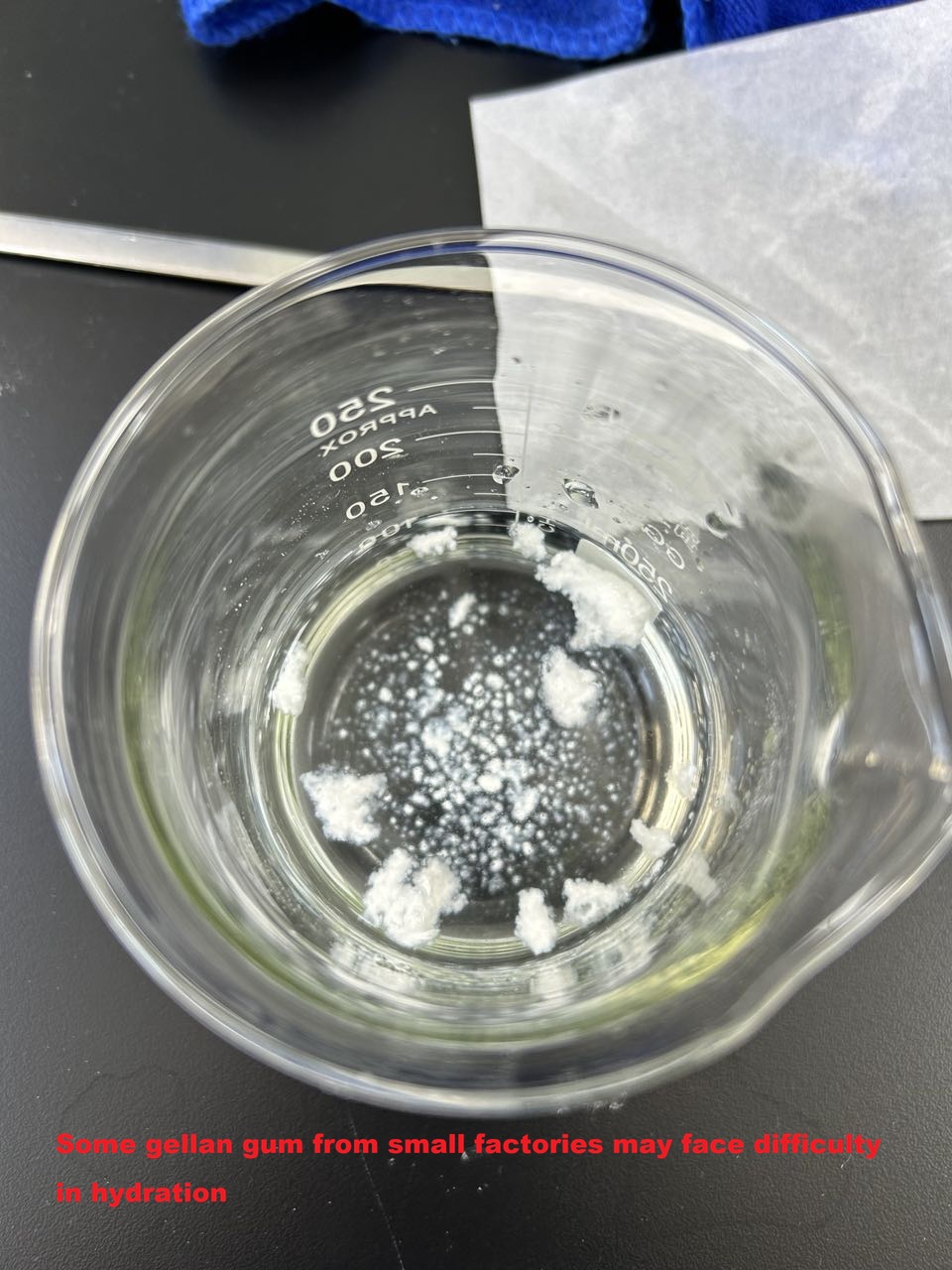
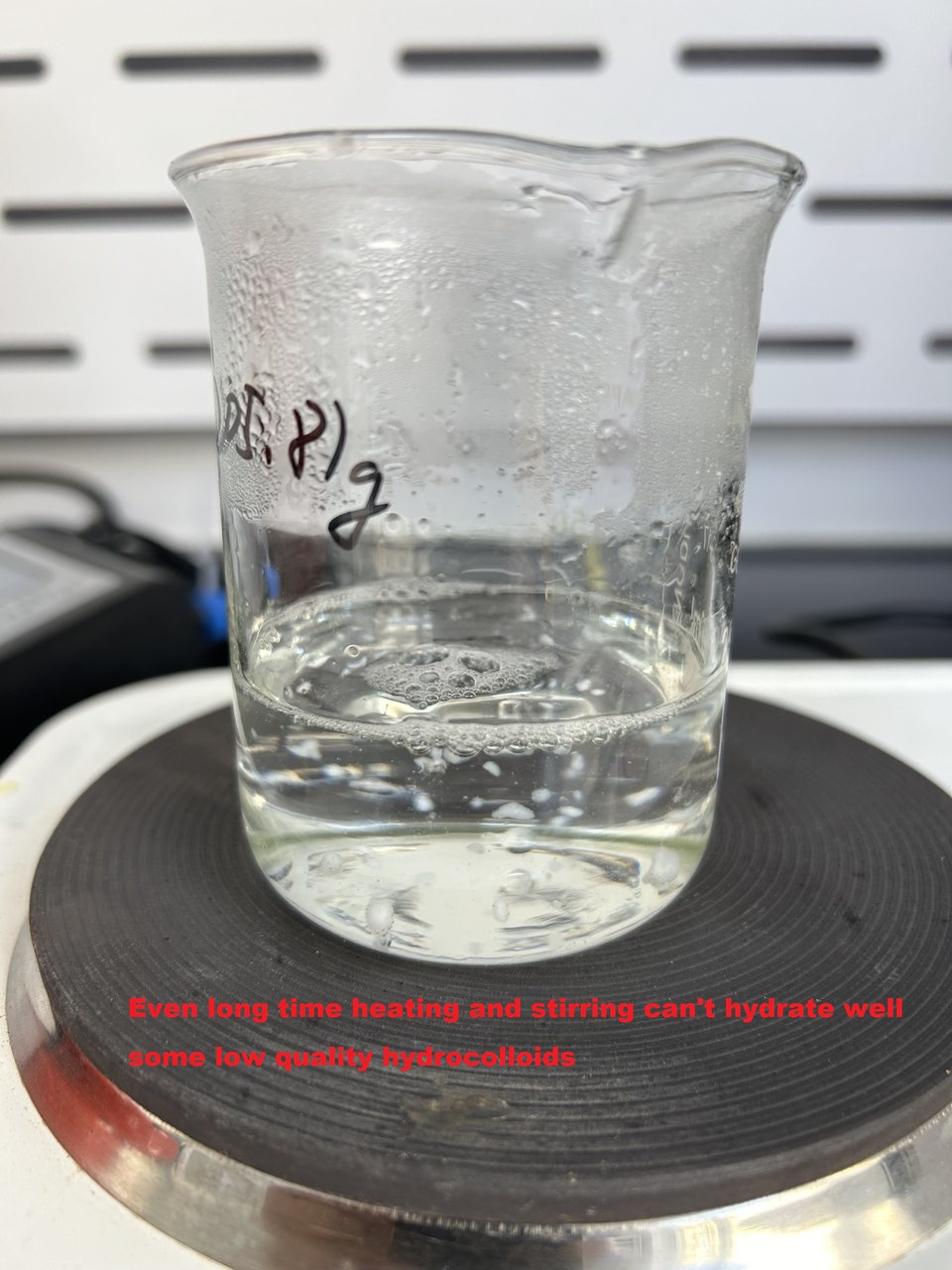
Quickly and easily determining whether a hydrocolloid (such as xanthan gum, gellan gum, agar, pectin, carrageenan, konjac gum, etc.) is completely dissolved is a critical step in production application and quality control. Here are several practical methods for different scenarios, ranging from the simplest to the more precise. Users can choose based on site conditions and accuracy requirements.
Core Principle: A completely dissolved hydrocolloid solution should be a uniform, transparent (or uniformly translucent), stable system with no visible particles.
I. On-site Rapid Judgment Methods (Simplest)
These methods are suitable for immediate judgment on production lines, in laboratories, or kitchens, without requiring precision instruments.
"Glass Plate Method" or "Spoon Back Method":
Operation: Take a small amount of the solution and drop it onto a clean, dry flat glass plate, petri dish, or the back of a metal spoon.
Observation: Tilt the plate to let the liquid flow down slowly.
Judgment:
Completely dissolved: The liquid flows evenly and smoothly, with no obvious particles, stringy substances, or "fish eyes."
Not completely dissolved: Tiny gel particles, undispersed gum lumps, or discontinuous flow are visible on the surface or within the liquid.
"Fingertip Rubbing Method":
Operation: Take a small amount of the solution between the pads of the thumb and index finger, and gently rub.
Judgment:
Completely dissolved: Feels very smooth, with no graininess or grittiness whatsoever.
Not completely dissolved: Distinctly fine, slippery, or sticky undissolved particles can be felt.
"Light Transmission Observation Method":
Operation: Hold a transparent glass or test tube containing the dilute solution up to a light source (fluorescent lamp, window).
Observation: Observe the uniformity of light transmission through the solution against the light.
Judgment:
Clarifying hydrocolloids (e.g., gellan gum, some xanthan gum solutions): Should be clear and transparent when completely dissolved, with no turbidity or suspended matter.
Translucent/opalescent hydrocolloids (e.g., konjac gum, carrageenan solutions): The solution should present a uniform opalescence or translucency, with no "starry" spots or flocculent inhomogeneities.
II. Simple Instrument-Assisted Methods (More Objective)
Using some simple, portable instruments can improve the objectivity and accuracy of the judgment.
Portable Brix Refractometer:
Principle: Solution uniformity affects the stability of the refractive index. A homogeneous, completely dissolved solution will have a stable refractive index reading.
Operation: Measure the solution's refractive index several times. Alternatively, let the solution stand for a few minutes and measure again, observing if the reading changes.
Judgment: Stable and reproducible readings typically indicate uniform dissolution. Readings will drift if undissolved particles settle.
Portable Viscometer (e.g., rotational, Stormer viscometer):
Principle: The viscosity of a completely dissolved hydrocolloid solution is stable under defined conditions. Undissolved particles can cause viscosity fluctuations or lower values.
Operation: Measure viscosity at a fixed speed and temperature, observing if the reading is stable. Compare with the viscosity of a standard, fully dissolved sample.
Judgment: The viscosity reaching the expected range and remaining stable during measurement is an important indicator of functional "complete dissolution."
Laser Pointer/Needle Method:
Operation: In a dark room, shine a laser pointer through a transparent container holding the solution. Or, gently place a fine needle or hair on the solution surface.
Observation: Observe if the light beam's "path" (Tyndall effect) is uniform, or if the needle/hair shows abnormal movement due to uneven surface tension.
Judgment:
Completely dissolved polymer solution: The Tyndall effect is uniformly faint (more obvious for sols, not necessarily for polymer solutions).
Undissolved particles present: You might see particles flashing in the light path, or microscopic films on the surface invisible to the naked eye.
III. Optimization and Prevention for the Dissolution Process
Quick judgment presupposes the correct dissolution method. Incomplete dissolution often stems from improper operation.
"Dispersion is key, dissolution takes time":
Thorough Dispersion: Under high-speed agitation, slowly sprinkle the hydrocolloid powder into the liquid to use shear force and prevent clumping. Alternatively, pre-mix with other dry powder ingredients (e.g., sugar, salt) to utilize their dispersing power.
Adequate Hydration: After dispersion, allow sufficient time and appropriate temperature for the hydrocolloid to fully hydrate and swell. Heating usually accelerates this process (but note: excessive heat may degrade some, like xanthan gum).
"Solution Clarity" is not an absolute standard: Some hydrocolloids (like high-quality xanthan gum) are inherently slightly turbid when dissolved; this is a natural characteristic and does not indicate incomplete dissolution.
IV. Summary and Selection Suggestions
|
Scenario |
Recommended Method |
Advantages |
Precautions |
|---|---|---|---|
|
Production line rapid inspection |
"Glass Plate Method" |
Very fast, zero cost, intuitive |
Relies on experience, insensitive to extremely fine particles |
|
Laboratory preliminary judgment |
"Fingertip Rubbing Method" + Light Transmission Observation |
Combines tactile and visual senses, more reliable |
Requires attention to hygiene for both sample and personnel |
|
Need for objective data recording |
Portable viscometer measurement |
Provides quantitative data, directly related to function |
Instrument investment, requires standardized test conditions |
|
Verifying dissolution uniformity |
Multiple refractometer readings |
Fast, objective, recordable |
May not be suitable for high-concentration, high-viscosity solutions |
The "Gold Standard" for Final Verification:
Pass the solution through a sufficiently fine sieve (e.g., 200 mesh or finer). If no gum particles remain on the sieve, it physically proves "complete dissolution." This is the most direct and reliable definitive method, although slightly slower than the above methods, the result is conclusive


Email: info@cagcolloids.com
Tel: 0086-19884908291 / 0086-573- 80890620
Website: www.cagcolloids.com
Address: No. 399, East Tongfu Road, Tongxiang City, Zhejiang Province. China.