


FAQs
Nature Refined, Quality Defined
Green Science for better living

How to make the elastic modulus measurements of high acyl gellan gum?
TEST METHOD
Suspension of Juice Beverages Containing High Acyl Gellan Gum
Purpose and Scope
This procedure describes the elastic modulus measurements of gellan gum in a simulated juice beverage formulation, and is used to assess the suspension properties of high acyl gellan gum. It is also used to determine the blending ratio and suspension performance of GELLAM GUM standardized products.
Principle
High Acyl GELLAM GUM are used to aid in the suspension of pulp in low pH fruit juice beverage applications. This document describes the sample preparation conditions, thermal processing and quantitative analysis of suspension properties in the juice beverage using elastic modulus. This technique can determine the suspension properties of HIGH ACYL GELLAM GUM as it measures the elastic modulus of the fluid gel network.
Reagents and Reagent Preparation
1. Potassium citrate, monohydrate
2. Citric acid, anhydrous
3. Deionized water
4. Bakers Special Sugar
5. High acyl gellan gum
Equipment
1. MicroThermics UHT/HTST Lab-25EHV Hybrid with Niro in-line homogenizer
2. Rheometer: V-E system, Vilastic Scientific, Inc.
3. Bohlin rheometer
4. Wire whisk
5. Gallon size plastic bag
6. 10-kg stainless steel container
7. 250-mL Nalgene bottles
8. Balance capable of measuring to 0.001 g
9. Balance capable of measuring to 0.01 g
10. Water bath (set to 20°C)
11. Plastic transfer pipettes
12. Timer
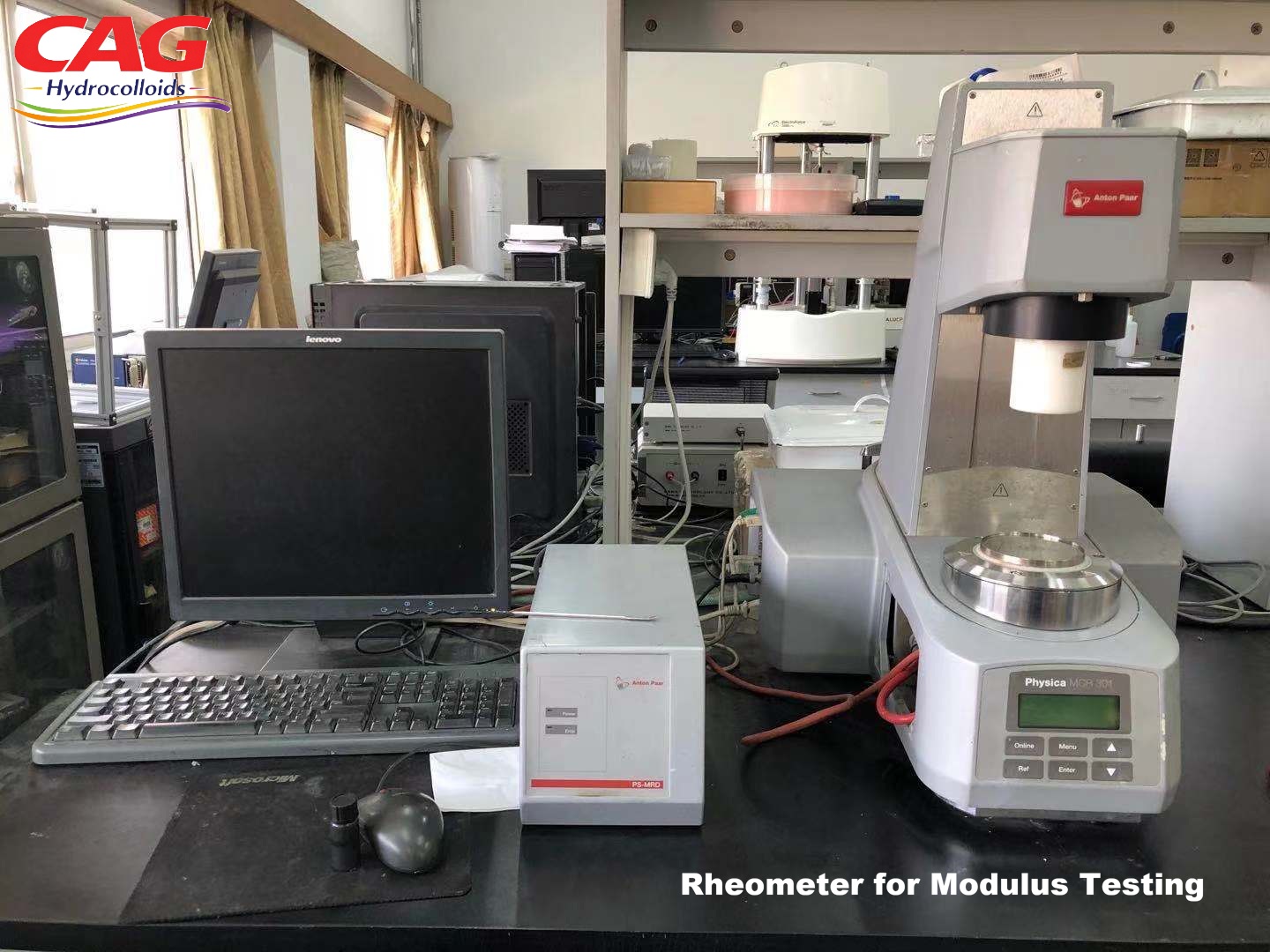
Equipment Calibration
1. See MicroThermics equipment manual for calibration procedures.
2. V-E System (This check to be performed each time the system is used or once per 24 hour period. This should also be performed if the program is restarted.)
a) Turn on instrument and computer system and open the Vilastic software program from the Calibration desktop.
b) Remove measurement tube and fill reservoir approx. 2/3 full of deionized water. See that there are no bubbles attached to the walls.
c) Using a tilt, insert the edge of the tube into the reservoir slowly to prevent air bubble formation.
d) Seal the O-ring and screw on retaining ring.
e) Connect the measurement tube to the water bath and let the system equilibrate to 20°C.
f) Go under the “Calibration/Verification” menu to “verify” system. If the system passes, continue with measurements. If the system does not verify, and is within the range of ±10%, recalibrate the instrument by selecting the “Open Tube Measurement” under the “Calibration/Verification” menu.
g) Place the thermistor temperature sensor in a location on top of the measurement tube.
h) Click “OK” to continue (the system will measure temperature first).
i) After this step has been performed, select “calculations” under the “Calibration/Verification” menu. Prompt to save the calibrations if they all pass the calculations.
j) If the system still does not pass the “verify” step, run a full calibration following the prompts.
k) After Calibration is complete and successful, remove the water and place any sample of the simulated juice to be tested into the instrument.
l) In the Vilastic software, select “Protocols,” then “Timert,” and finally “Sample Evaluation.”
m) In the window that appears, set the frequency to 1 Hz, the integration time to 5 seconds and the drive level to 2.
n) Select the “Evaluate” button to run a preliminary evaluation. When asked to enter the sample density, accept the default value.
o) When the evaluation is complete, a Diagnostics screen will appear. Select the “Continue” button to move to the next screen.
p) When asked to save the data, respond, “No” and then click the “Continue” button on the next screen that appears.
q) Instrument calibration and sample evaluation is done.
3. Bohlin Rheometer Calibration Check
a) Using the following test conditions, check instrument using a 50-cP mineral oil standard. The measured viscosity should be within 5% of the standard. If not, contact the manufacturer for service.
Geometry: 4 cm 4° cone
Temperature: 20°C
Thermal equilibrium time: 60 sec
Shear rate: 75 1/s
Number of samples: 2
Delay time: 20 sec
Integration time: 5 sec
Safety Hazards
1. Follow all safety precautions in the MicroThermics equipment manual, including using caution around hot piping.
2. Always wear safety glasses and lab coat when operating MicroThermics equipment.
3. Use full face safety shield when cleaning the equipment with acid or caustic cleaner.
4. Wear safety goggles when using the V-E System.
Suspension of Juice Beverages Containing High Acyl Gellan Gum
Procedure
1. Sample Preparation
a) Weigh ingredients according to the table below.
|
Ingredients (g) |
LT100 screening, LT100P |
Gellan Gum - 0.0275% |
Gellan Gum - 0.0250% |
Gellan Gum - 0.0275% |
Gellan Gum - 0.0300% |
Gellan Gum - 0.30% |
|
Gellan gum |
2.2 |
2 |
2.2 |
2.4 |
24 |
|
|
Sugar |
800 |
800 |
800 |
800 |
800 |
|
|
Citric acid |
52 |
52 |
52 |
52 |
52 |
|
|
Potassium citrate |
40 |
40 |
40 |
40 |
40 |
|
|
Distilled water |
7105.8 |
7106 |
7105.8 |
7105.6 |
7084 |
|
b) Blend all dry ingredients thoroughly in a plastic bag.
c) Disperse the dry blend into distilled water using a wire whisk.
d) Configure the MicroThermics unit to bypass the homogenizer and final heater.
e) Adjust cooling valve to achieve an exit temperature of 58°F for water (this should correspond to a product exit temperature of 65°F).
f) Heat treat the simulated juice beverage with the following parameters:
Pre-heater: (to achieve a product temperature of 195°F)
-- 205°F for regular grade HA GEllAN GUM screening
-- 210°F for Enzyme free grade HA GELLAN GUM
Flow rate: 1.0 liter/min
Hold Time: 2 min (4-bundle configuration)
Exit temperature: approximately 65°F
g) Add the gellan/model juice beverage solution to the MicroThermics UHT system, stirring constantly during addition.
h) Clean-fill 250 mL of UHT-processed sample into two Nalgene bottles.
i) Store bottles in a temperature-controlled room (72 ± 1°F) for approximately 18 to 24 hours prior to analysis.
2. Analysis of Elastic Modulus using the V-E Vilastic system
a) Clean water out ofservoir and blot excess with re tissue, careful not to puncture or damage the membrane. Blow excess water out from the capillary tube.
b) Fill reservoir with gellan/simulated juice beverage to approx. 2/3 full and connect to water bath.
c) Close the screw on retaining ring and allow the sample to sit in sample reservoir for 5 minutes (set timer).
d) In the Vilastic software open “Protocols” then “Timert” and then “Set Protocol.”
e) In the screen that appears about “Pre-Drive” click the default “No” button.
f) In the next screen, click on “Single Constant Parameter” and enter the following values:
Integration time: 5 s
Time interval: 0.125 min
Constant parameter: Shear strain
Constant value: 0.3
Number of measurements: 10
g) Next, click on the “Continue”
h) In the Vilastic software, go to “Measure” under “Run/Calculate” menu.
i) Save file after run.
j) When all runs are complete, go to “File” and save each file as an ASCII file by selecting elastic modulus, viscosity modulus, time and strain.
3. Viscosity Measurement using the Bohlin Rheometer
Note Refer to product specifications to determine if this measurement is applicable for a particular product.
a) Test conditions
Geometry: 4 cm 4° cone
Temperature: 20°C
Thermal equilibrium time: 60 sec
Shear rate: 75 1/s
Number of samples: 2
Delay time: 20 sec
Integration time: 5 sec
b) Load the sample containing 0.3% PS with a plastic transfer pipette.
c) Measure the viscosity in cP (1 Pa·s = 1,000 cP).
Calculations
1. For fine mesh HA GELLAN GUM tested as CAGGEL H100: plot the use level (0.025, 0.0275 and 0.03) vs the log of modulus and determine the linear fit using a graphing program. Repeat the measurements if the R² value of the linear fit is less than 0.9. The linear fit equation will be in the following format:
C=A+B×log(G′)
Where A and B are constants derived from the linear fit
G′= the elastic modulus measured for the sample
C= concentration of the sample
2. Solve the above equation for the modulus at a concentration of 0.0275%.
Modulus=10((0.0275−A)/B)
3. For PS standardization: calculate the concentration required to achieve a G′of 0.28 dynes/cm² using the equation above: C=A+B×log(0.28).
Then, Blend ratio (in %) = 9×(C/0.0275)
Reporting
1.Sample preparation data, including sample lot number, are recorded in laboratory notebooks.
2.Record all results and forward to QC, including but not limited to the following:
a) 80-mesh LT100: G′
Note: In addition, forward this result to Production.
b) Fine-mesh CAGGEL H100 and CAGGEL HFB:
Calculated G′at 0.0275% use level, and the R2value
Calculated blend ratio for GELLAN GUM standardization.
c) GELLAM GUM
G′
Viscosity at 0.3%.
Responsibility
Corporate QA is responsible for writing/revising this procedure.


Email: info@cagcolloids.com
Tel: 0086-19884908291 / 0086-573- 80890620
Website: www.cagcolloids.com
Address: No. 399, East Tongfu Road, Tongxiang City, Zhejiang Province. China.