

FAQs
Nature Refined, Quality Defined
Green Science for better living

How to make agar-based Yōkan ?
Making agar-based Yōkan is the art of using agar's ability to form a high-strength, high-melting-point, thermoreversible gel to transform sweet bean paste, sugar, and water into a dense, refined confection. The core technology lies in achieving a precise phase balance: the agar network must be robust enough to support solid particles while remaining moist and pleasant.
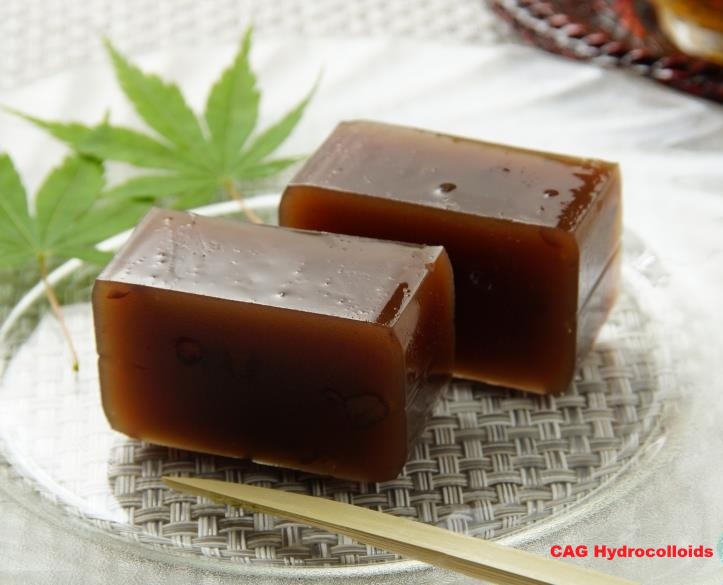
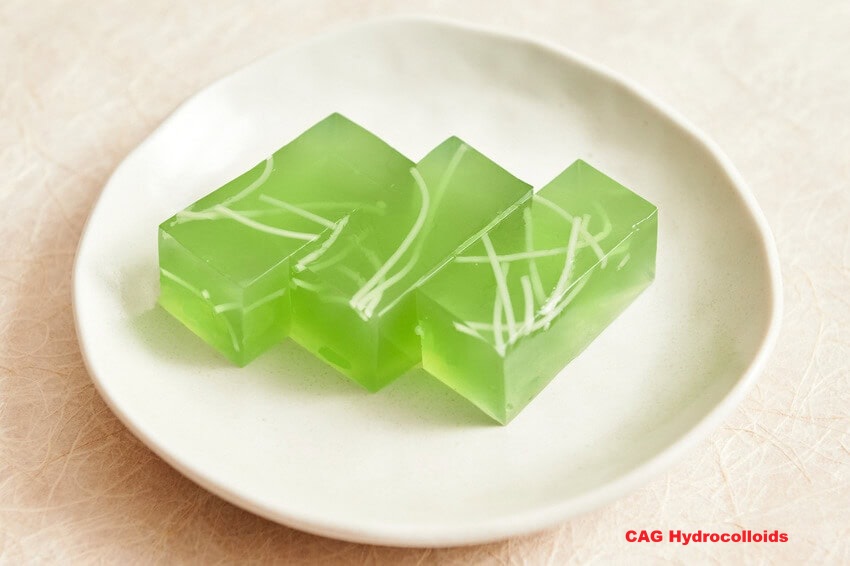
The following is a detailed, modern food-science-based guide.
A classic Red Bean (Anko) Yōkan base formula (yield ~500g) is shown below:
|
Ingredient |
Weight (g) |
Function & Scientific Principle |
|---|---|---|
|
Sweet Red Bean Paste |
250 |
Primary Flavor & Filler. Provides flavor, color, and solids. Its sugar content (~50%) contributes to total soluble solids. |
|
Granulated Sugar |
80-100 |
Sweetener & Texture Modifier. Promotes agar cross-linking, enhances gel strength, and lowers water activity. |
|
Agar Powder |
4 - 6 |
The Gelling Skeleton. The key determinant of texture. Use high gel strength (>800 g/cm²) food-grade agar. 4g for softer gel; 6g for firmer texture. |
|
Water |
200 |
Solvent & Medium. |
|
Salt |
A pinch (~0.5g) |
Flavor Enhancer. Balances sweetness. |
Key Ratios: Agar concentration: ~0.8%-1.2%. Total soluble solids >60%. This is the window for a stable gel.
Overall Process: Solubilize Agar → Mix → Concentrate → Mold → Set
Phase 1: Complete Dissolution of Agar (Critical)
Preparation: Dry-mix the agar powder with about 5 times its weight of granulated sugar (from the total).
Dispersion & Dissolution: Add all the cold water (200g) to a pot. While the water is still cold, slowly sprinkle in the agar-sugar mix while stirring.
Boiling: Heat to a full boil. Reduce heat, maintain a gentle simmer, and stir continuously for 2-3 minutes. The solution should become clear and slightly viscous.
Principle: Agar must be fully hydrated above its gelation point (>85°C) to form a uniform dispersion.
Phase 2: Integration of Sugar and Bean Paste
Add Sugar: Add all remaining sugar, stir until dissolved.
Incorporate Bean Paste: On lowest heat, add bean paste in batches, mixing thoroughly until smooth and lump-free.
Phase 3: Concentration and Endpoint Determination
Water Evaporation: Cook on low heat with constant stirring to evaporate water and increase solids.
Endpoint Determination:
Spatula Test: Paste should leave a clear, slow-to-fade trace when dripped.
Temperature Method (Precise): Stop at 103-105°C core temperature.
Phase 4: Molding and Gel Setting
De-aerating & Molding: Pour from a height (15-20 cm) into the mold. Remove bubbles with a tool.
Quiescent Setting: Cool naturally at room temperature (20-25°C). Do not refrigerate immediately. Slow cooling allows for a strong, uniform gel.
Phase 5: Demolding and Maturation
Complete Setting: Set at room temp for 2-3 hours until firm.
Demolding: Briefly warm mold exterior to release.
Maturation (Recommended): Wrap tightly and refrigerate overnight for improved texture.
|
Problem |
Likely Cause |
Solution |
|---|---|---|
|
Too soft, doesn't set |
1. Agar not fully dissolved/insufficient. |
1. Boil agar >2 mins; +0.5g agar. |
|
Too hard, chalky, cracks |
1. Too much agar. |
1. Reduce agar by 0.5g. |
|
Surface water (Syneresis) |
1. Inhomogeneous gel. |
1. Ensure full dissolution, slow cool. |
|
Gritty texture |
Bean paste not mixed well. |
Use smooth paste; mix thoroughly or blend briefly. |
|
Flat, cloying flavor |
Lacks complexity. |
Add salt, malt syrup, or citrus zest/osmanthus. |


Email: info@cagcolloids.com
Tel: 0086-19884908291 / 0086-573- 80890620
Website: www.cagcolloids.com
Address: No. 399, East Tongfu Road, Tongxiang City, Zhejiang Province. China.