


FAQs
Nature Refined, Quality Defined
Green Science for better living

How to Establish an Effective Incoming Quality Control System for Carrageenan Raw Materials? Is Supplier COA Alone Sufficient? Which Parameters Best Predict Real Product Performance?
Carrageenan is one of the natural hydrocolloids with the greatest batch-to-batch variability in the food industry. Its quality can be significantly influenced by factors such as seaweed origin, harvesting season, extraction conditions, and processing variations. For manufacturers producing high-value dairy products, relying solely on the supplier's Certificate of Analysis (COA) for incoming material acceptance presents substantial risks.
An effective in-house quality control program should distinguish between parameters that truly predict end-product performance and those that merely demonstrate regulatory compliance.
| Parameter | Test Method | Predictive Value | Recommended Frequency |
|---|---|---|---|
| Milk-Based Gel Strength | Texture Analyzer (TPA), standardized milk formulation | Very High – directly reflects application performance | Every batch |
| Water-Based Gel Strength | Texture Analyzer, standardized water system | Moderate – mainly relevant for water-based applications | Every batch |
| Molecular Weight Distribution | GPC / SEC | High – predicts batch consistency and thermal stability | Quarterly / critical batches |
| Viscosity (1% Solution) | Rotational viscometer at 75°C | Moderate – indirect indicator of molecular weight | Every batch (rapid screening) |
| Moisture Content | Halogen moisture analyzer | Low – primarily affects dosage calculations | Every batch |
| Ash Content / Sulfate Content | Muffle furnace method / titration | Moderate – reflects degree of sulfation | Quarterly |
| Microbiological Parameters | Standard plate count and related tests | Compliance-related – not directly linked to functionality | According to regulatory requirements |
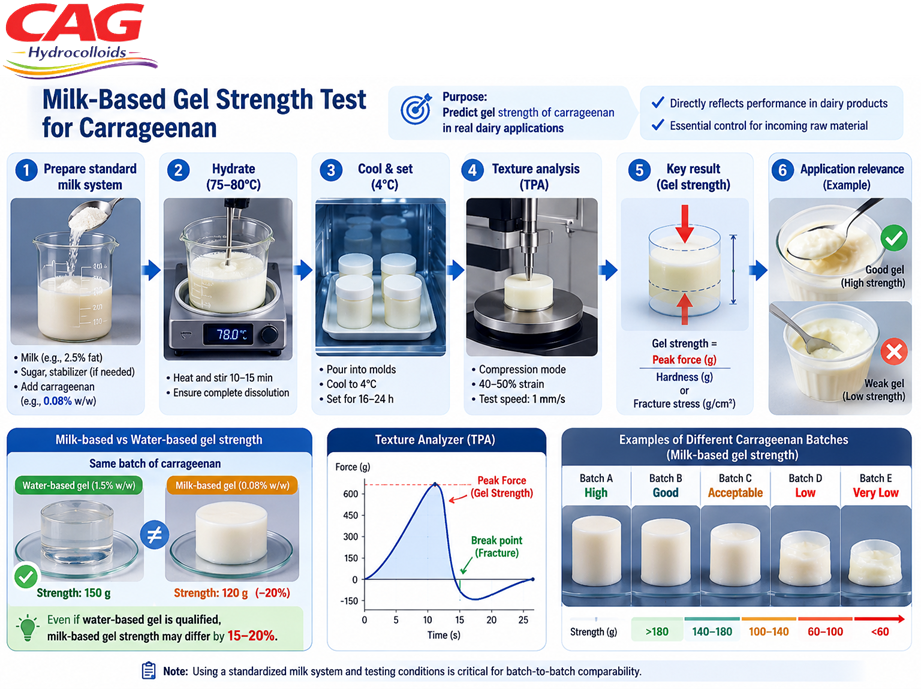
Water-based gel strength testing is currently the most widely used incoming inspection method in the carrageenan industry. However, for dairy applications, it is actually one of the least predictive performance indicators.
A carrageenan batch may fully meet specifications for water-gel strength while exhibiting a 15–20% deviation in milk-gel strength due to differences in:
For dairy manufacturers, milk-based gel strength should be regarded as the primary acceptance criterion, while water-based gel strength should serve only as a supplementary reference.
For high-volume manufacturers, a two-level inspection system combining rapid screening and in-depth verification is recommended:
Perform on every incoming batch:
Perform quarterly or on strategically important batches:
The most advanced carrageenan users do not rely solely on pass/fail specifications. Instead, they establish a historical performance database containing:
By tracking long-term trends, manufacturers can identify gradual shifts in raw material quality and detect potential performance problems before they affect production.
For dairy applications, the most valuable predictor of carrageenan performance is milk-based gel strength, not traditional water-based gel strength.
An effective incoming inspection program should therefore combine:
Every Batch
Quarterly / Critical Batches
This "rapid screening + periodic in-depth analysis" approach provides significantly greater protection against raw material variability than relying solely on supplier COAs, while maintaining a practical balance between testing cost and quality assurance.


Email: info@cagcolloids.com
Tel: 0086-19884908291 / 0086-573- 80890620
Website: www.cagcolloids.com
Address: No. 399, East Tongfu Road, Tongxiang City, Zhejiang Province. China.