


FAQs
Nature Refined, Quality Defined
Green Science for better living

How to detect the glucomannan content and viscosity of konjac gum? How to quantitatively evaluate the viscosity and transparency of its hydrated solution?
Glucomannan content and viscosity are the two core indicators for evaluating konjac gum quality. High-purity food-grade konjac gum typically has a glucomannan content of ≥70% and a viscosity of ≥20,000 mPa·s for a 1% solution. Transparency is quantitatively evaluated using transmittance (T%) measured with a spectrophotometer.
Glucomannan is the active functional component of konjac gum. The industry primarily uses the following two methods for detection:
|
Method |
Principle |
Scope & Features |
|---|---|---|
|
Ethanol Precipitation - Gravimetric Method |
Utilizes the property of glucomannan being insoluble in ethanol. The sample is dissolved, precipitated with 80% ethanol, dried, and weighed. |
Most common (GB/T 18104-2000). Suitable for routine QC of raw konjac powder. Results expressed as mass percentage. |
|
Acid Hydrolysis - Spectrophotometry / Chromatography |
Acid hydrolyzes glucomannan into mannose/glucose, quantified by DNS reagent (colorimetry) or HPLC/GC. |
More accurate. Reflects true molecular content. Used for complex products (e.g., gels, compound foods). |
Standard Reference: Food-grade konjac refined powder typically requires glucomannan content ≥70%, with high-purity grades reaching ≥85%.
Konjac gum is a high-viscosity pseudoplastic fluid. Strict SOPs are essential for reproducible testing.
Concentration: Standard test concentration is 1% (1g konjac gum per 99g water).
Dispersion: Slowly sprinkle powder into deionized water under high-speed stirring to prevent "fish eyes" (lumping).
Hydration: Stir 30-60 minutes until fully hydrated. For refined konjac, heating to 80-85°C accelerates dissolution and deaeration.
Instrument: Brookfield rotational viscometer (RV or LV series).
Conditions:
Rotor: Select LV-3, LV-4, or RV-2 based on viscosity range (ensure torque 10%-90%).
Temperature: 30°C (water bath, ±0.1°C).
Speed: 12 rpm or 20 rpm (record both speed and rotor).
Reading: Wait for stabilization, record apparent viscosity (mPa·s).
Acceptance Criteria: Standard-grade 1% konjac gum solution viscosity: ≥20,000 mPa·s; premium grades: >30,000 mPa·s.
Static Viscosity: Apparent viscosity at fixed shear rate.
Thixotropy: Evaluate viscosity recovery after high shear (simulates processing).
Viscosity Stability: Monitor viscosity change after standing 24h/48h.
Transparency indicates purity and refinement level.
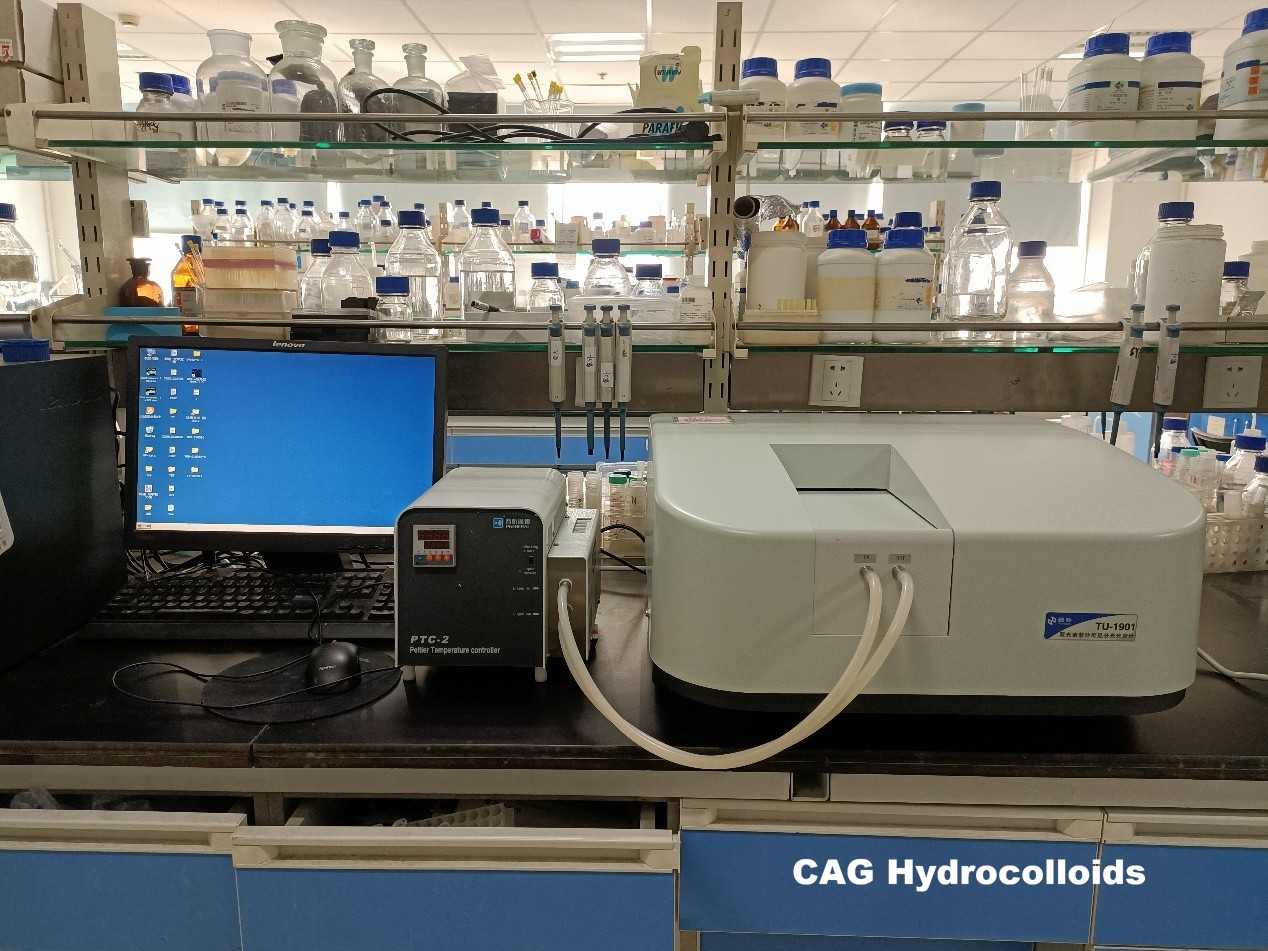
Method: Visible Spectrophotometry.
Procedure:
Prepare 1% solution (heated to 85°C for complete dissolution).
Cool to 25°C.
Use 1cm quartz/glass cuvette.
Measure transmittance (T%) at 450 nm or 620 nm vs. deionized water blank (100%).
Evaluation Standard:
High Transparency: T% ≥ 80% (high purity, low insoluble residue).
Low Transparency: T% < 60% (crude product, high impurities, or incomplete dissolution).
|
Step |
Parameter |
Control Point |
|---|---|---|
|
Raw Material |
Glucomannan ≥70%, Moisture ≤12% |
Reject low purity/high moisture material. |
|
Dissolution |
1% solution, 85°C heating, deaeration |
Ensure no undissolved particles. |
|
Viscosity QC |
30°C, LV-3 rotor, 20 rpm |
Standardize for batch comparison. |
|
Transparency QC |
T% @ 450nm ≥ 80% |
Critical for clarity-demanding applications. |
Note: Viscosity and transparency are highly dependent on dissolution quality. Poor dispersion leads to low readings, indicating preparation failure, not necessarily material defect.
Email: info@cagcolloids.com
Tel: 0086-19884908291 / 0086-573- 80890620
Website: www.cagcolloids.com
Address: No. 399, East Tongfu Road, Tongxiang City, Zhejiang Province. China.