


FAQs
Nature Refined, Quality Defined
Green Science for better living

how should an industrial tissue culture facility systematically evaluate and switch plant tissue culture–grade agar suppliers to minimise operational risk?
Switching agar suppliers in a high-volume tissue culture facility is a high-risk decision. A change in agar batch can cause systematic shifts in contamination rate, differentiation rate or rooting rate without any other formulation change — and the cause may only become apparent several subculture generations after the switch.
Structured supplier transition process — three phases:
Phase 1 — Documentary evaluation (1–2 weeks): Request and compare the following from candidate suppliers: ① product specification sheet (upper and lower limits for gel strength, sulfate, ash, pH, moisture and heavy metals — all as specific numerical ranges, not "passes specification"); ② COAs from the three most recent production batches (to assess batch-to-batch consistency — focus on the standard deviation of gel strength); ③ production certifications (ISO certification, raw material origin documentation); ④ minimum order quantity and pack size options (25 kg bulk bags vs. small packs).
Immediately exclude any supplier whose gel-strength coefficient of variation (CV) across batches exceeds 8%.
Phase 2 — Parallel small-scale trial (4–8 weeks): Request samples from at least three different production batches (minimum 500 g each). Run parallel comparison trials: keep the existing formulation 100% unchanged — substitute only the agar raw material. Cover the facility's principal species (e.g., orchid + banana + one sensitive indicator species) at 5 vessels × 3 replicates each. Observe: contamination rate, first-generation multiplication coefficient, explant surface morphology (any hyperhydricity), medium colour and clarity.
Phase 3 — Pilot scale-up (8–16 weeks): After a successful small-scale trial, introduce the new supplier agar on 1–2 production lines representing 10–20% of total capacity. Run 2–3 full subculture cycles before completing the transition. Retain existing supplier inventory as emergency backup stock — three months' supply is recommended.
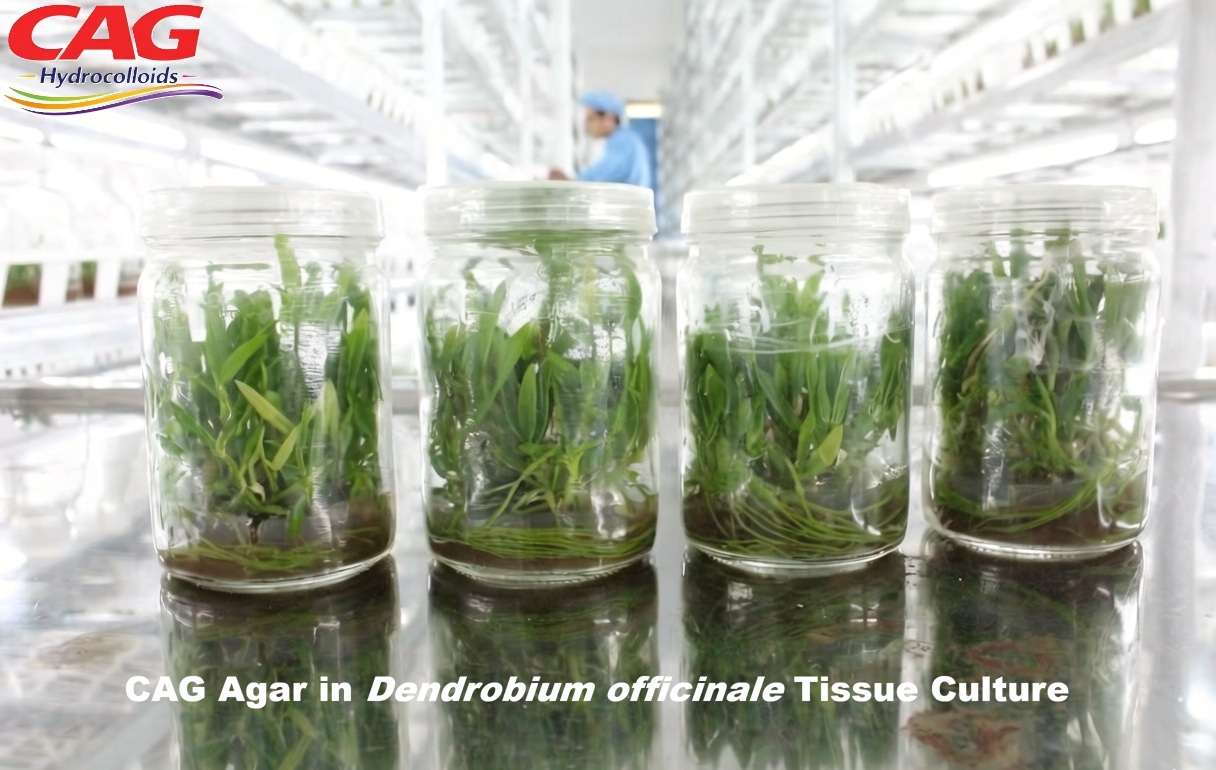
Fig. Agar for plant tissue culture


Email: info@cagcolloids.com
Tel: 0086-19884908291 / 0086-573- 80890620
Website: www.cagcolloids.com
Address: No. 399, East Tongfu Road, Tongxiang City, Zhejiang Province. China.